

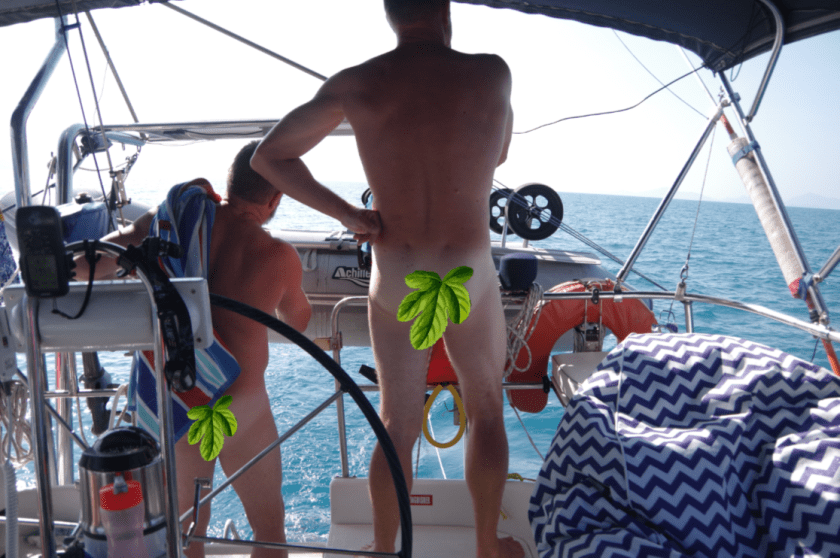
I promised another blog hot on the tail of the other, so here it is. From Mackay to the Newry’s, through the Whitsunday’s to Hook Reef and back again. There’s even some gratuitous nudity.
The Newry Islands
This time heading into the Whitsunday’s, instead of going over the same ground, we sailed to the Newry Islands, which are north of Mackay but very close to the mainland. The seas were a bit confused, but it wasn’t far. We were soon anchored in a very calm spot close to Outer Newry, with the old resort on Newry Island behind us, with a CCCA boat we knew from back home: Amici. This anchorage offers protection in almost all weather. We spent that night and the next at the Newry’s, enjoying sun-downers with John and Jane and their very cute toy poodle, Josie.

The Newry’s are an interesting spot, with the charm of bygone years. The resort dates back to the 1930s, and was in operation until 2001, when it reverted to National Park. Queensland National Parks has made a good attempt to fence off and preserve what remains, with good signage to explain the original purpose of the buildings.
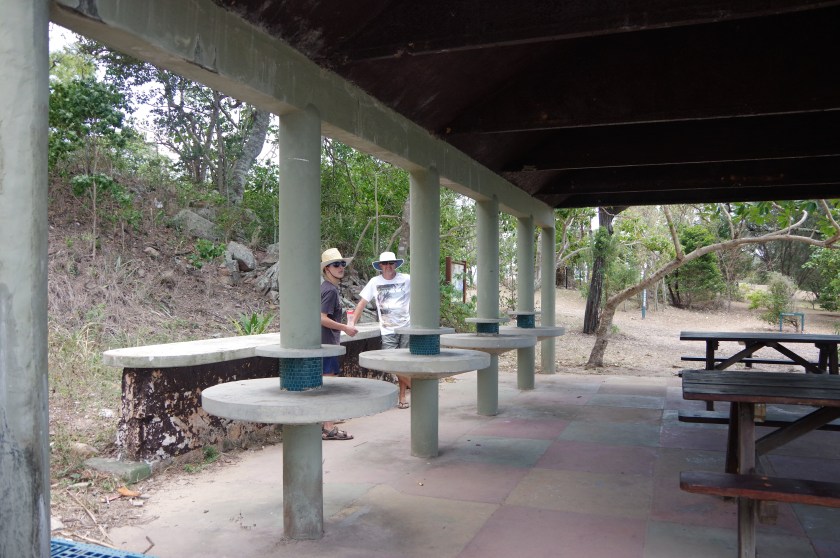
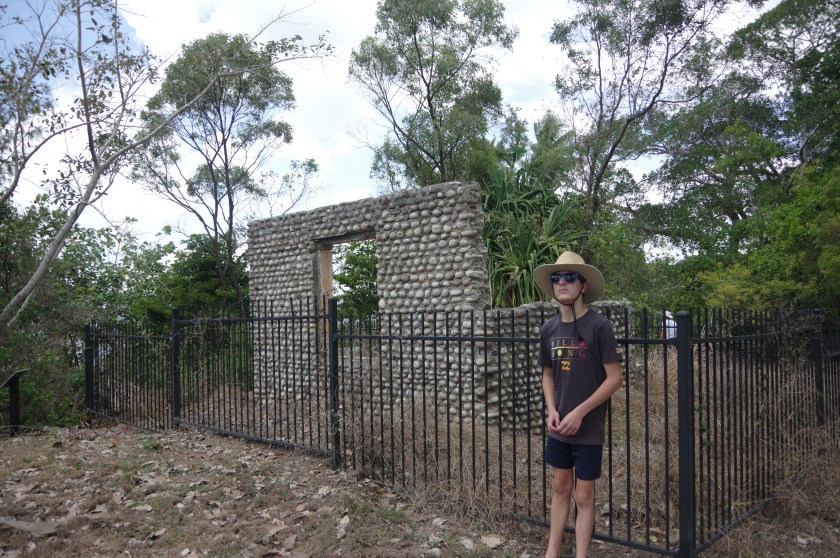

Jill Knight wrote about her experiences of the Newry’s some years back, and it seems a lot has changed over the years. At one time, the resort buildings were quite intact and you could wander through them, unimpeded. There were vegetable gardens and dams, all now gone. However, we enjoyed our visit and recognised that you could spend quite a bit of time here, exploring the island group, discovering more of the area’s history, attempting the walks (although the tracks seemed overgrown) through dry rainforest and eucalypt looking for koalas and echidnas and checking out the unusual rock formations. I’m sure they have names, but we named a couple of them ourselves. Perhaps we were hungry at the time? One is Birthday Cake Rock and the other is the Pancake Stack. If you can come up with anything better, let us know!


We left the Newry Islands with Amici not far behind, heading back into the Whitsunday’s to Thomas Island. Thomas is a very pretty spot and we have fond memories of good snorkelling ten years ago, but the anchorage proved to be really rolly and uncomfortable. With an hour or so of daylight left, we weighed anchor, said farewell to Amici, (who had been great company), and shifted over to our familiar flat anchorage at Burning Point.
Hook Reef
Christian, who had left Blackwattle at Hamilton Island for a few days and flown back to Sydney for business, was back on board and keen to go out to the Reef in company, so the next morning we were away early and heading out to Bait Reef and beyond. (We had 40-odd miles to travel, Christian only 20-odd as he had overnighted in Butterfly Bay.) We eventually found ourselves in Hook Reef, about 22 miles out to sea from the top of Hook Island. From the reef, you can just make out the peaks of Hook Island in the distance. They are a grey, cloud-like smudge on the horizon.
If you haven’t been out to a reef before, you’re basically anchoring in a shallow spot in the middle of the ocean. If you’ve picked the right weather conditions, then the ocean is calm and clear.
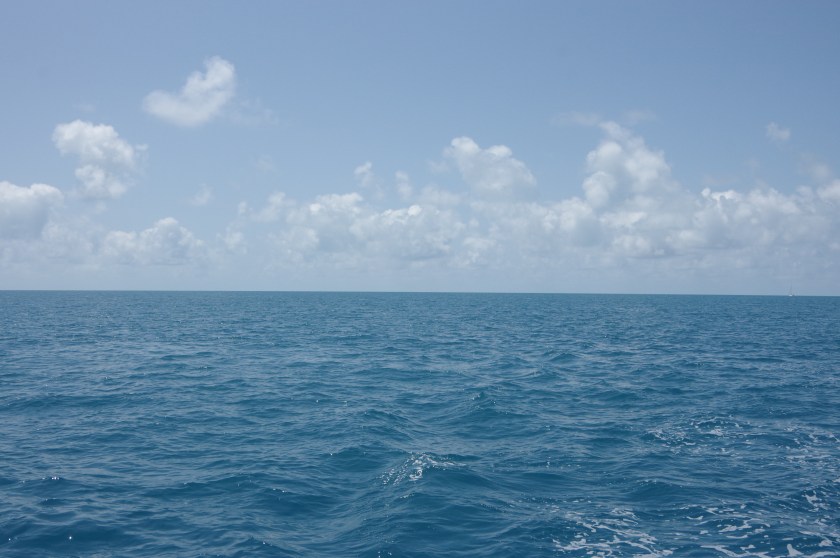
If you’re close, you can see rolling, breaking waves at low tide, but they expend their energy on the reef and come no further. Between the hours of about 0930 and 1600 you can see into the depths, so you can navigate around the coral bommies that rise from the sea bed. Shallow areas appear green or yellow amongst the aqua and ultramarine, and those are ‘no go’ areas, especially for a fibreglass boat. We hit one of those, we’re probably sunk. There’s nothing much to see above the water, unless it’s a really low tide, then you might see some rocks. We go there mainly for what’s under the water.
Christian, who had anchored ahead of us on a higher tide, discovered he was anchored way too close to a shallow bommie. After we successfully anchored, Graeme went and helped him re-anchor. Not an easy thing to do in a bommie field! (Christian later discovered he had hit the bommie – it took some of the antifoul and paint off his keel, but no lasting damage, thank goodness!) We enjoyed a swim in the deliciously clear water. It was wonderful to be away from the charter and backpacker boats and be out there on our own.

The next day we enjoyed snorkelling over various bommies.


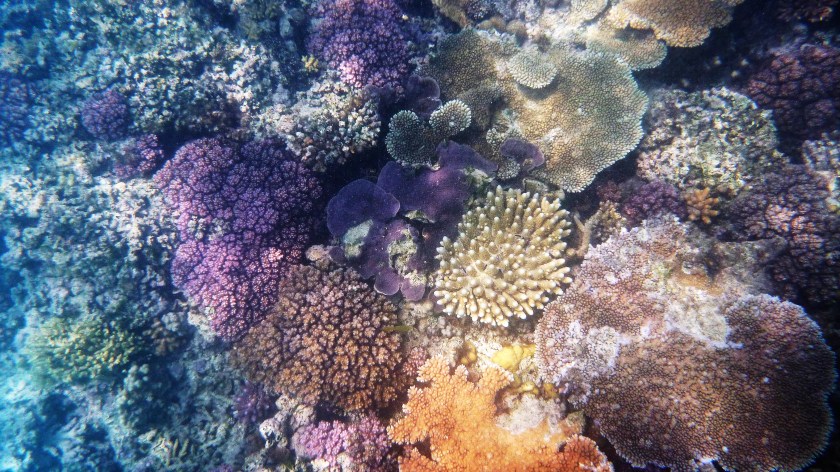
The visibility was quite good and we saw a lot of hard coral, some soft corals and plenty of fish life, including butterfly fish, rainbow-coloured parrot fish, anemone fish, humbugs (black and white striped – Christian calls them zebra fish), patterned sea cucumbers, honeycomb cod and many more. The photos don’t really do it justice – we must update our underwater camera.


Graeme went for a spearfish with us following along behind him in the dinghy. The current was quite strong so he let it take him from bommie to bommie. While he saw quite a few reasonable sized fish, he also saw a few too many reef sharks. At one point, he got a shot off but the fish – now wounded – got away. There were FIVE SHARKS near him within moments, all keen for a free dinner. After that, he displayed a little reluctance to go in again. Can’t understand why! However, with some encouragement, he went out for a short swim the next morning with his spear gun and came back with a stripey, which was an absolutely delicious sweet white-fleshed fish.

Bait Reef
We watched Christian winch his anchor up mid-morning and start to head back. We weighed anchor a short time later and started to make our own way back, ahead of increasing wind. Coming back near popular Bait Reef, we found someone dropping a mooring, and decided it was a fortuitous sign, so we picked it up. (There is no anchoring at Bait Reef, so if you can’t get a mooring, you can’t stay.) We went for a snorkel in very strong currents, and then a dive at the highly recommended Stepping Stones; a long row of bommies apparently unique to Bait Reef. We were a little disappointed by the lack of coral along the top of the bommies, or rather the apparent destruction of the coral. Every bommie we looked at was topped with coral rubble. Diving further down proved a little better, with quite a lot of fish including some big ones. Graeme took the Go Pro and shot some footage through the canyon between two bommies, and the fish lurking at the other end. We saw both some soft and hard coral, but nothing like what we had expected to see – nothing like we saw in the same place ten years ago. Has the cyclone caused all this damage or is there something else at play here? Something else happening that is destroying the coral? I’ve only seen one crown-of-thorns starfish – nothing like the numbers you would think would be required to wreak such destruction.
Stonehaven Anchorage
Back at the boat, we had a late lunch in the gorgeous reef surrounds, and let go of the mooring. We still had a few hours of sailing to get back to the Whitsunday’s. We may have slightly misjudged how long it would take us to get back, or lost time by heading around the western end of Hayman Island. As the day was fading, we motored through Blue Pearl Bay. No moorings, and we couldn’t find a suitable spot to anchor. (The ‘free’ area was around 18 metres deep!) So, with the sun setting, we kept on, heading for Stonehaven – an anchorage on the west side of Hook Island. Along the way, we managed to spot moorings in the near-dark along Langford Island. After several attempts to pick one up (due to poor visibility) before we were successful, we ended up working out that the area offered no protection from the predicted northerly winds, so we dropped the darned thing and resumed our route to Stonehaven, now in full dark and with a reef to negotiate. Fortunately, the end of the reef is lit, so we kept the light to starboard and soon found ourselves motoring towards what looked like the twinkling lights of a small town. These lights, of course, were all the anchor lights of the myriad boats sheltering in Stonehaven. We were feeling a little anxious about anchoring in the dark, as Christian had relayed to us over comms that anchoring had been difficult in deep water, and he’d done it in daylight. Our charts showed a circular shoal area of about 10 metres depth a fair distance off the main anchoring area, so with no one in the immediate vicinity, we dropped our anchor there. It proved a perfect spot, although the doof-doof music and raucous laughter from the party boats carried a little too well across the calm water.
Airlie Beach and Stonehaven – and guests!
A mecca of backpackers the world over, Airlie Beach is a bustling township that has spread up the surrounding hills in recent years. The constant ebb and flow of backpackers ensures the pubs and souvenir shops are busy, hostels are always full and the party boats are overflowing. From Stonehaven, with its dramatic backdrop of steep hills and cliffs, we motor-sailed down to Airlie Beach and anchored amongst the moorings in the area known as Muddy Bay. (It’s notorious for being a spot where boats drag their anchors, the bottom being apparently a light layer of mud over very hard clay.) It was Saturday, and we were keen to check out the beach-side markets and try and do some shopping before our visitors joined us. The markets were expansive, with fresh produce, handicrafts, live music and an impressive sand sculpture of a dragon, with smoke wafting from his nostrils. There was even a couple of real beardless dragons you could pet.
We discovered that since our last visit they’ve built a big Woolies, so we did a bit of shopping (only as much as we could carry back to the dinghy at the Sailing Club wharf).
That evening, Graeme’s brother David, and his wife Alison, arrived in Airlie Beach from where they had been camping near Bowen. They had already travelled from Canberra to Townsville and we all were excited about them joining us for the next week. We met up with them at the Sailing Club for a couple of drinks, finalising plans for collecting them from shore the next day.
Next morning, we didn’t get away before 1200, with some complicated moves to get both David and Al to the boat while leaving their car and caravan some 20 kms away. Once we had everything stowed and everyone aboard, we set sail for Stonehaven again, and this time managed to anchor in daylight!
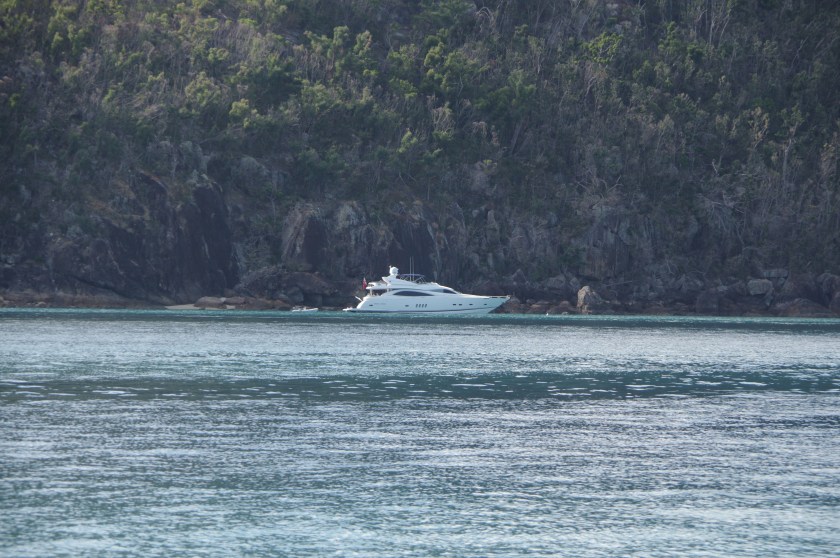
The next morning, we set off for Hook Reef again, excited to show David and Al somewhere special; somewhere they hadn’t been before. We had two more wonderful days and nights out at Hook Reef, with perfect conditions, anchored in almost the exact spot we had anchored before. We enjoyed some excellent snorkelling and diving around nearby bommies, swimming in the clear water, and just spending time together.


Graeme tried out his home-made high-pressure dive setup (Hookah style – whereas we’ve been using a low-pressure Power Dive setup) off the back of the boat, and whilst down the bottom in 10m he noticed some big fish. He came back up, got the homemade Hookah off, donned his snorkelling gear and took down his spear gun. It took three goes free-diving down before he saw the fish again, but on his third attempt, he came up with a fish on the end of the spear! And what a beauty! We identified the 64cm fish as a slate bream. Al and I made a lip-smacking coconut fish curry for dinner, which fed five and had enough left over to feed the guys again the next night.

Luncheon Bay, Saba Bay, Hill Inlet and Whitehaven
With lots more places to visit, we finally tore ourselves away from the Reef and headed back to Hook Island. On the way, there was this section of ridiculously clear cellophane-blue water, so we dropped the anchor and tried swimming. The current was so strong you had to hang onto the ladder, and your legs popped out behind you. Later, David was keen to be shark bait, so we let a line drag off the back of the boat with some knots in it, and he hung onto it, as we sailed along doing about 4 knots. Not to be outdone by his big brother, Graeme had a go too. Apparently, it was extremely hard to pull yourself forward on the rope back to the boat.


With hopes of good snorkelling on the northern side of Hook, we picked up a mooring at Luncheon Bay (to the east of Maureen’s Cove, which we’d already identified as a good spot). 100 Magic Miles, the definitive guide to the area, suggested Luncheon was also a good spot. How disappointed we were to discover that not only was the water visibility terrible, the whole place was a coral graveyard! The only thing worth seeing was a crayfish tucked under an overhang, his long white antennae giving him away. We have to assume that Luncheon Bay was hit hard by the cyclone, and we just hope that in time the reef there will recover.
We ended up anchoring in Saba Bay for the night – a lovely spot on the eastern side of Hook Island, where we had a calm night. (There are many great anchorages all the way around Hook Island.)
Next morning, we were off early. We anchored off Hill Inlet and went in for a delightful swim in the crystal-clear shallows of the Inlet. Our swimming requirements satisfied, Graeme, David and Jamie went back to the boat and proceeded to move it to the southern end of Whitehaven, while Al and I walked the length of the beach. The sand is still that squeaking white silica, and the water the graduating shades of pale aqua through to cerulean, but the grey shambles of torn and twisted trees on the shoreline is a constant reminder of the cyclone’s fury just months ago.

Turtle Bay, Goldsmith Island and Mackay
We moved to Turtle Bay for the night, watching the charter boats flock in behind us, many of them coming in at dusk and some anchoring uncomfortably close. A snorkel the next morning showed that Turtle Bay had a similarly decimated coral reef to what we had seen previously in Luncheon and Butterfly.
We were enjoying mild winds from the northeast, but with strong southerly winds forecast for a couple of days’ time, Graeme came up with a cunning plan. With David and Al on board, we would make use of the nor’easters and make our way to Mackay. From there, we would grab a hire car from the marina and drive them back to Airlie.
From Turtle Bay, we had a pleasant sail to Stingray Bay on the southern side of Goldsmith Island. It was great to be out of the charter boat grounds and into an area less frequented. We enjoyed swimming off the beach the next morning and then a hooting sail down to Mackay. We were even able to provide an experience we didn’t think we’d get to share with David and Al – a whale and her calf practising their breaching skills!

Must have been the last whale to head south. We reached Mackay in the mid-afternoon and had twenty knot winds against us getting into the marina pen. Nothing like a challenge!
The last time we were headed back to Mackay, it was with the knowledge that we intended to return to the Whitsunday’s. Now we were turning our backs on the Whitsunday’s and beyond for the last time. Any place, any anchorage, cove, bay or reef would now have to wait until another journey north. We were at that turning point: officially on our way home. I don’t think it was much in our minds at the time; the idea that we were now heading south.
Whilst showing Al around the marina we discovered, much to Jamie’s horror, that someone had tried to burn down the laundromat (gas dryers). Suffering considerable damage, it was ‘closed until further notice’. Returning to the boat, we ran into Helen from John Barleycorn. Their boat was on the hardstand nearby, awaiting a part to be shipped up to make some repairs. Their rudder, prop and cutlass bearing was out, and as to what was wrong, let me just summarise by saying ‘there was a dry joint in the propeller line time base’, or something to that effect. They’ll be back in the water soon, and heading south. We were thrilled they joined us all for a delicious dinner at George’s Thai. (Have to recommend the Penang Duck!) It was David and Al’s last night on board, after a great week. We were sad to say goodbye the next day.
Seemed like everyone was heading south. David and Al would be heading south, the whales were heading south, John Barleycorn would soon be heading south.
And as soon as we got suitable weather, we’d be heading south too.


Sue. This has been another great read! But I think the gratuitous nudity did not show enough embarrassment material.
LikeLike
Michael, unfortunately I’ve got the nudist’s work colleagues looking at the blog occasionally. Happy to send you the unedited pic, though!
LikeLike