From playing with the whales at Fraser Island, we travel overnight to the beautiful Lady Musgrave Island…
Lady Musgrave is a coral cay island enclosed in a large lagoon. It is unique in that it is the only island with an accessible lagoon on the Great Barrier Reef. Due to its proximity to the mainland and its stunning outlook, it is very popular with both cruising boats and tourist boats. It is only a matter of hours for a high-speed boat to cruise across from Bundaberg doing 20+ knots. It’s a whole different story for a sailing boat cruising at an average of 6 knots!
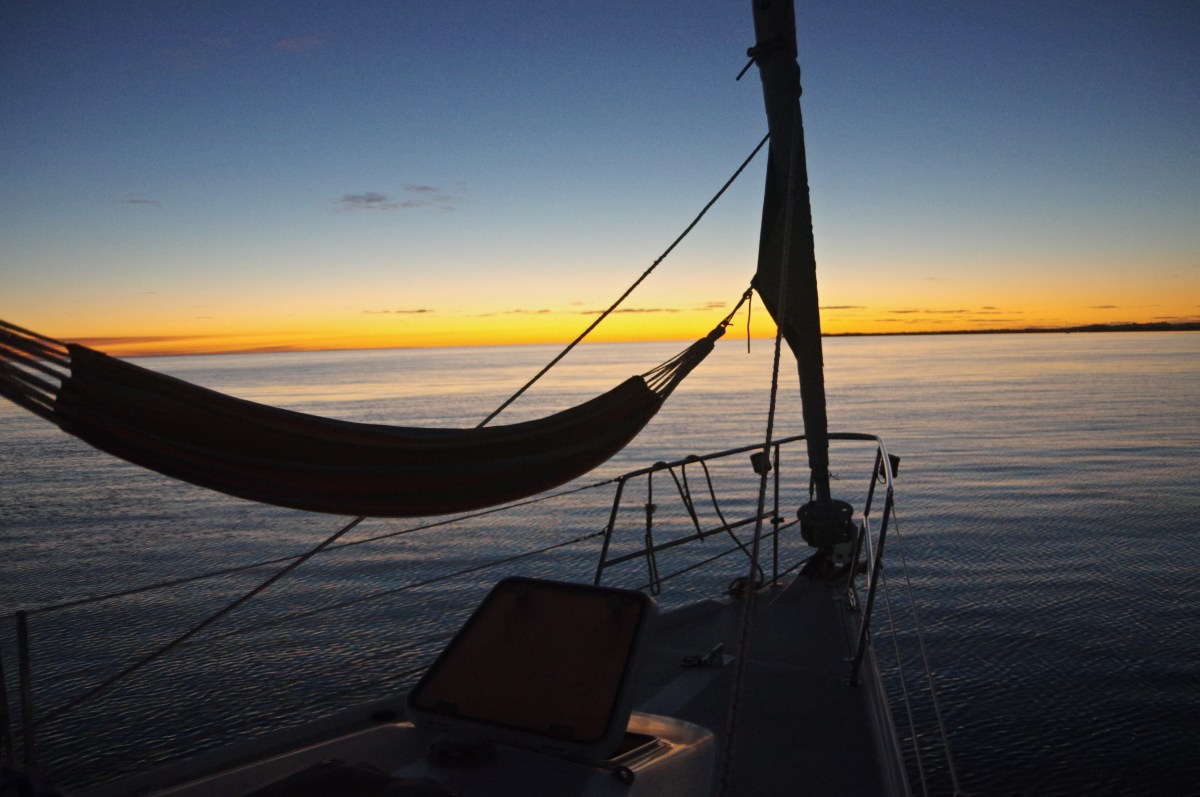
We left Platypus Bay/Rooney Point at the top of Fraser Island at 2100 (9pm, for those who haven’t become familiar with my 24-hour format). We determined that we had 70 miles to cover, and we needed to be entering the lagoon after 0930 to ensure good visibility of the reef. This meant we needed to sail overnight. With no moon, and no loom of city lights, it was a deep dark night. Starlight, intensified out here, sparkled in silver lines across the water. We could hear whales all around us, so we moved at very low speed out of our anchorage, fearing that we might hit one. Once clear of the bay, we set a course, turned on the auto pilot, and motored into a calm sea. Graeme was on watch from 2130 to 0200, and watched an amazing moonrise; a huge orange glow that he initially took for an approaching ship. I took over from 0200 to 0600. It was flat and moonlit and beautiful, but otherwise uneventful – and that’s just how I like my watches to be.
Land-ho!
We approached the entrance to Lady Musgrave lagoon just on 1000, accompanied by a small pod of dolphins. We were arriving at the optimum time for visual navigation. Too early and the sun silvers the water, making it impossible to see where the coral is. (Same thing happens if you try to leave after 1600.) The approach was clear and wide. Looking from above, you can see a distinct ‘cut’ through the lagoon’s fringing reef. Our system is that I stand forward on the coach house roof and direct Graeme. This way we make it safely through the pass and around the coral bommies. It is a system that works well for us.
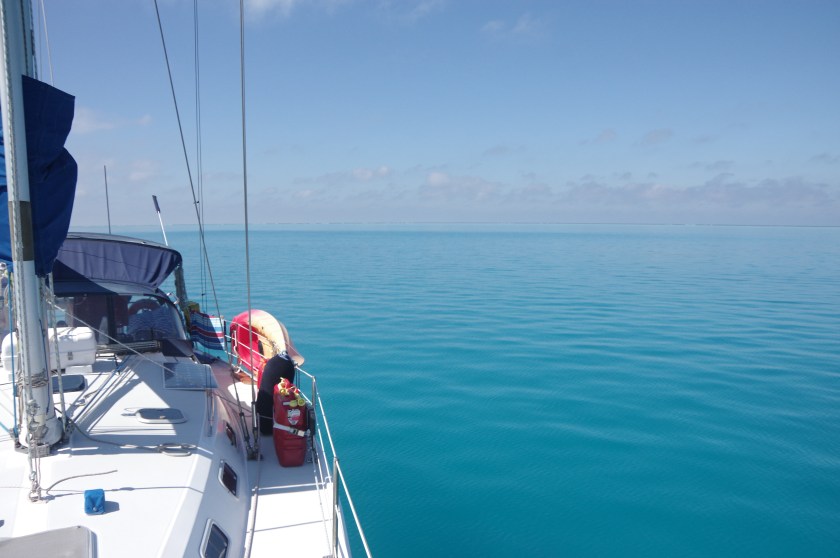
The lagoon at Lady Musgrave is really something special. With calm waters most of the time, it is an oasis in what can be a wild ocean. When we arrived, the water was turquoise blue gleaming like a polished gemstone.
Lady Musgrave lagoon … like a polished gemstone.
It was the busiest we’ve seen the lagoon, with about twenty-five boats including the big tourist boat. We found ourselves anchored not far from John Barleycorn and their friends from Pittwater, Aussie Rules, a Catalina similar to our friend’s yacht, Nineteen.
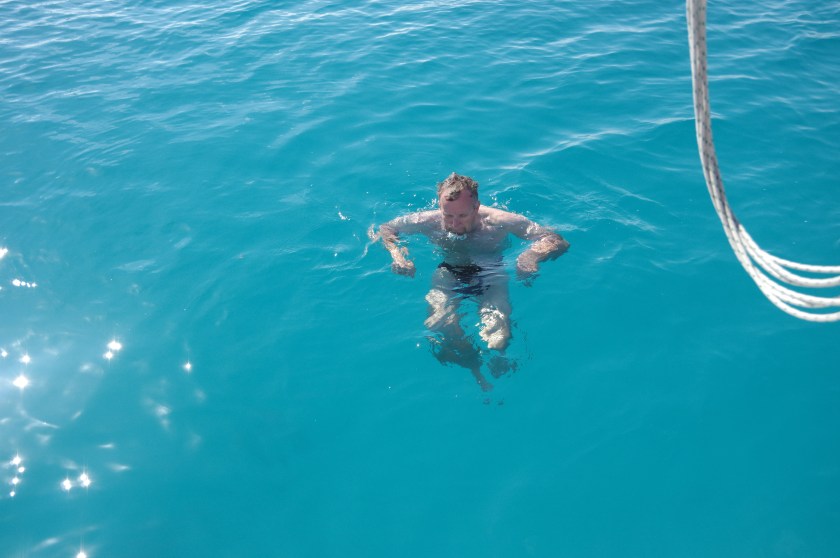
With the water such an inviting shade of blue, Graeme took the opportunity to dive the anchor chain. A lot of people do this in coral bommie areas to see if there might be anything the chain or anchor could get caught on, or to ensure their anchor is dug in well. While beautiful and seemingly benign, the winds can and do come up. If your anchor starts dragging in the night in a place like this, you’re up poo creek without a paddle.
Er… the water makes him look a lot whiter than he really is…
Graeme reported the water was fine, so we loaded all our snorkel gear into the dinghy and headed to a likely spot. The visibility was great and there was a lot to see, but we didn’t last long in the water, on account of Jamie getting too cold. Occasionally we need to be reminded it is still winter, even if it’s warm enough to swim. Two turtles hung around us for a while, as curious of us as we were of them. We saw an abundance of colourful fish, hard coral and even some anemone fish darting in and out of their anemone (same family as the clown fish).
More snorkelling the next day, this time with our wet suits. Getting Jamie into his full-length wet suit is quite the feat and you’re ready for a cooling swim by the end of it. It is very thick and fits like a second skin, and you have to kind of pour him in – and he does little to help the process! Our second snorkel at Lady Musgrave was altogether more successful. Everyone stayed warm and we enjoyed showing each other the giant clams, various corals, anemone fish, giant sea cucumbers and spotted cowrie shells. We were particularly taken with a boulder coral covered in tiny lilac ‘flowers’. Sorry, no snorkelling photos yet. We forgot the underwater camera both times. We intend to be more diligent next time, and try to get some shots of the underwater world.
The second night at Lady Musgrave we enjoyed a BBQ on Blackwattle and possibly had a little too much to drink.
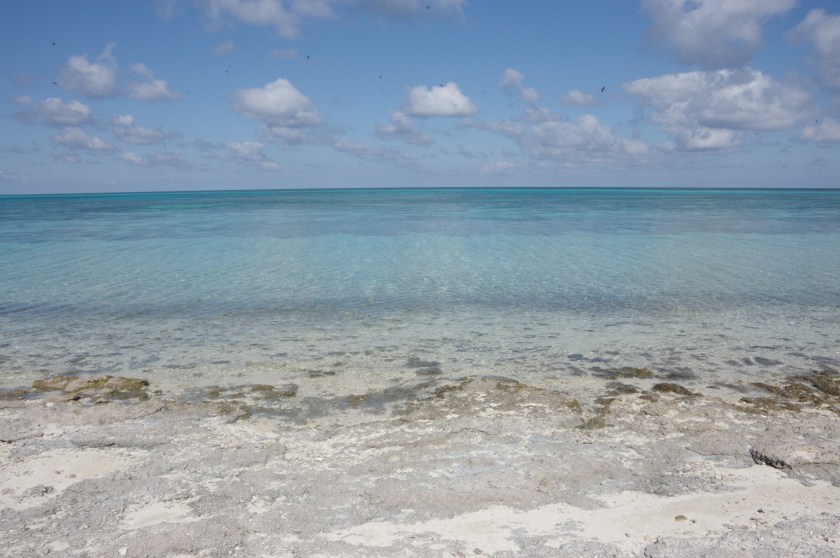
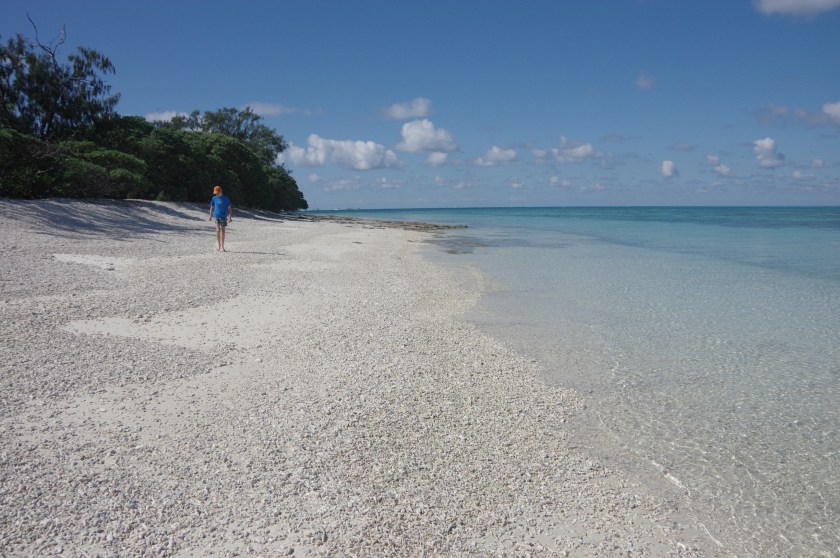
The next day, (Wednesday 16 August) we went over to explore the island. We walked more than half way around on the coral strewn beach, delighting in the various crystal blue and green shadings of the water stretching away into the lagoon .
A school of fish flashed past like scattered silver coins in the shallows, herded by a reef shark. Later we watched a huge (cowtail?) stingray, rippling its wings to show the white underneath, as though getting ready for flight.
Fruit of the pandanus tree. Seeing pandanus always makes us feel like we’re in the tropics.
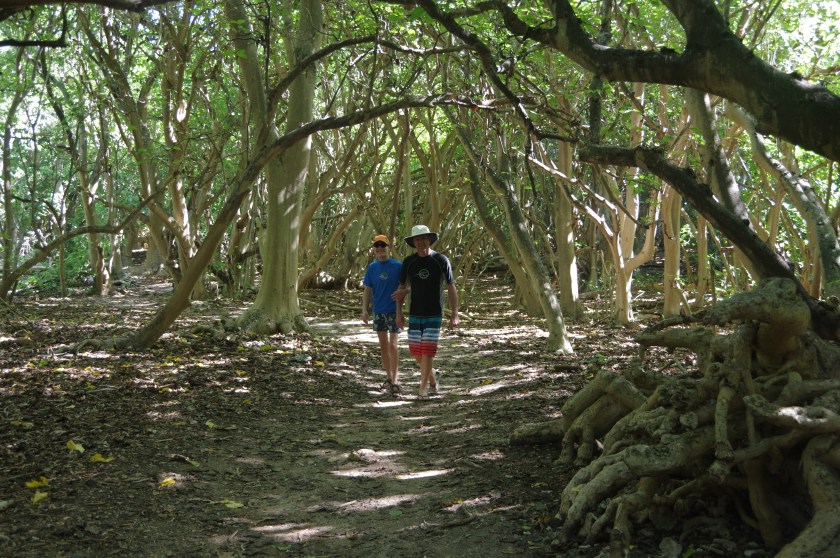
We walked back through the cool interior of the island, through the groves of pisonia trees where black noddy terns squabbled in the tree tops. Fortunately, most of the birds were out enjoying the air. We’ve walked through these groves at other times where so many birds are roosting in the trees that it appears to be raining!
That afternoon, Steve and Helen from John Barleycorn turned up for an impromptu happy hour, and Christian joined us soon after. A great end to another fabulous day. Talk got ‘round to the weather and the forecasted strong winds. We wanted to be out of there before it became untenable. It was decided Blackwattle and Symphony would depart, with plans to head to Pancake Creek, at 0930, by which time we expected to have good visibility to navigate our way back through the channel.
We had no idea what the Lady had in store for us the next day, and ignorance is bliss, hey?
Our last blog saw us leaving Kingfisher Bay Resort and heading for Platypus Bay, in the hope of encountering a friend, and a whale or two…
Finding Blackwattle
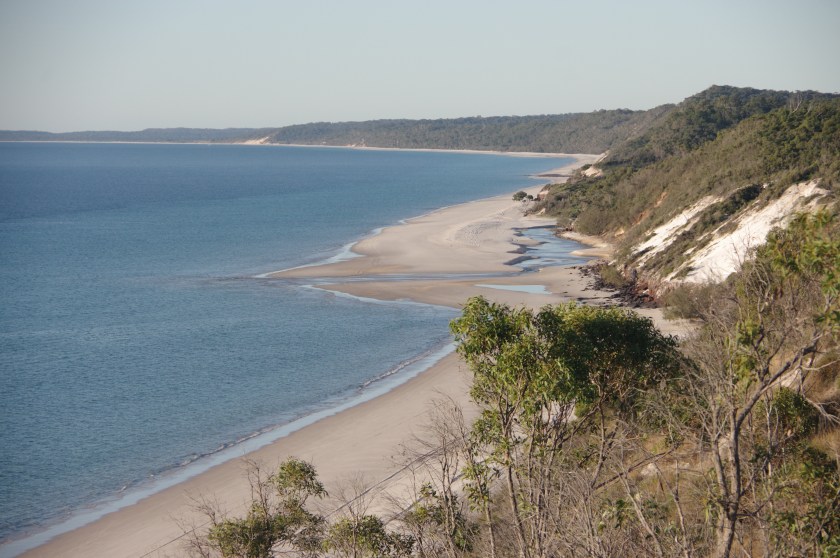
On Tuesday 8 August, we left Kingfisher Bay Resort and made our way up the Great Sandy Strait passing Big Woody Island to port then Moon Point (Fraser Island) to starboard, until we reached a spot at the southern end of Platypus Bay called Arch Cliff. This part of Fraser Island is quite devoid of landmarks so Arch Cliff is a landmark due to its significant orange sand dune.
We dinghied to shore and enjoyed walking on the beach and trying to climb the steep dunes, which sent avalanches of sand pouring out of every footstep. Graeme made it to the top and took some nice photos across the Strait, then he joined us and we wandered some more.
Arch Cliff (distance) Fraser Island. Ours are the first footprints of the day. Plenty of tyre tracks, though!
View from the top looking north towards Platypus Bay.
Arch Cliff was the perfect place to rendezvous with our CCCA friend, Christian, on the beautiful Blackwattle. He’s been up here since earlier in the cruising season and has already been enjoying the wonders of the area. It was great to catch up and have him aboard for sundowners, and swap adventure stories.
Blackwattle
We bounced around a bit that night. Not all sailing is plain, and not all anchorages are calm!
Whales
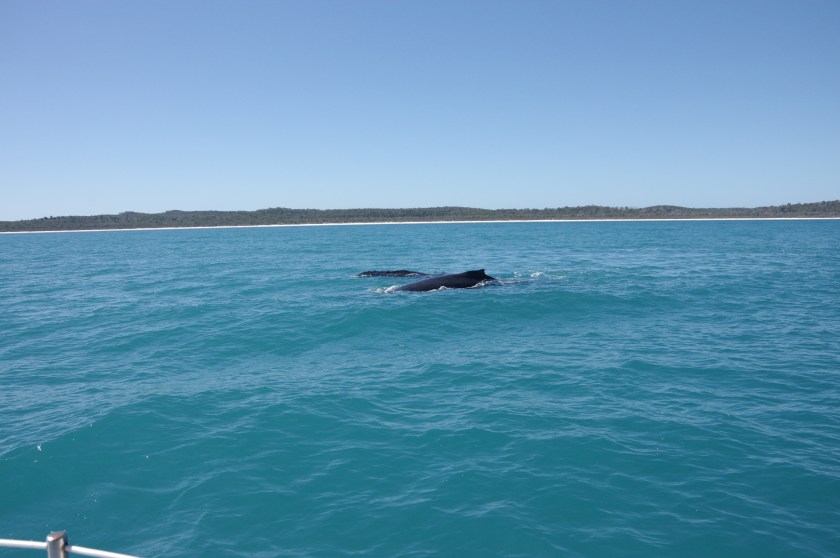
Wednesday 9 August we headed further into Hervey Bay, finally entering the much-anticipated whale playground: Platypus Bay. It was exhilarating. I can’t adequately express the feeling of pure awe and joy at seeing and hearing these magnificent creatures up close. We watched the humpback whales all the way across the bay.
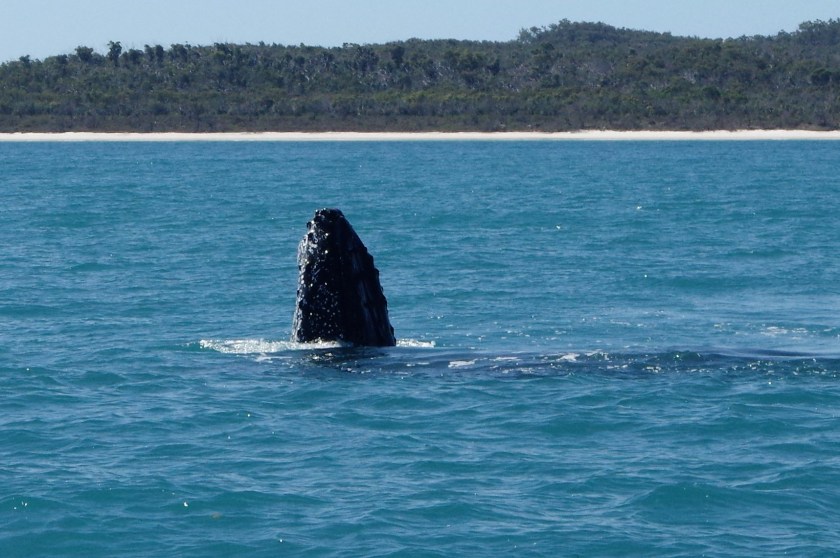
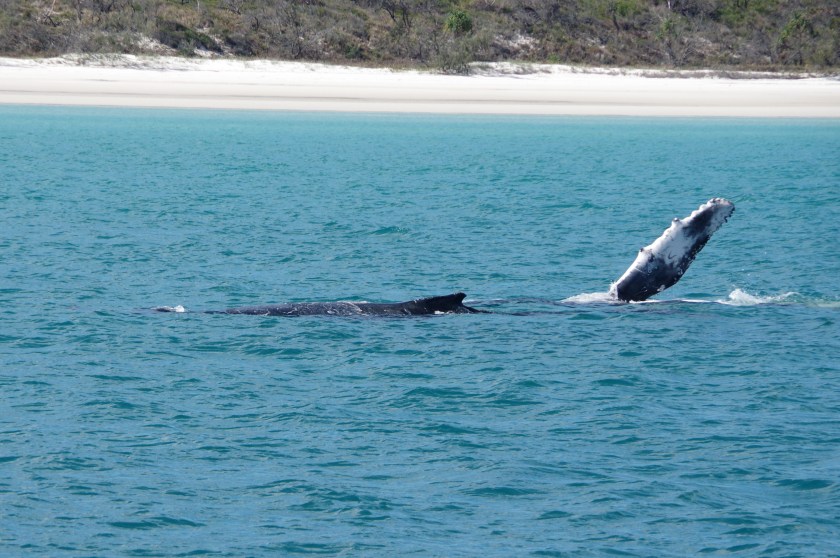
A humpback, ‘spy-hopping’.and again…About to dive under the boat!!
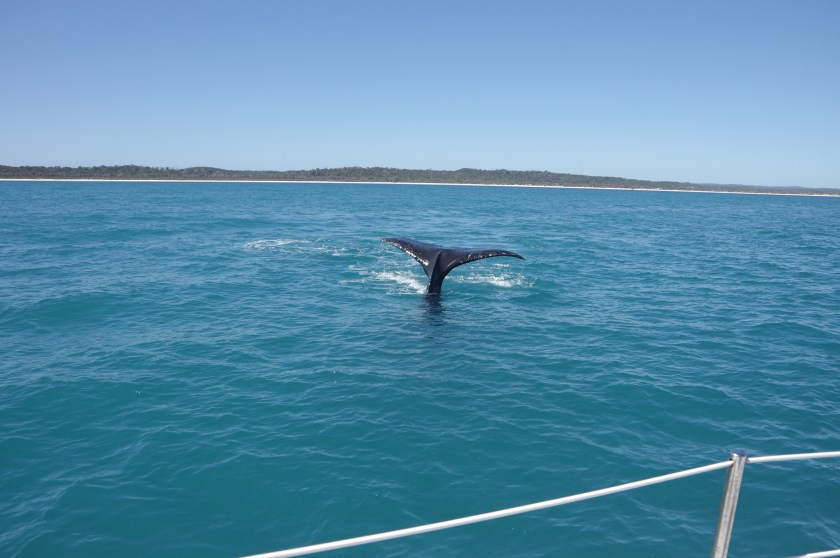
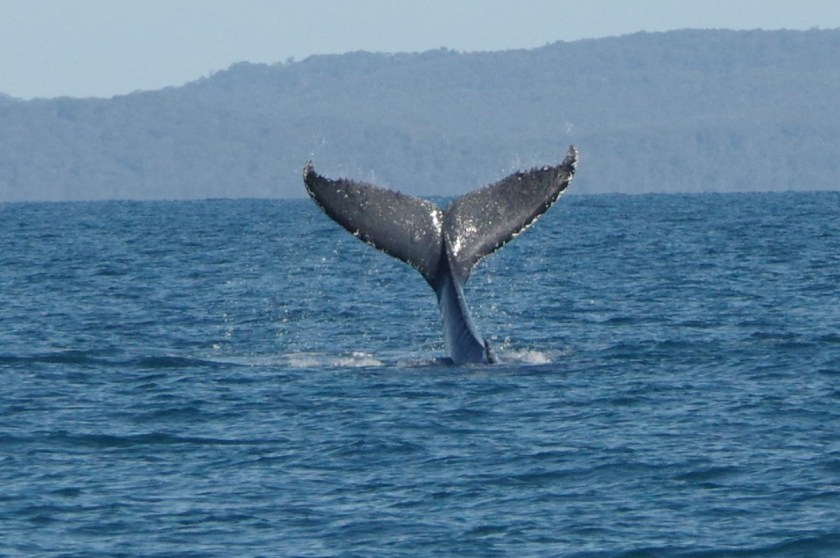
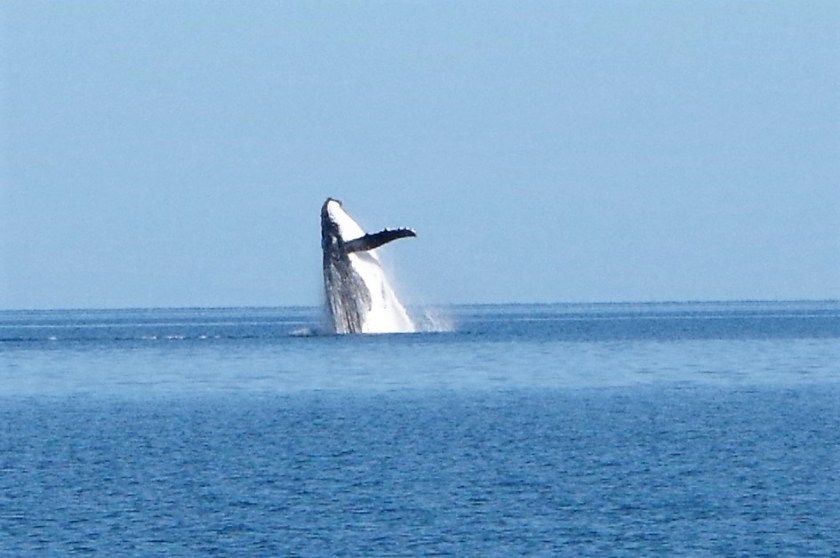
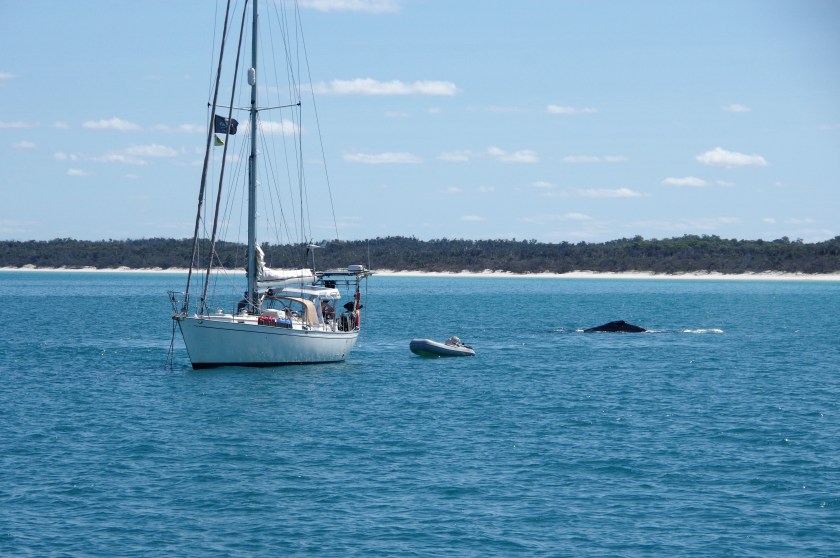
We eventually anchored north of Station Hill. Over the next couple of days there were countless magical moments. Some we captured on our cameras, other times we just enjoyed being there to witness the many kinds of whale behaviour; cruising along in pods with their new calves, blowing and ‘snoring’, fin and tail slapping, spy-hopping (where they pop their heads out of the water to eye level, to get a good look above water), and various versions of breaching. When making way, we are always careful to observe the minimum 100-metre distance rule, but once anchored, it’s then up to the whales to choose how close to come. And, wow, did they come close! We had whales cruising right up to our boats, sometimes doing a lap around for a second look. Whales were going under the boat at times, and we were only anchored in less than 8 metres. A whale bumped into Blackwattle’s anchor chain one evening, causing a shudder through the boat. Occasionally, they would do something dramatic right off the stern, other times you would hear the whoomph of a distant whale repeatedly tail slapping or breaching.
My only successful breach shot.
I could have jumped on for a ride, this one came so close to us!
Night time in Platypus Bay was special. The nights were still and dark, the sea like oil. The moon was late to rise so the stars were bright and the Way stood out in all its milky glory. Whale song penetrated the hull of the boat – the unearthly trumpeting calls and whistles. Outside, you could hear the whales not far from the boat, resting at the surface, breathing their ‘grandpa snores’. We felt so privileged to be able to live with the whales for a time. The experience will remain with us always.
Urangan
With strong onshore wind predicted for our area, we finally tore ourselves away from the whale wonderland and headed back south-ish to Urangan on Friday. Christian told us that reprovisioning in Urangan was easier than at Bundaberg, also Col and Noelene would be there in their boat, Inspiration, and we’d never been to Urangan before, so even though we were effectively going backwards, we decided Urangan was the destination. We left late morning and had a fabulous sail across Hervey Bay, enjoying speeds more than 7 knots (with a helpful current at times). Because of our late departure, we got into Urangan right on sunset. With no other arrangements made, we anchored outside the artificial harbour in what we felt was a very exposed position, with windy and bouncy conditions. The conditions fortunately settled down late that night, and we got some sleep.
Saturday morning by 0800, we were on the phone to the marinas looking for a berth. Out of three marinas, Great Sandy Straits Marina (the big one) was full. So was the one next door. The last one, Fisherman’s Wharf Marina, was closed on weekends! Someone called Jo answered the phone, however, and although she was walking her dog on the beach, she managed to organise a berth for us. No sooner had we docked than it was off to breakfast with Colin and Noelene, up at the big marina. Lovely coffee and brekky and great to hear about their adventures too. Too soon, it was time to let them go and for us to get to work. It was a day of laundry, refuelling, cleaning, filling water tanks and reprovisioning. Jamie was thrilled to oversee the washing again. I walked 2km to the shops with Christian and filled up my trolley. I called Graeme, feeling slightly panicked.
‘Honey, the trolley is FULL and I haven’t got everything!’
‘Don’t worry,’ he said, ‘Just get that lot and we’ll go up again later.’
And we did. And almost filled another trolley! Two taxi trips and 10kms on foot and I was finished for the day.
That evening, the little township held their ‘Blessing of the Fleet’ ceremony. No, not blessing the fishing boats for plentiful catches – blessing the whale watching boats. For plentiful tourists, perhaps? (Ah ha! Now we know why the marinas were full!) Christian went over to the festivities and managed to slip into the bar. The event concluded with a fabulous fireworks display, which we watched from prime position on Symphony’s bow.
Dolphins and more whales
Next morning, we were away by 0730, with plans to head to Lady Musgrave Island via Platypus Bay.
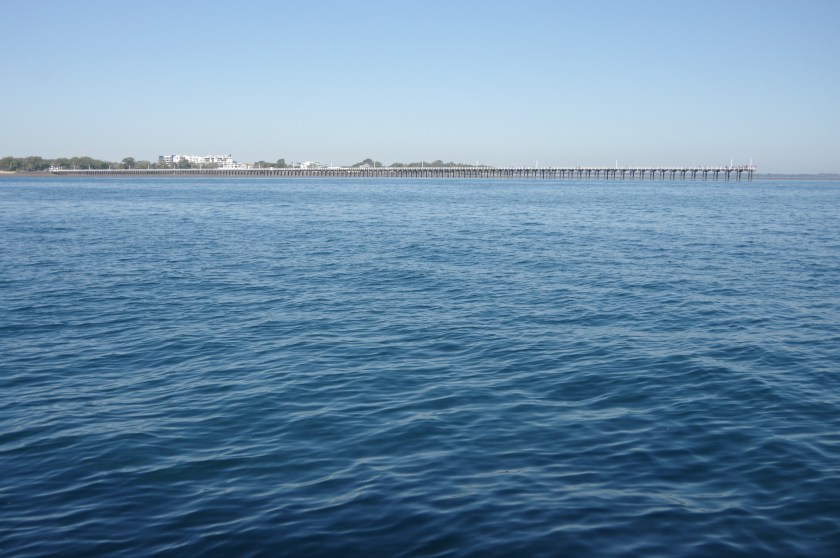
Amazingly long jetty at Urangan. Just thought I’d better slip in a photo that wasn’t a whale.
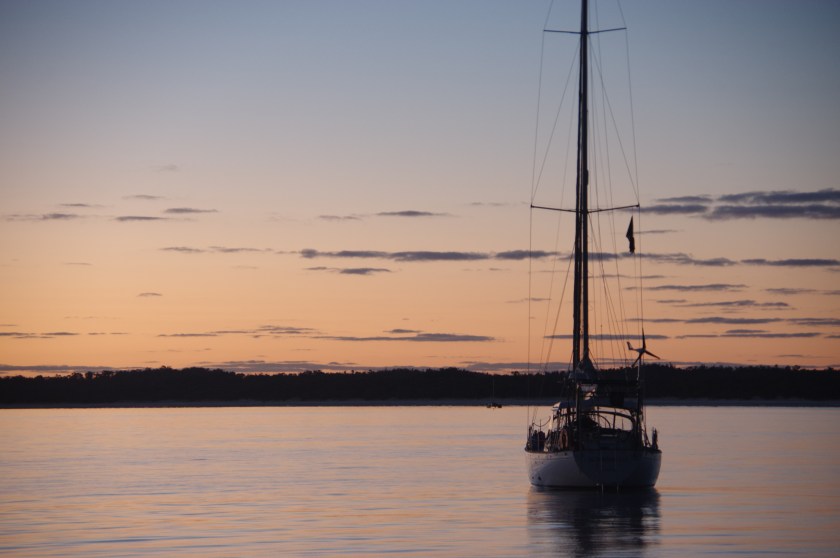
We motor-sailed the 32 nautical miles across the bay, at one stage in the company of a pod of five dolphins who stayed with us a good while, playing in our bow waves as we rode the bow above. They would roll on their sides to eye-ball us before shooting ahead to leap and twist, then slide back into the wave or chase their mates – always a thrilling experience to interact with the dolphins. We eventually anchored close to Rooney Point at the top of Fraser Island mid-afternoon. No sooner had we laid anchor than the whales were putting on a grand show for us. The setting sun turned the sky pearlescent; gorgeous colours that were mirrored in the placid waters.
This guy must be on his back to be doing this.This one’s heading right for us.The whales really took a liking to BlackWattle.
My last blog concluded with us heading for the Wide Bay Bar – the most notorious bar (and deservedly so) on the east coast of Australia. The Wide Bay Bar is at the southern-most point of Fraser Island, allowing passage into the Great Sandy Straits – the beautiful waterways between Fraser Island and the mainland. There’re not too many mariners, no matter how experienced, who don’t feel at least a little nervous when approaching the Wide Bay Bar. Beacon to Beacon, the popular Queensland navigation directory, has a note on the Wide Bay Bar page:
Caution – crossing Wide Bay Bar should not be attempted without local knowledge. Conditions on the bar can vary rapidly with changes in tide height and direction, ocean swell and prevailing winds. Extreme caution should be exercised when crossing the bar … Ebb tide combined with a south east swell or sea may cause significant waves to form on the bar and break on the adjacent banks.
And seriously, any bar with a section called the ‘Mad Mile’ should be respected! To me, the Wide Bay Bar is kind of like a wild tiger. You can be prepared, but you’re never quite sure what to expect. Maybe it will be asleep and you can just sneak past… Or maybe it will have its claws unsheathed, mouth twisted into a snarl, ready to spring. And so we approached…
The seas swirled and built. The swell seemed to be coming from all directions. Three metre waves were breaking on either side of the crossing; big rolling tubes of white foam, threatening to engulf our boat at any moment and smash us to pieces. Jamie and I huddled in our lifejackets in the cockpit as salt spray stung our faces and the waves roared by like wild beasts. Graeme clung to the wheel, grey-faced, water streaming from his wet-weather gear, edging us ever deeper into the white walls of water. The boat was tossed about like a bath toy and I watched my potted herbs go over the side, swallowed by the frothing water, followed by the cockpit cushions and a bundle of ropes. As a huge tsunami of water tumbled towards the boat, Graeme looked at me with terror in his eyes and yelled above the roaring seas, ‘Sorry honey, guess this wasn’t such a good idea after all!’
Nah.
Only kidding.
None of that happened. There were no huge seas or breaking waves. I didn’t even lose my herbs. It was the most placid we’ve ever seen the bar. Yep, the nasty tigey-wigey had gone beddy-bye-byes.
So, what really happened?
Given its dynamic nature, the channels and safest approaches through the bar shift and change. So, anyone attempting the bar needs to request the GPS way-points over the VHF radio from the Coast Guard based at Tin Can Bay. (That’s the bit about gaining ‘local knowledge’.) We like to be well prepared for these moments of ‘extreme sailing’, so we’d checked the tides, swells, wave heights and wind predictions using almost every app known to mariners. We chose a day when conditions were forecast to be optimal, and set off from Mooloolaba (as previously mentioned) to arrive a couple of hours before high tide. It all went beautifully to plan. We found ourselves sailing along with another couple of boats and one of them called on the VHF to see if anyone else was planning to cross the bar. We confirmed our intentions and, all of a sudden, we were ‘sailing in company’ with a boat called JohnBarleycorn.
John Barleycorn, a steel cutter, coming in to Wide Bay Bar with us.
These things are always less worrying when attempted with someone else. Graeme entered the way-points into the navigation system and we all followed them in. That’s pretty much it. Things were so darn quiet the volunteer at Tin Can Bay Coast Guard stopped answering our radio calls. We figured he must have knocked off early and gone fishing.
We didn’t have much time before we lost the light, so we anchored at Elbow Point and our new friends from John Barleycorn, the delightful Steve and Helen from Fremantle, came over to ‘knock the froth off a beer or two’. Turns out they left Fremantle in January in their full keel, steel boat, sailed around the bottom and are ever so grateful they no longer have to wear their beanies.
Yes, the weather is certainly getting warmer as we move north, and we’ve put all our winter clothes away too. Shorts and bare feet are now the go.
Great Sandy Straits
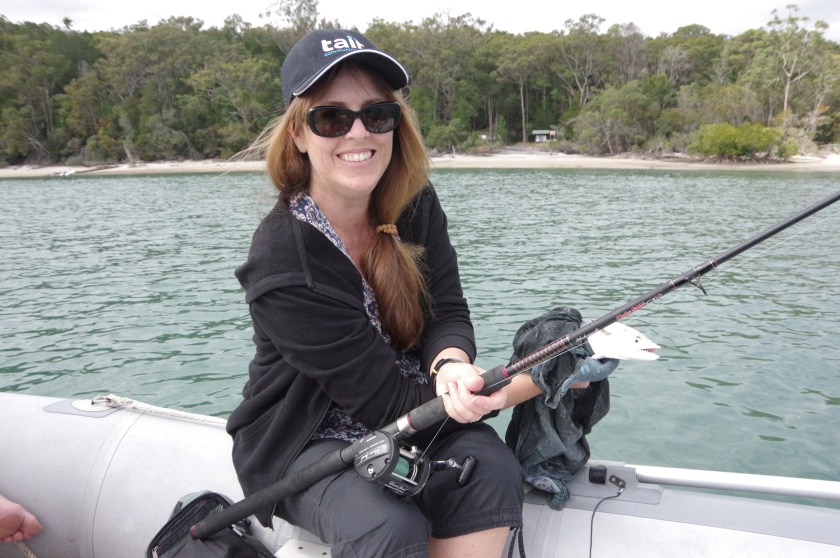
We were underway the next morning by 7am, for a quick run up to a spot just beyond the popular Garry’s Anchorage with the last of the rising tide. It was time to try out some of the fishing gear (we’ve been trolling from the yacht with no success as yet) so we decided to troll from the dinghy. (We’re pretty lazy fishers, really.) Well, it was quite a bit of fun and I even caught two Queensland schooling mackerel. Schooling mackerel need to be a minimum of 50cm (they make ‘em big up here) so our little 30cm fellas had to be kissed and thrown back. Thanks to our nephew James for the loan of a great rod and reel. It works!
You can’t tell, but that fish is thrashing like crazy. I didn’t really kiss him. He had lots of sharp teeth.
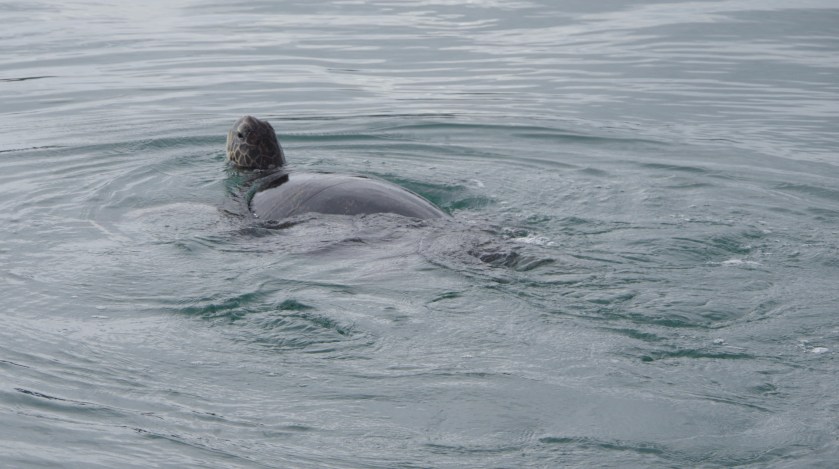
There are loads of turtles around these parts, popping their heads up for a look around then darting away when they realise they’re being watched. We also startled our first dugong. Those things erupt from the water like small mountains. We launched the kayak for the first time, and I went for a paddle to soak up some of the serenity. Gorgeous area.
The Eye of the Needle
Alarm at 0600. AGAIN. But necessary. The next stretch of the Straits involves passing through the Eye of the Needle, a treacherously shallow section where you really have to play the tides and thread your way along watching your position and the depth at all times. The skipper managed to get it exactly right. Not that he wasn’t a little white-knuckled at times! I think the shallowest it got was 3m, which means we still had 800mm under our keel. We stopped for breakfast at South White Cliffs then continued up the Straits then into Susan River, a small river that shares the same mouth as the bigger Mary River.
(Here are a few pics of the Straits when we were going through; so very placid. We were so early that we caught the pelicans still sleeping. They looked like they were headless!)
Susan River
Kind of nice having a river named after me. 😉
The northern bank of Susan River is flanked by a peninsula of land called North Head, and has a small settlement (big houses with nice water views) called River Head (probably an outer suburb of Urangan). Both Graeme and I had a sense of unease as we headed into the anchorage. There was a strong current from the tide which was against the wind, making for an interesting spot to anchor. We decided this would just be a quick stop – we would just stay to grab a few things at the local shop and be on our way. The sky was clouding over and rain was predicted. The first of our trip so far. Graeme dropped Jamie and me at the boat ramp and went back to Symphony to keep an eye on things back there. The shop was a bit more than a kilometre but I had my trusty (slightly rusty and held together with cable ties) grandma shopping trolley. We were not impressed by the local IGA, which was trying to stock everything from clothes to fishing gear but not much of anything else. (Jamie was disappointed the ‘bell tower’ outside the shops didn’t have a bell. I couldn’t convince him it was just a ‘sign tower’ – he kept asking the shopkeeper where the bell was.) Came away with only about half my shopping list. On the return walk it started to sprinkle. We arrived back at the boat ramp to discover a small crowd had gathered, looking out to the water, phone cameras ready.
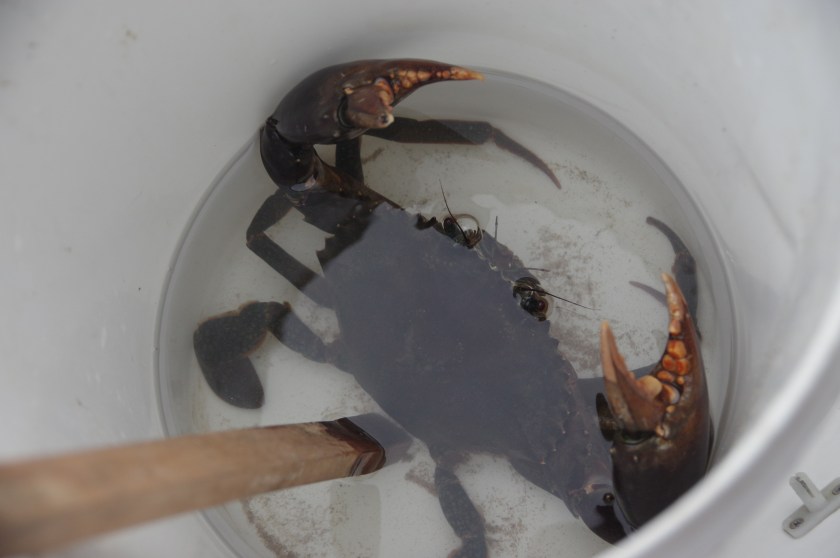
‘There’s a whale just up there in the river,’ a fellow said to us. Graeme arrived. Avoiding fishing lines, we stuffed the shopping into the dinghy and clambered aboard. The rain started to get heavier. A fellow from a fishing runabout called Baited Breath (who had been fishing near us earlier) called out to us that he’d left a mud crab on our boat. He’d only caught one, and one simply wasn’t enough to bother taking home.
‘Welcome to Queensland!’ he called, grinning, as he motored away.
The Susan River Whale
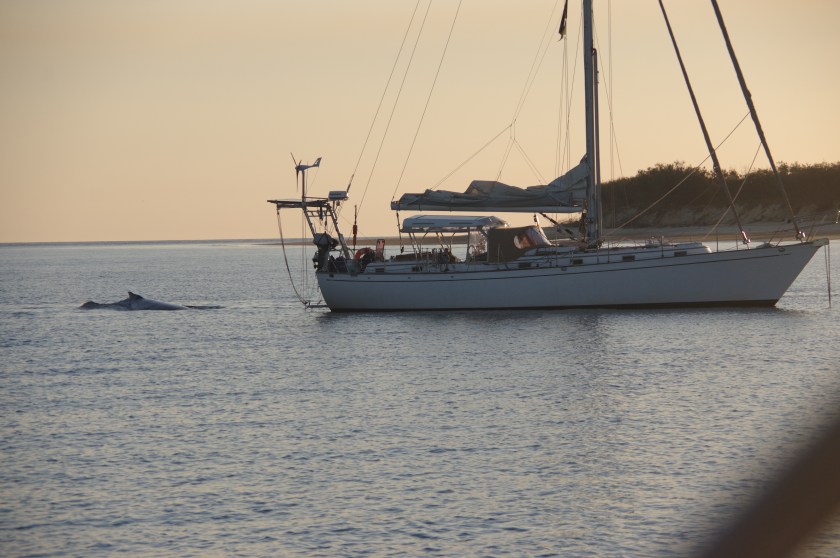
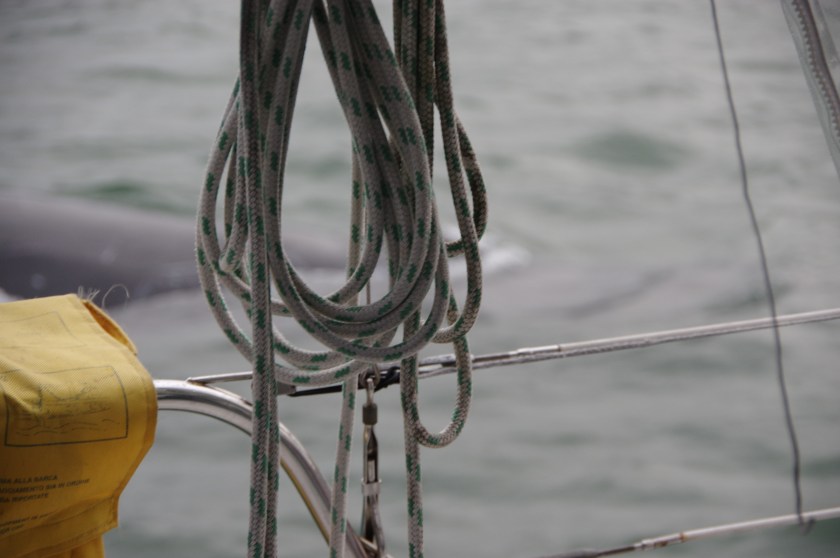
There certainly was a whale just up there in the river. It was right near our boat, actually. Closest a whale had ever been to our boat and we weren’t even on board! We motored back to the boat but the whale had moved further into the river. We found our mud crab – what a beauty – and stowed the shopping, keeping an eye on the tell-tale signs of the whale beyond the furthest moored boats. There were a couple of tinnies following the whale around. We didn’t know if they were trying to herd it back out of the river or just capture the unusual moment with their camera phones. Eventually, the whale decided it had done enough exploring and headed our way again. It came up just off the stern to port, and I managed a blurry photo – but this gives some idea of how close it was and it was the best I could do in the adrenalin-filled moment.
As we scrambled to get up on deck to watch it, it came up so close to our port side that we couldn’t see it from our position on the coach house roof. Fellow in the tinny was yelling, ‘It’s right there on your port side!’ It then dived right under our boat, and we held on, wondering if it would hit us. We were only anchored in about 6 metres of water. It came up again well off our starboard side and continued into the bay. The show was over.
The Mud Crab
After all the whale action, we decided to tackle the mud crab. Literally. Not having had much success crabbing in the past, we had ditched our crab pots and the pot to cook them in. All I had was a big saucepan. We weren’t sure he was going to fit.
Graeme lassoed a claw while I got the pot ready with boiling water. Well, he didn’t want to go in. Can’t understand why! It was quite the contest. Graeme prodded him in with a long stick. I held the saucepan lid like a shield. Finally got him in and got the lid on, then had to poke his legs in. Apologies to anyone who thinks this was a bit inhumane. I did attempt to stroke him – I believe that helps ‘put them to sleep’, but his claws were enormous and he didn’t seem to want to be stroked. It was all over very quickly, I promise. We got him back on the heat and pretty soon we were enjoying our first mud crab of the trip. He was divine.
Consumed as we were with devouring the crab, we failed to notice the boat was being invaded by mozzies. (Maybe they were from Greenpeace?) We spent quite a bit of time killing the blighters and making sure no more could get in. The rain continued and because of all the dramas it was well after dark and too late to go anywhere else. It ended up being a very quiet night, with the rain pattering on the roof. Not sure what we’d been worried about.
Monday morning (rather late) we weighed anchor and headed back out into the Straits. We watched dolphins playing in the shallows, then, wonder of wonders, watched a spotted eagle ray leap out of the water right next to our boat.
A few hours later we anchored off the Kingfisher Resort on Fraser Island. Tough area to anchor due to a steep shoaling shoreline, so you might anchor in 7 metres but then the boat will be sitting in 17 metres. Certainly makes it a tough gig for the Rocna. We were rocking and rolling around with current and wind 90 degrees to each other.
Kingfisher Resort, Fraser Island
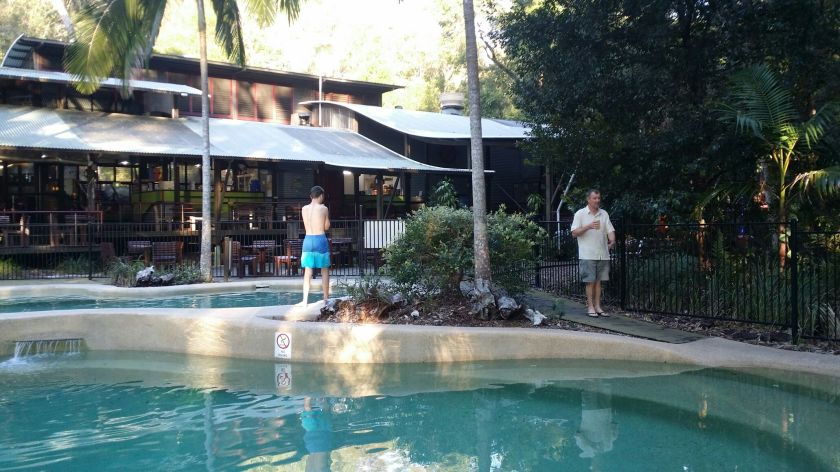
We went ashore mid-afternoon – probably wasn’t a good idea. First sign: conditions were too rough to manhandle the heavy 9.8hp outboard onto the dinghy, so Graeme put on the much lighter 3.5hp. Of course, the 3.5hp goes much slower through the water… and it was ‘farting around’ (in Graeme-speak). We could get it running but when we’d try to put it into gear it would stall. It was a bit of a hairy ride to shore when we finally got it going, dodging waves and trying not to get swamped. Once ashore, we pulled the boat well above the high tide mark near the bar on the jetty. Kingfisher Resort really is a lovely place (what we’ve seen of it), with an expansive wooden deck and plenty of shady trees, and an eco-friendly roof-line created to emulate Fraser’s many sand-dunes. The resort has a reputation as ‘friendly to yachties’ because they welcome us to use their facilities – pool, bar, restaurant, showers… Well, that’s all very nice but I’m pretty sure the women’s shower has been ‘out of order’ for years. So I showered in the men’s. Jamie tried the pool but didn’t get past his knees. Too cold, was the verdict.
The gorgeous pool at Kingfisher Resort looked better than it felt.
Dinner was good – pizza and Angus burgers loaded with bacon with great chips, but pricey. A (small) schooner of pale ale will set you back $9. We left the resort in the dark. Never like doing dinghy stuff in the dark when it’s rough. The dinghy had been liberally splattered with sand – thanks very much. And it was tough to get it going. After what seemed like ages we made it back to the boat. We spent a very bouncy night off Kingfisher and we were happy to get away early the next morning.
The inland waterway between the Gold Coast and Moreton Bay has a rather capricious character.
To navigate these waters in a monohull with a 2.2 metre draft you have to play the tides and keep close watch on the depths and the channel markers.
After leaving the tourist-busy Spit you start navigating through the reclaimed luxury waterfront islands. These islands are shaped, from above, like curved mini-labyrinths, created to allow everyone absolute waterfront. One mega-mansion we passed, on the rather pretentiously named Sovereign Island, was built across four large blocks. Sovereign Island is also purportedly the location of several lavish homes belonging to Clive Palmer.
As you head further north, away from the mega-mansions with their jetties and luxury toys, the waterways begin to narrow and twist, and quickly revert to mangrove swamp on either side. Occasionally you’ll see a white plume against the blue sky from a factory in the distance, or the roof of a warehouse, but the skyline is mostly featureless. The waterways are a minefield of hidden sandbanks so you have to remain alert.
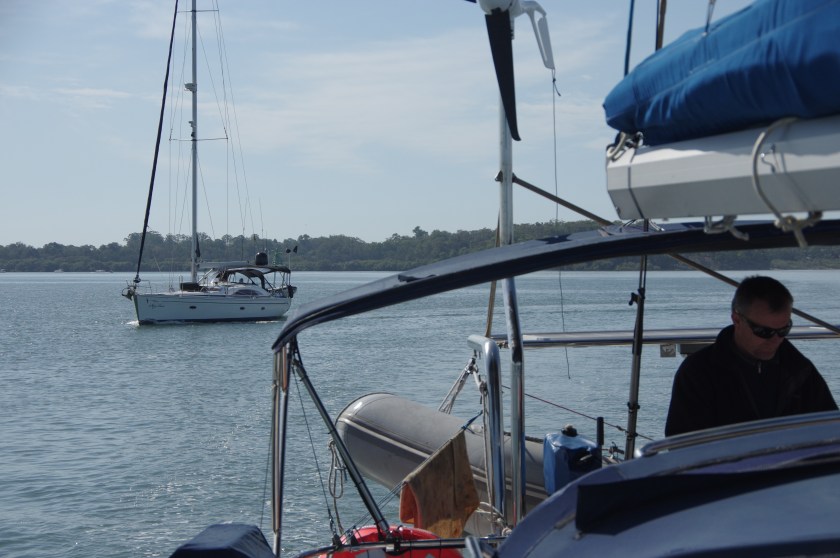
Mary Claire followed close behind us. They draw the same as us so figured if we could get through, they’d be alright too.
The further away you get from the Gold Coast, the more you become removed from the glitz and glamour. Beyond Jacobs Well, waterside businesses have hand painted signs and cluttered yards. ‘Mooring minders’ list at alarming angles. It feels like a place old boats come to die.
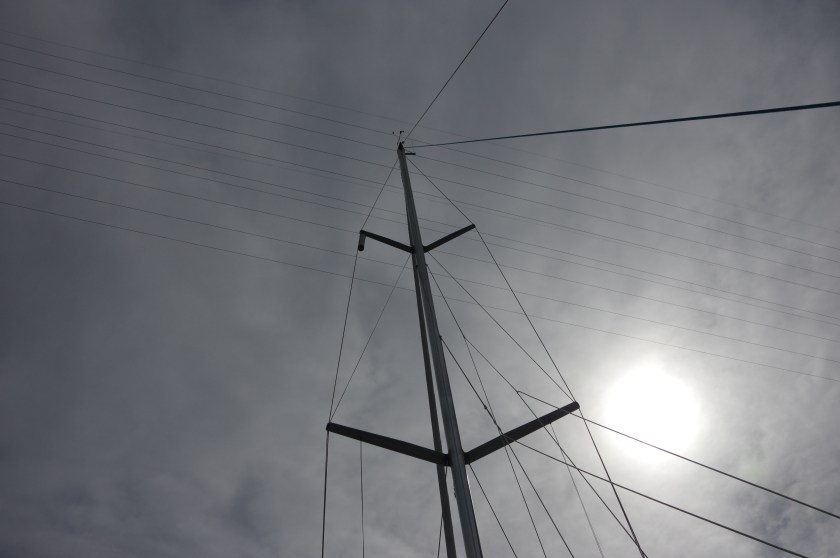
Along with the treacherous shallow areas, you must also pass under powerlines at one point. Tom was concerned he might have to wait until the tide dropped a little before attempting to pass under the lines. Mary Claire has a mast height of 21m. The official clearance distance of the lines, allowing for arc distance and tide and everything else, is 20m. Not much room for error.
Our mast going under the powerlines
We approached the lines first, having a mast height a few metres less than Mary Claire. We soon realised we could have almost doubled the height of our mast and still had safe distance. Mary Claire also passed under with oodles of clearance. Big sigh of relief from Tom and Patricia, I’m sure! We were glad we didn’t have to wait for the tide to start dropping before attempting the pass, as with it still rising, we had some leeway to get off again if we had run aground.
Beyond the powerlines the waterway opens wider with deep areas but there’s still plenty of shallow sections to avoid.
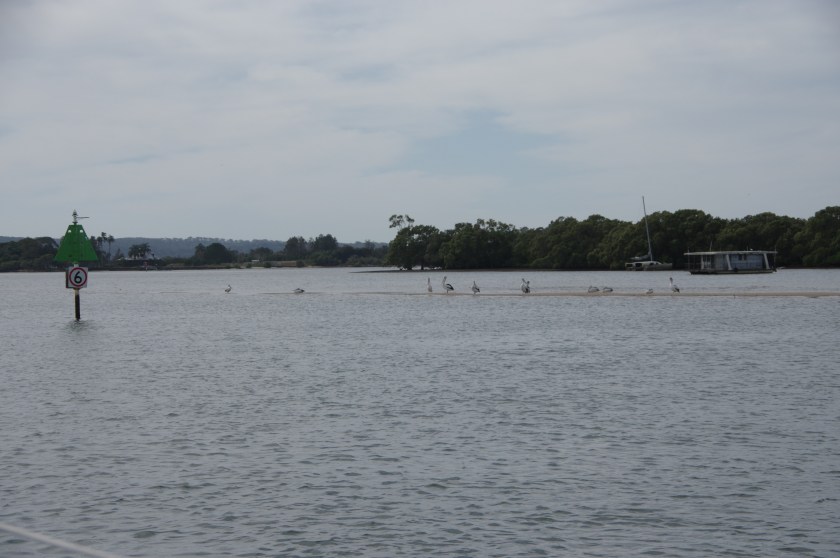
Pelicans line the sandbanks, beady-eyed sentinels witness to our passing. Ferries ply the waterways between the sparsely populated islands, and lone fishermen cast lines from their tinnies. It’s a slower pace up here; placid and serene.
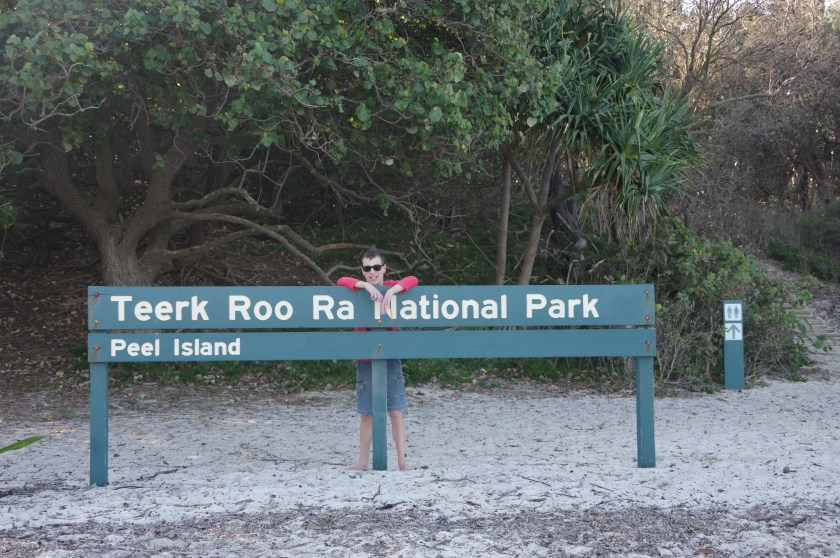
Once through the waterway, we anchored off Peel Island in Horseshoe Bay. Peel is roughly shaped like a young girl in a long dress that kicks out at the back as she walks. The gentle fall and curve of the dress from neck to floor forms the bay. (Not really very horseshoe shaped, if you ask me.) The island is low, and the bay has a long narrow beach. It’s part of a national park, and there are some basic facilities and a camping area, but you can’t have a camp fire. Once comfortably anchored, we went for a walk on the beach and investigated the campsite. Interesting how there’s always evidence of a campfire right next to the ‘no campfire’ signs. Afterwards, we had a pleasant Happy Hour aboard Mary Claire.
On Saturday we weighed anchor and headed to Raby Bay Marina, tucked up in the canals of Raby Bay. The marina is in a great spot, near a vibrant promenade area with bars and restaurants, a nice park and very close to shops and all amenities. We were surprised to discover the marina had no laundry, (and you can imagine Jamie’s consternation!) but then it wasn’t really set up for cruising people. I think most of the berths are owned and used by locals, with few casual berths. We were right on time for the monthly twilight markets too. Raby Bay was a great place to catch up with several old friends over some great meals. It was fabulous to catch up with Colin and Noelene, who moved up from Canberra some years ago and live right on the canals. Col is a keen sailor and is crossing Wide Bay Bar a day before us, taking his boat up to the playground of Harvey Bay for a while, so there’s a chance we may catch up with them again.
We finally tore ourselves away from Raby Bay. It’s very easy to become settled in a marina, with everything you need right there (even a friend who’ll let you use their washing machine!). We planned to go over to Moreton Island but the wind was up a little and on the nose, so we found ourselves at Peel Island again for the night.
It pretty much took us the whole day to sail up to Tangalooma on the western side of Moreton Island. Moreton Island is mostly national park, and is a playground for four-wheel-drivers, being like a mini Fraser Island with long sandy beaches to drive on, many places to camp and some dramatic sand hills. It’s close to Brisbane and the Gold Coast so easy to access. You can get your car there by ferry, or you can sail, like us. On the western side of the island at Tangalooma is a pretty extensive resort as well as some private housing.
Tangalooma, Moreton Island
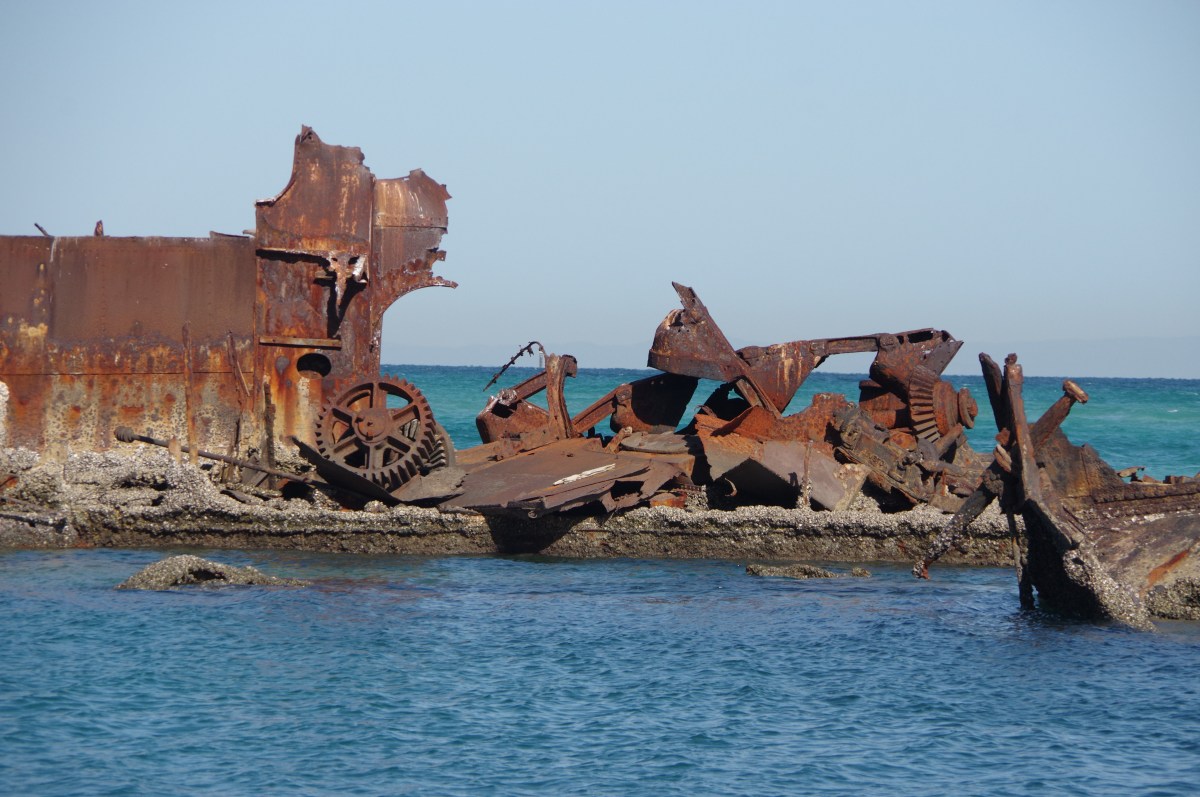
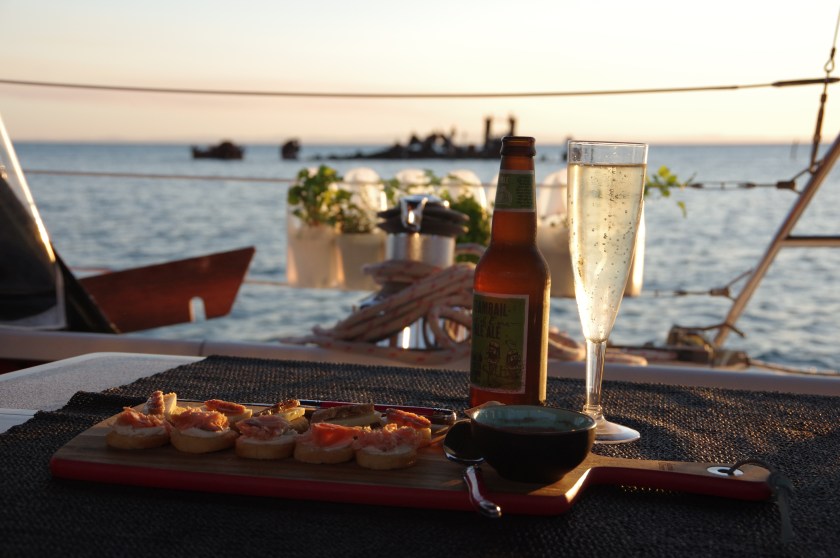
There’s the remains of an artificial harbour at Tangalooma, north of the resort. Some years ago, a bunch of old vessels were scuttled in a line to create an artificial harbour. When we last anchored here, ten years ago, the vessels were still in pretty good condition, and we’ve got a great photo of the sun setting behind the bucket conveyor of an old dredge. The harbour was never considered effective. Time and tide have not been kind to the old steel vessels, and they’re fast rusting away. The sunset photos may not be as dramatic this time, but we certainly enjoyed watching the day end over the rusting hulks; warm breeze, drinks in hand, enjoying the rewards of another successful day sailing.
Next morning we were away by 8am, heading for Mooloolaba. Shipping channels lead to and from Brisbane Harbour and they were very busy that day, with various cargo carriers, bulk carriers, car carriers and dredges manoeuvring through the narrow channel, so we certainly tried to stay out of their way. We were treated to the sight of the US Aircraft Carrier Reagan and an impressive US Destroyer carrying Osprey aircraft (amazing aircraft, worth a Google if you’re interested in that sort of thing) heading out after the Talisman Sabre exercises.
We had a quick chat to the captain of one of the almost-kilometre-long container ships, to make sure he wasn’t going to get in our way as he passed us and the US Destroyer in the narrowest part of the Spitfire Channel. Ho ho. But seriously, it’s nice to know there are people keeping a look out of those massive vessels, and we are all just a radio call away.
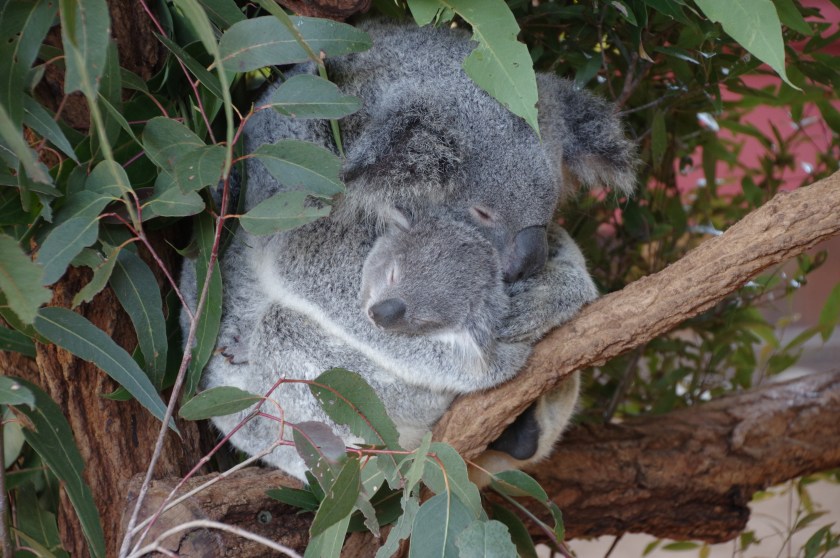
Mooloolaba! With plans to make it a Big Jamie Day, we took a berth in the Mooloolaba Marina and went to bed pretty early. We had a HUGE day at Steve Irwin’s legacy, Australia Zoo. We were extremely impressed when we went to the zoo ten years ago and not a lot has changed. The staff are all polite and knowledgeable, many of them roaming the pathways with an animal in hand. Jamie, who acts like he’s going to get electrocuted if he attempts to pat a cat or dog, ASKED to pat a blue tongue lizard, and a snake!!! He also remembered seeing the komodo dragons last time, and wanted to see them again. So maybe he has a thing for reptiles. He most certainly did not get that from either of his parents.
We were disappointed not to see any elephants this time. Jamie was lucky enough to hand-feed one last time. Not sure what happened with them… Their enclosure is used for Segway tours these days. We spent the day covering every exhibit in the zoo, and enjoying the many shows. Always love the bird and croc demonstration in the big Crocoseum. One of the newer exhibits is Bindi’s Island, where you can do a walk-through with the lemurs. That was a bit of a highlight for me, although Jamie put them in the ‘scary domestic pet’ category and didn’t want a bar of them. Graeme particularly enjoyed the talk on the giant Aldabran tortortoises, and also enjoyed our time patting and feeding the kangaroos. The tigers are also very impressive, the young cubs with paws the size of dinnerplates, who, when stretched full length are taller than their handler. Imagine being that big and being able to run up a post holding on only with your nails. Jamie has just told me he liked seeing the giraffes, the otters, the kangaroos, and patting the koala and snake. All in all, a great day. We covered 15km on foot and came back to the boat exhausted.
Seriously, could there be anything more adorable???
The alarm went off today at 0600. Yep, even on holidays we have to get up early sometimes. And the reason we leapt out of bed this morning? – the good ‘ol Wide Bay Bar. It is around 55 nautical miles from Mooloolaba to the Wide Bay Bar (bottom of Fraser Island). We need to arrive at the bar on the latter part of a rising tide, so around 1630. Giving ourselves an average speed of 5.5 knots (allowing for very light winds and the need to motor at times) we estimate it will take 10 hours to get to the first way-point of the bar. That means departing Mooloolaba at 0630, with a little time up our sleeves. So, there’s method to our madness.
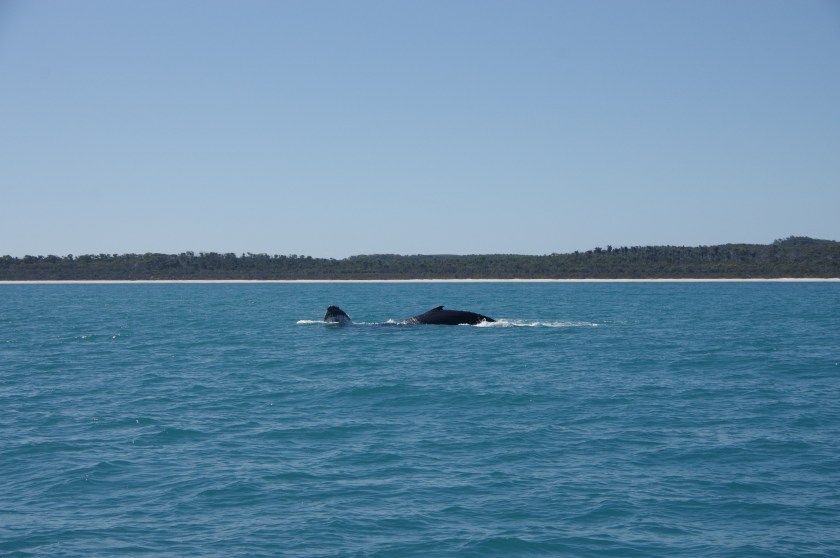
It is a lovely day on what is now a glassy sea. Graeme managed to catch a photo of one of the whales. Sorry, its blurry, but normally we get the camera out after all the action, so we’re pretty pleased we managed to get this at all.
The Wide Bay Bar is the most notorious bar on the entire east coast of Australia.
In my previous blog I reported that we were sitting in a protected anchorage in Salamander Bay (Soldiers Point) expecting the weather to get nasty. Nasty it got. For the next few days, weather conditions ‘outside’ (at sea) were hazardous. There was a big low over the Tasman, towards New Zealand, which was pushing up large swells accompanied by strong winds. Seas and swell combined were supposed to give a total wave height of around 3-5 metres. Definitely not seas for the faint hearted, or for us fair-weather sailors. So, we stuck it out in Port Stephens, twiddling our thumbs. By land, there’s probably heaps to do in Port Stephens when the weather is yucky. When you’re in a boat, and you’re at the whim of the weather, it’s more important to be in a safe, comfortable anchorage than it is to get to the shops or hit the nightspots.
The day after our arrival in Port Stephens dawned surprisingly warm and sunny. We headed back to shore to stretch our legs. I found a geocache at an interesting spot – an historical old well (spring) that once provided water to ships from many parts of the world. The water was said to have extraordinary keeping qualities, remaining fresh long after other water had turned. Anyway, it was a nice diversion and allowed for a good wander.
Shortly thereafter, Graeme decided to study the thermal qualities of the water and took a short swim. Turns out its slightly warmer than McCarrs Creek. That’s all I’m allowed to say. Don’t even ask. I wrote more, but it appears to have been redacted.
That afternoon we pulled up our (very muddy) anchor and decided to check the conditions over at Nelson Bay. Well, turns out our little anchorage was very protected. Conditions just crossing the Bay were pretty nasty, and we knew Nelson Bay would be untenable, so we retreated back to our spot. Oh, and we were the ONLY boat out there on all that wide bay. That’s saying something.
We did eventually get to Nelson Bay, and enjoyed dinner out. The most exciting thing for Jamie was being able to do a load of washing in the marina laundry! We planned to return the following day for more fun and frivolity, but by early morning the wind had shifted and we were bouncing. It wasn’t viable to stay on the courtesy mooring any longer, so we headed over to Fame Cove; the pick of anchorages in the Port Stephens area. We found ourselves a mooring in a lovely sheltered spot, enjoyed a dinghy safari into North Arm and revelled in the warmth and gorgeous conditions. That evening, we triple-checked the weather forecast and decided we could finally resume our journey north the next day.
Heading out of Port Stephens on Sunday morning proved a little more challenging than we’d hoped. We’ve never really thought Port Stephens had a bar, but we’ve changed our minds. The breakers on the shoals were an impressive 3-metre break that would run along the shoal for about half a km (surfer’s dream!) and certainly showed us where NOT to sail. We headed out on the leads which took us surprisingly close to some of the breakers and even on the leads the swell had picked up and we had large steep (scary) waves of around 4 metres. And the wind was right on our stern, at 25 knots. Not quite the benign conditions we were expecting! We had to gybe (where the wind goes around the back of the mainsail and the boom suddenly flips to the other side with a big whoomph) to change direction. The first time our controlled gybe went very well and Graeme was praising the boom break – the device that helps to control the rate of the whoomph. (Sorry about all the technical terms!) The second time we attempted a controlled gybe, we managed to rip an 8mm solid steel bale right out of the boom – bent it almost in half. That meant Graeme had to go out onto the deck in those conditions (lifejacket and tether on) to get the main down and under control. I had to try and steer the boat into the wind with current and winds trying to draw us towards a rocky end on Boondelbah Island. The adrenalin was pumping. After getting the main in, Graeme had to get the boom under control (which was flopping about, threatening more damage). He tied the boom in place and jury-rigged a sling around the boom to replace the bale. Once finally under control, with Graeme safely back in the cockpit, our heart-rates settled down to an acceptable rate. We set a course to avoid the other islands in the immediate area and found a comfortable motion for the boat. The swell dropped to a reasonable 2-3 metres. Our log for the day shows conditions being alternately ‘sloppy’, ‘bouncy’, ‘choppy’ and ‘rolly’, averaging speeds of around 5 knots when the wind died to nothing. Later in the evening the log shows conditions going from ‘not bad’ (a nautical term) to ‘good’. We saw one other sailing boat that day, heading south.
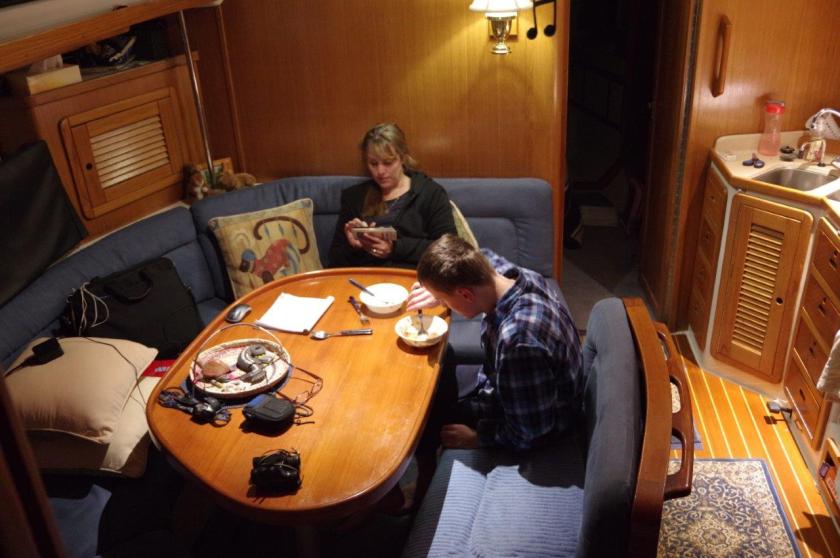
Typical scene in the saloon.
No one got much sleep that night. Sometimes it takes a while to settle in and feel comfortable enough to rest when you’re off watch. Jamie wouldn’t rest unless everyone else was resting. Which wasn’t possible. From about 2100 Jamie was asking if the sun was coming up soon. Even though conditions were great, it was a very long night. I was on watch as the sun came up. There’s something quite special about being out at sea on watch alone and witnessing the sunrise over the ocean.
It was an absolute delight at sea that day, although there could have been more wind – we had to do a lot of motoring. We had tentatively planned to go into Coffs Harbour but with such great sea conditions we decided to continue northwards. That evening, conditions were flat enough that I could cook a meal from scratch. We enjoyed a creamy sundried tomato, chicken and pasta dish. Conditions remained fabulous throughout the night, with all of us getting good blocks of sleep (probably from exhaustion!) and Graeme was on watch for another magnificent sunrise.
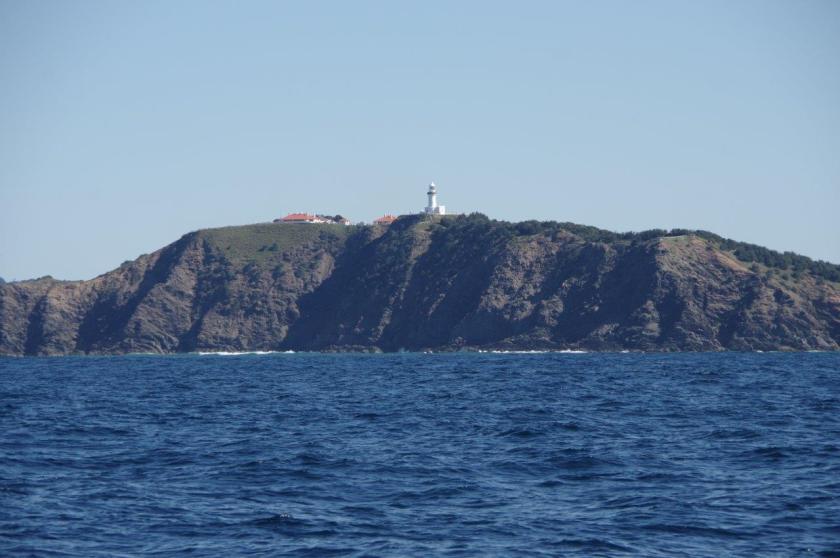
Rounding Cape Byron – Australia’s eastern-most point.Jamie in ocean camo eating breakfast. Can you see him?
It was a day of whales as we edged ever closer to the Queensland border. We watched one whale breach four times in a row, and many others tail slapping or just cruising along. We think we’ve missed them before as we were too far out to sea, and the whales seem to stick fairly close to shore. Not sure why that is?
The jutting towers of Surfer’s Paradise came into view on the horizon as the sun began to set. We all started to feel a bit of excitement, knowing we were going to be reaching our destination and sleeping at anchor that night. We crossed the bar around 2000, (full dark) having to dodge the numbnuts fishing right in the middle of the narrow channel.
The Gold Coast towers against a sepia sunset. We’re almost there!
Ah, Southport! The Gold Coast! What a shock to the system after spending three days alone at sea. Helicopters passing by close overhead, jetboats, jet skis, tourist charters, bright lights, tall buildings, people everywhere – it’s all happening here! But we’re safe. We made it. Celebratory banana pancakes with lashings of maple syrup for dinner, then showers and a bed that wasn’t moving. Ahh. Bliss. Sometimes it’s the small things in life that give the greatest pleasure.
Update – Thursday 27 July: We’ve caught up with some Cruising Club members, and my old friends Deb and Loz. A wonderful evening with them on the boat last night, watching the sun set and the coloured lights spangle across the water over bottles of wine and fresh prawns. More socialising today (shopping, lunching) with Deb. She’s an inspirational woman and I cherish our time together. Meanwhile, Jamie and Graeme went to find the laundromat (bit of a first for Graeme – lucky he had Jamie to show him what to do!) more to appease Jamie’s desire to do washing than for any pressing need! Funny, I would have been wanting to hit Sea World, but our boy has other priorities, it seems.
We’ll be out again this evening with Deb and her family. She’s even told Jamie he can do a load of washing in her machine, so a pretty great day for Jamie too!
We plan to leave tomorrow morning (Friday) and head up the inland passage to Moreton Bay, followed by Tom and Patricia in their beautiful new Bavaria (whose name I won’t mention as I can’t be sure to get it right). There are more club members and land-based friends just a little further north, waiting to catch up.
And so the journey continues.
Thanks for reading! We appreciate all your comments and are delighted to see we have even gained some ‘followers’. It’s wonderful to be able to share our adventure with you.
Preparation leading up to our departure for our trip north was nothing short of monumental. When you’re leaving home for four months, there’s a lot to take into consideration. Countless ‘To Do’ lists later, which included many modifications, upgrades, clear-outs and additions to the boat, organising Jamie’s extended leave from school and his schooling supplies, putting together a comprehensive first aid and medical kit, haircuts, stowage diagrams, work hand-overs, and much more, we finally reached a point of near readiness. Here, then, begins a blog of our latest adventure. (If you’d like to read more about our boat, please see the previous blog post.)
On Saturday (15 July) we finished jobs and loaded stuff onto the boat. There’s always a worrying few moments where you’re wondering where on earth everything is going to fit, but it eventually finds a home. Sunday, I ‘spring cleaned’ the house as we loaded the final bits and pieces into the car. Having mused on my need to leave the house spotless, I have concluded that cleaning is part of my mental preparation for both being away from home for an extended period and heading outside my comfort zone (going to sea).
Cutting a boring story short, (sorry, I’m not known for my brevity) we were finally ready to move aboard. Graeme took the car and trailer home on Monday morning and his mum gave him a lift back down to the creek, via Whitworths and Bunnings.
Uncle Brian came down to see us off, so we had a huge farewell party (OK, a cup of tea with some rockin’ choc chip cookies), then Graeme took his mum and uncle back to shore. This should have been a fifteen-minute exercise.
The first unexpected event occurred when Graeme failed to return from dropping off the last of our partygoers. Time went by. I started to worry. Had someone fallen in? Taken ill? Needed to desperately return to Bunnings or Whitworths for one last thingamabob? I tried his phone. It rang. Downstairs. On the boat. Not with him. Now what? He’s got the dinghy. I couldn’t exactly go looking for him. During this time, I briefly glimpsed a dinghy hanging off a friend’s boat further down the creek about 500m away. When we’d gone past earlier, they hadn’t been there. Could Graeme have dropped in for a cuppa and a very long chat? The boats drifted around and the scene was lost from sight. Around this time, I also noticed a Maritime boat slowly patrolling the area. Really s l o w l y. Hmm. Graeme hadn’t worn a life jacket…. Perhaps he was visiting our friends waiting for Maritime to leave so he wouldn’t be busted for being non-compliant? More time passed. Just as I was thinking it might be worth trying to phone someone, I saw a small shape bobbing through the water towards me. It was Graeme’s head. He was swimming. In the middle of July. Nice day for a dip, hey?
Climbing aboard, clad only in some seriously saggy purple undies, he explained he’d been hanging around on our friend’s boat waiting for Maritime to leave. But they didn’t. Having no way to contact me, and with no other creek friends happening along to help, he’d decided swimming was the only way. He wasn’t cold while he was swimming – and it was a 500m swim, at least – but his temperature soon dropped once he stopped. He rugged up, teeth chattering, and I poured warm sugary tea into him. It took him quite a while to recover. No phone. No lifejacket. No brain?? Some lessons learned today, methinks. (Graeme wanted me to tell you he’s so tough he swam back and collected the dinghy once Maritime went away. Not true. I have a kayak on board. I put on my life jacket and paddled to the dinghy, then towed the kayak back.)
So, departure wasn’t looking imminent. Fuel tank still needed installing. Someone still needed to go up the mast and install the anchor light. And we needed fuel and water. And there was still stuff to stow and batten down. And it was now late afternoon.
We decided to head over to the RMYC for our fuel and water. They don’t close the fuel wharf until 5.30pm even on a winter week day, so we were grateful for that.
Without any further mishap, we pulled up alongside RMYC and began the process of refuelling and filling our water tanks. Tim stopped by to say hello (a friend with a stink boat, Papaya – don’t worry, he’s a good bloke). That was unexpected! And Lynne from Cruizen, a Cruising Club friend with a proper boat, happened by, calling out our names. Also, unexpected. Lynne and Tim had just met, and conversation led them to discover they both knew us. Tim reckons he’s going to buy her beautiful Buizen sailing boat one day to do some real cruising. See, I said he was a good bloke. We conversated. We were thinking we’d head over to Coasters Retreat (the Basin) for the night, get acclimated (it can be pretty rolly there) then head out in the morning. It was Tim that suggested, given outside conditions were good, that we just go. Just go? What, now? Head out to sea? In the dark? Now???
Yep.
So that was unexpected. Not that we haven’t done this sort of thing before. But still! Our first log of the trip is recorded as 19:45. (We had a small dinner, tidied up, and battened down first, so nothing too impulsive.) After getting through the heads, and yes, everything looks different at night, we basically turned left. Graeme took first watch and I tried to have a rest with Jamie. Everything started out OK. Slight seas to start, and no wind, so we were just motoring, then, in Graeme’s words, seas from the north kicked in and there was a lot of spray and it got a bit bouncy. Graeme put some sail out to keep us steady and had to change direction a few times to get a reasonable motion. Me and Jamie weren’t getting much sleep at this point.
Graeme logged on with Marine Rescue Sydney for coverage up the coast. He spent much of his watch listening to music and watching the stars. Occasionally he’d look for sea traffic too. We are ever grateful to our AIS system, which shows ships on our plotter. We can see which way they’re going, what speed, their call sign and other information. Most importantly, we get alerted if there’s any chance we’re going to bump into each other.
I relieved Graeme for the graveyard shift – from around 0200. The moon had risen around midnight; a perfect lemon wedge. The seas had quietened down. Moonlight across smooth seas is a heartening sight. It was cold in the cockpit but not lonely. I had the moon, and I had plenty of visits from Jamie, wondering if we were there yet. No wind, so we motored along. I sat for a long part of my watch on the princess seat starboard aft and watched a light show on the eastern horizon; orange flashes of lightening like firework bursts. I couldn’t hear any thunder, so I figured the storm was too far away to offer any threat. I took my leave with the arrival of Homer’s rosy-fingered Dawn.
Graeme took the watch, sighting pods of whales from 0645 onwards. They’re heading the same way as us – North to warmer climes.
We came into Port Stephens around 1000. Once through the heads the harbour opened up, silken waters under a clear blue sky.
We logged off with Marine Rescue Port Stephens and anchored – first time with the new Rocna – in 12 metres off Wanda Wanda Beach, in Salamander Bay. Probably deeper than we’d like but we have a lot of faith in the new anchor, and need to keep clear of the moored boats, especially if the weather blows up like it’s supposed to do.
Well, it’s been a glorious day. Mid-twenties and warm in the sun. Starting to feel like we’re on holidays! We’ve done a spot of shopping, had a Drumstick, wandered along a beach and headland track, and now we’re settling in for an uneventful evening. Managed to capture a pretty impressive sunset, although I’m not sure the red bodes as well as the sailor’s saying tells us.
The weather is due to turn quite nasty for the next few days, with strong winds and big seas predicted, so we’ll be keeping a close eye on the forecasts and observations and staying holed up here until conditions improve. As I finish writing this, the wind is already making eerie sounds through the rigging, lines are starting to flap against the mast, and Symphony is sailing about on anchor. Yep. Here it comes.
With many thousand nautical miles under our collective belts, the crew of Symphony is getting ready once again for an extended trip away. In mid-July, 2017, we’ll weigh anchor (OK, drop the mooring), set the sails, check the compass heading and sail off into the sunset. Er, well, not exactly. The sun sets in the west, last time I looked. If we leave Sydney and head west… we’ll hit land. So we won’t be sailing off into the sunset just yet. The Skipper is probably fairly relieved to discover I know my compass points, as he’ll be leaving me on watch for hours at a time and will want to sleep with both eyes closed, I’m guessing.
It makes sense to tell you a bit about Symphony before we go any further (in the blog, not the boat. We haven’t left yet!) Symphony is a Catalina 42 Mk 2. For those who already know our boat (or know boats, in general), you might as well skip to the next blog. This is just a warm up! But for the landlubbers amongst you, this will give you some idea of our ‘floating accommodation’ for the next four months.
Symphony was launched in 1996, so she’s got a few years on her, but like most 21-year-olds will tell you, she’s pretty cool and has awesome fashion sense. We like the way the Catalinas are built, and many have successfully crossed oceans and circumnavigated. (The featured image shows us coming into Panasia, an island in the Louisiade Archipelago, Papua New Guinea, in 2013.)
Symphony is a sloop, (one mast), is 42-feet long (almost 13 metres) with a beam (width) of almost 14-feet (more than 4 metres). She has a large cockpit (with gas BBQ), which can seat around 10 people comfortably, a spacious and comfortable saloon, which can seat 6 or 7 people for dinner, three double cabins, an in-line galley (with double sink, 3-burner stove/oven and fridge), two heads (bathrooms), and a nav-station with lots of screens and buttons. Symphony is powered by a Yanmar 50hp inboard engine. She has a bank of batteries, solar panels and a wind generator to supply the boat’s many electrical systems. Up forward, we’ve got a Rocna anchor (25kg) and about 100 metres of chain.
We find she has a kindly sea motion and we enjoy her many creature comforts. Our average cruising speed is around 6-7 knots, which is equivalent to 11-13 kms per hour. You can’t run faster than this, but you could beat us on a bicycle! So, to give you a better idea, while it will take only a couple of hours to drive from our place in Sydney to Port Stephens (a distance of 185kms), it will take us from Pittwater about 14 hours to sail at our average cruising speed.
It is all about the journey, not the destination, haven’t you heard?




















 Next morning we were away by 8am, heading for Mooloolaba. Shipping channels lead to and from Brisbane Harbour and they were very busy that day, with various cargo carriers, bulk carriers, car carriers and dredges manoeuvring through the narrow channel, so we certainly tried to stay out of their way. We were treated to the sight of the US Aircraft Carrier Reagan and an impressive US Destroyer carrying Osprey aircraft (amazing aircraft, worth a Google if you’re interested in that sort of thing) heading out after the Talisman Sabre exercises.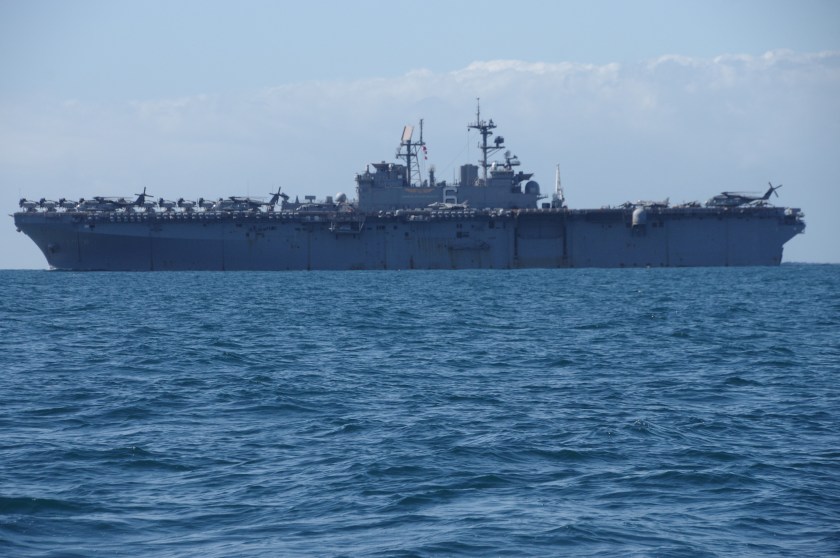






 Symphony in Sea