‘Lectronics, Lunatics, and Lunar Eclipses

(Or… Mooloolaba to Bundaberg)

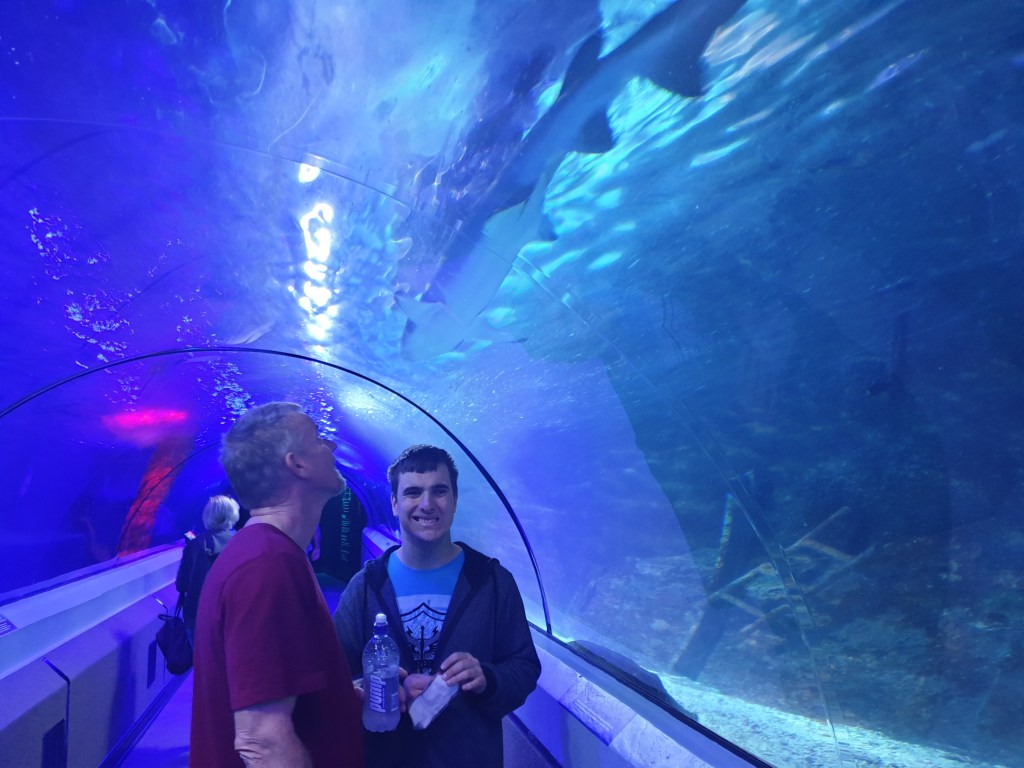
The day came to depart Mooloolaba for Bundaberg.  We had filled in our time with an excursion to the aquarium (a taster of what we’ll see out at the reef!), fish n chips (what we’ll eat at the reef – hopefully!), shopping, and Jamie even got to have a go in one of the Sail-ability boats right near the marina.
We had a weather window that showed relatively calm conditions at sea, but it was due to close on the Thursday with very strong winds (‘dangerous and powerful surf conditions’) forecast, and seas increasing to 3-metres (yucky).  So, we had to time our exit from Mooloolaba with the outgoing tide, as Mooloolaba is a barred harbour, which meant leaving no later than 0800, preferably a couple of hours earlier.  We set multiple alarms to wake us up at 0430 (ewww, early!) and tried to get to bed early the night before after making ready to depart.  ‘Course, getting to sleep early is easier said than done…

We leapt (yeah, right) out of bed at 0430 and were ready to depart by 0500.  We had the engine running and were ready to cast off the lines when we noticed – no instruments again. 

That’s OK.

Don’t panic.

It’s probably the same thing that happened at Tangalooma – that plug has wiggled itself loose …  Pulled apart the hub on the pedestal… Checked the plug.  Nope.  Graeme had already crimped that plug and it was seated firmly, which was a bit unbelievable.  How could we have two different faults in the same system, so close together?

Feeling some concern at this point…
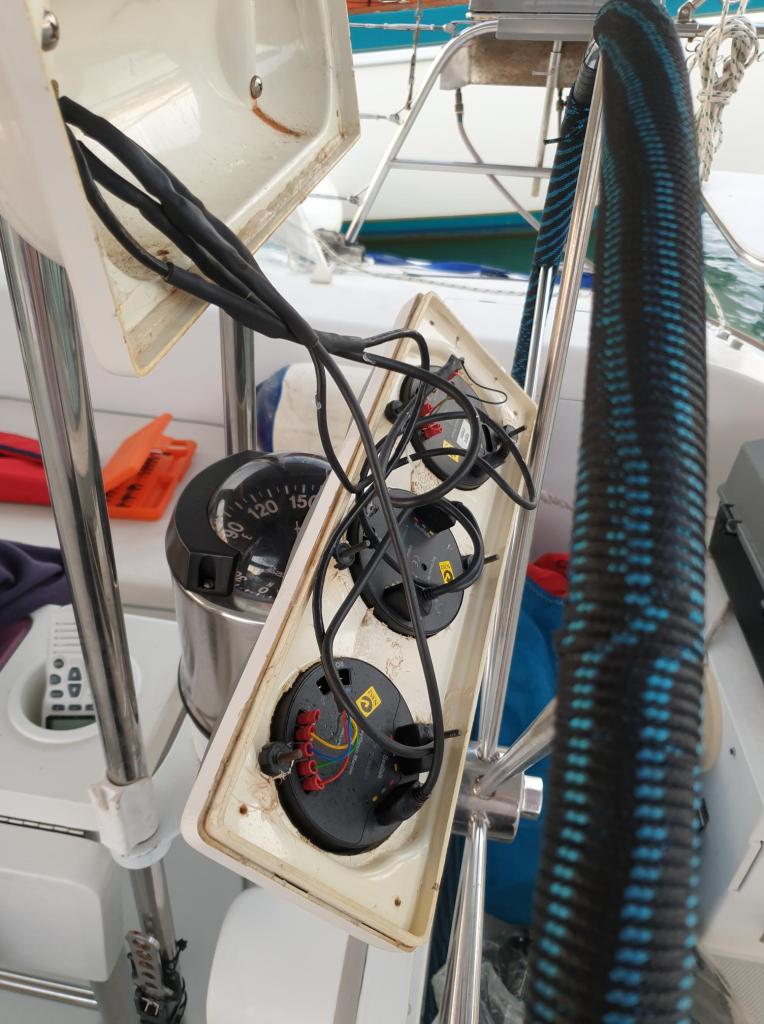
Grae started checking all the things that were easy to check.  He looked at the ‘lunatic’s lunch’ wiring in the junction box.  While it looks really bodgy, there’s nothing technically wrong with it.  Graeme is NOT responsible for the original wiring and has often expressed his desire to get in there and rewire everything and label it and neaten it all up, but that has been waaaaay down the list.  Especially when everything is working.  He then checked behind the plotter, and checked the fuse we had replaced at Tangalooma.  Nothing obvious. 

Feeling the mild butterfly wings of panic.

‘Don’t know what else to do.  I think we’ll just have to go without the instruments.’ 

Huh?  No depth display, no wind display, no speed, no autopilot.  Hand steering for 30-odd hours all the way to Bundaberg?  (Hand steering for long distances at sea is widely considered soul destroying.) 

By this time, it was about 0600.  We had two hours to get this sorted or we would be STUFFED. We’d be stuck until the next outgoing tide in 12 hours, and we would get caught in the destructive conditions coming up the coast.  Or we would have to wait until the next calm weather window, which was maybe due in a week, thus missing the final date of arrival in Bundaberg, and potentially missing the whole rally.

OK. Now I’m panicking. 

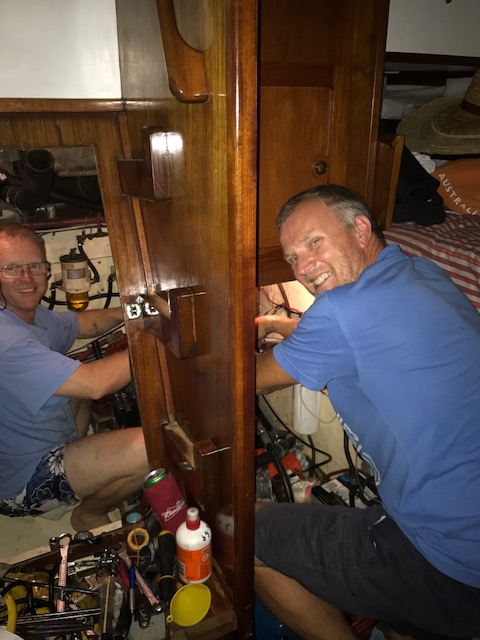
There wasn’t time to engage the help of a professional.  So, Graeme put on his detective hat again (which looks remarkably like a head lamp) and proceeded to examine all the clues.  Opened up the switchboard, where once again the wiring is just a jumbled bird’s nest, unmarked and undocumented.  He then realised he really would need to start tracing the wires; a job that could take a whole day… but he kept at it, hoping for a minor miracle.

What he discovered was that at the back of the boat there was white wire and at the plotter there was a black wire that were doing the same function. There must have been a join somewhere, but there shouldn’t have been.  Found a really bodgy join right in the back of the electrical panel which had had salt water on it, and which literally fell apart in Graeme’s hands.  So, that was great because he had FOUND the problem, but then we had to start fixing it. 

So, wiring, cutting, joining, soldering (all that ‘lectrical technical stuff) and we were finally able to get underway, but it wasn’t optimal.  As we exited the breakwater, there were some large waves rising like the backs of huge watery beasts, threatening to break onto our starboard side.  Fortunately, they didn’t break, and we rode up and over them with our breaths held.

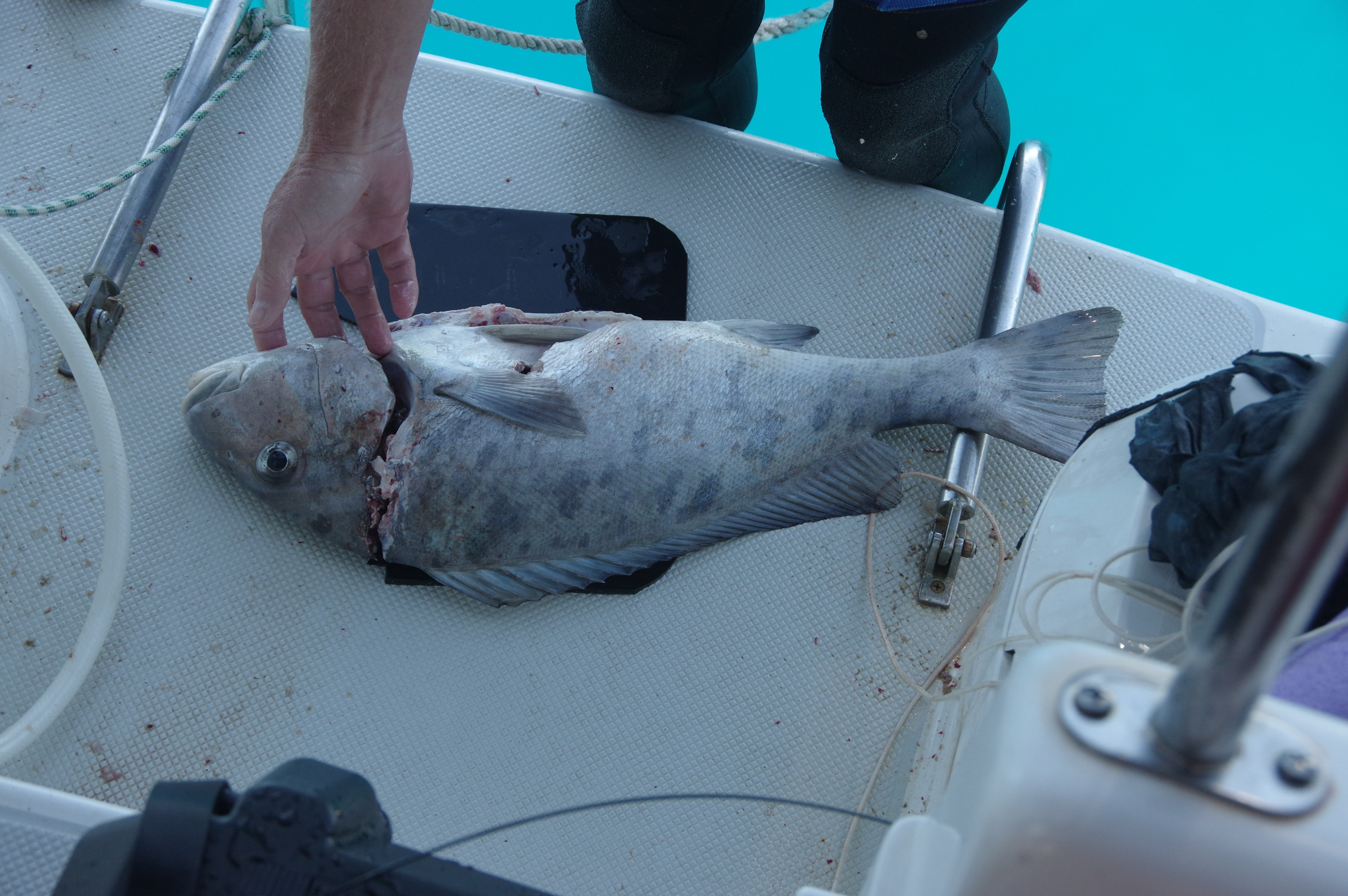
An hour or so out of Mooloolaba, with somewhat rolly conditions (a 2-metre ‘greasy’ swell), Graeme decided to drop out a fishing line.  We have an awesome set up this time ‘round.  We follow a vlog called Free range Sailing, about a couple (Troy and Pasquale) on a 30-foot Clansman (tiny yacht) circumnavigating Australia from Perth the wrong way round.  Troy is quite the accomplished fisherman, and we’ve taken on some of his suggestions such as trolling with a TLD-25 fishing reel on a beach rod, instead of just dragging a venetian blind cord on a hand reel.  An hour later the line went nuts.  The fish put up quite the fight, but we won, and finally got it alongside the boat.  Turned out we had hooked it through the side, then during the fight it had got the line caught around its tail, so we dragged it in backwards!  I could see the iridescent stripes on its side and initially thought it was a Spanish mackerel, but then as Graeme gaffed it and brought it onto the deck, I thought it looked more like a tuna, with its solid torpedo shape.  We got out our fishing identification books and discovered it was a Mackerel Tuna.  I was right!  A mackerel AND a tuna! Didn’t even know such a thing existed.  Unfortunately, they don’t make good eating (unless you’re into sinewy sashimi).  So we threw him back.  We do have proof, however….  Next time, the plan is to catch something edible.

Our next challenge was the Wide Bay Bar.  Those of you who’ve read my previous blog from 2017 may remember that the bar is notorious, due to several factors:

  • Its length (3 nautical miles, so that’s about half an hour of potential terror)
  • It is known for rogue waves (waves that are much larger than predicted)
  • It is open to the sea and, like all bars, is dynamic, with shifting sands and regularly updated (or not updated!) recommended waypoints.
  • It is known for causing carnage. 

We always approach Wide Bay Bar with much respect (one section of the bar is called The Mad Mile, for goodness’ sake!) and WE will only cross in ideal conditions (going in on a rising tide about two hours until high) with no more than a 1.5m swell, preferably much less, and low winds.  For many days, the bar conditions had been unfavourable, with 1.8m+ waves and moderate winds.  Lots of boats were waiting behind Double Island Point for better conditions and some had been waiting for quite a few days.  The whole point of crossing the Bar is to get you in behind Fraser Island into the Great Sandy Straits, a calm, pleasant and attractive waterway for covering the distance to Hervey Bay, with lots of prime anchorages along the way. 

We made the informed decision NOT to cross the Bar this time.  That meant we would be taking the long way around Fraser Island, in the open seas, with an extra 30nm tacked on the top of Fraser as you have to go around a long series of shoals.  We were looking forward to that…

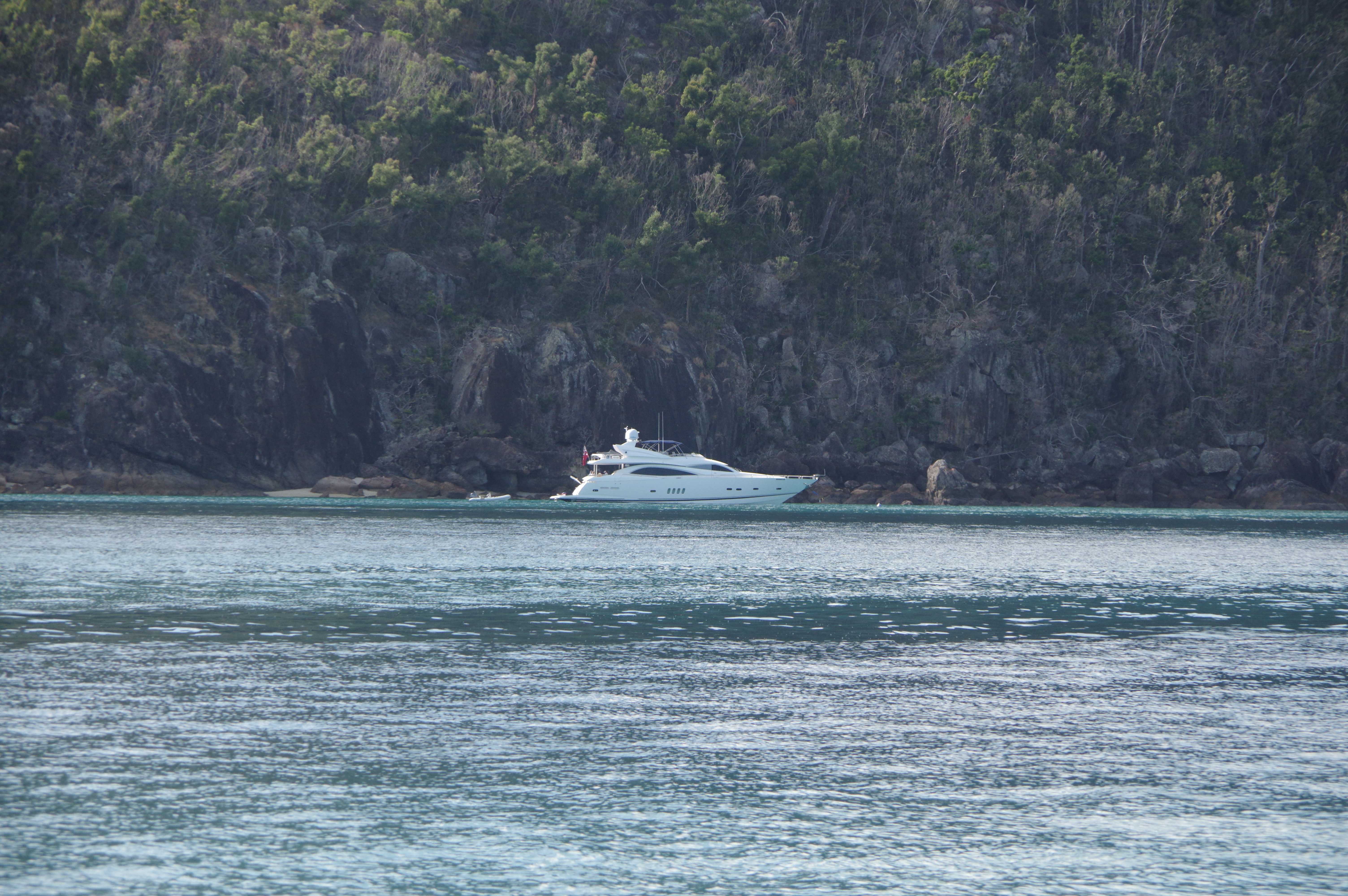
There were several boats following us throughout the day on the way north to Wide Bay Bar.  Two of them peeled off to go and wait behind Double Island Point.  The third (a big powerboat), we were shocked to see, powered straight into the Bar.  They didn’t call Coast Guard Tin Can Bay to get waypoints, did not wait for the right tide (it was a .9 metre falling tide at the time, so a huge likelihood of hitting the bottom and getting stuck there) and did not wait for optimal conditions.  Just WENT.

A short time later we heard Tin Can Bay call up the boat.  ‘Numpty*, Numpty, Numpty (* I made that up to protect the innocent), this is Coast Guard Tin Can Bay.  We just watched you come through the Bar and we have to ask… How was it??’  The reply came back moments later.

‘F*$%^#& SCARY!’

A couple of the more sensible people waiting behind the Point tried radioing the boat for more details, but the lunatic didn’t answer.  Probably busy changing his pants.

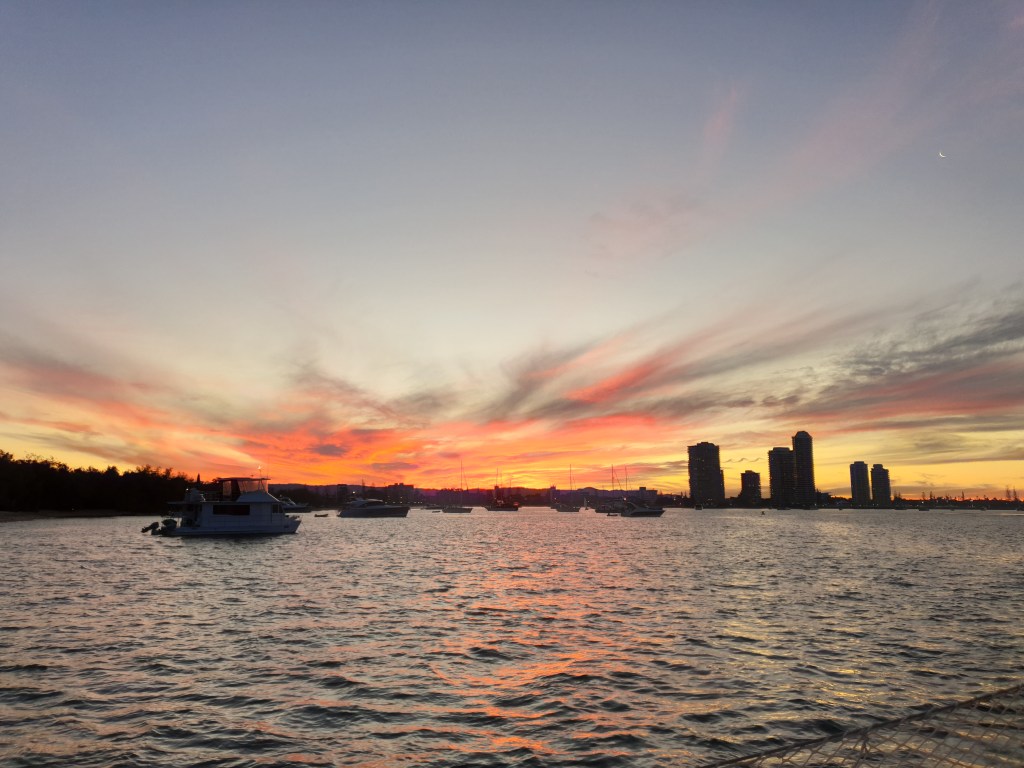
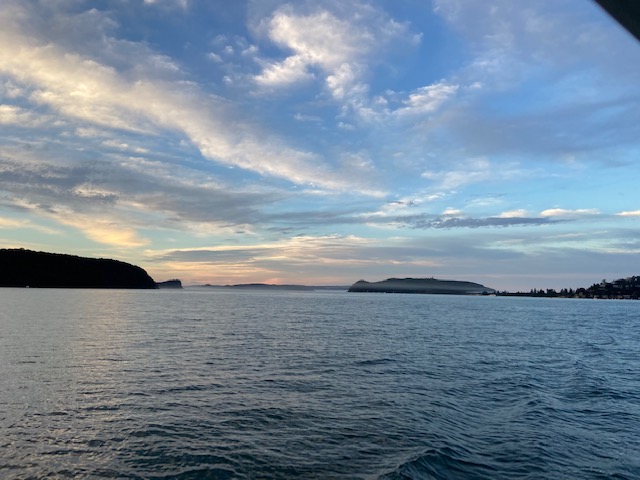
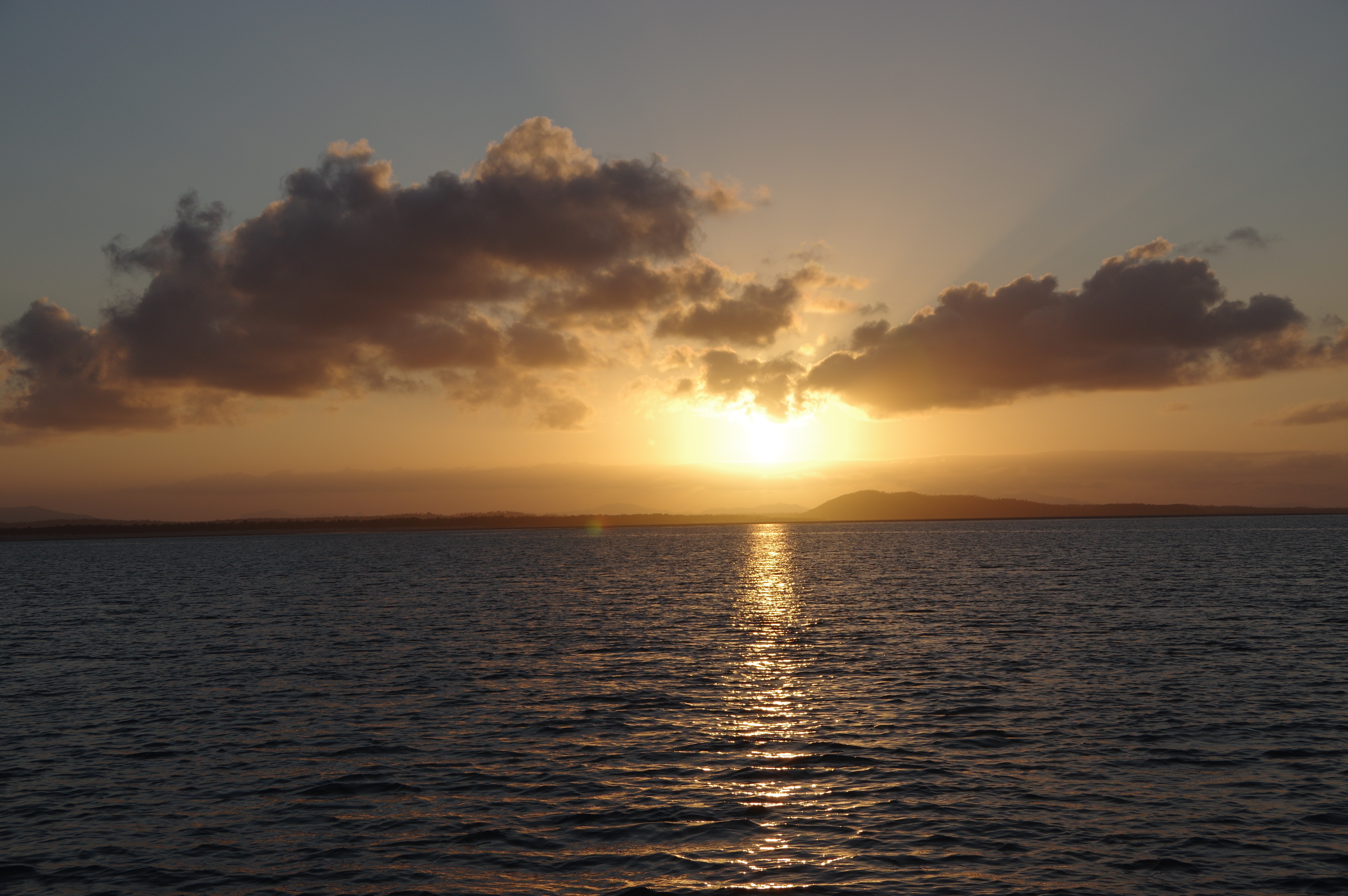
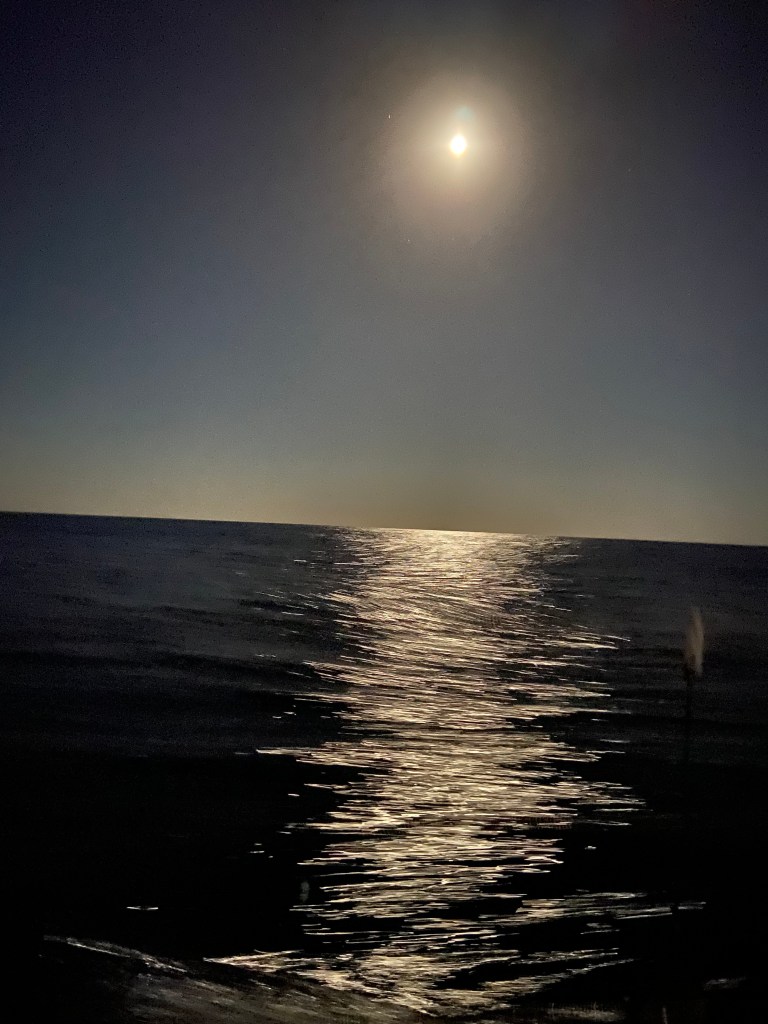
I’m happy to say we had no such dramatic moments.  It was a very long and boring motor-sail along Seventy Five Mile Beach and up the rest of Fraser Island overnight.  The boredom was broken up a little watching the ENTIRE Super Flower Blood Moon Lunar Eclipse.  Sorry, slow shutter speeds do not work on a moving boat, so no photos.  But I did like this one of the silvery path to the horizon… (yes, the horizon is meant to be crooked :P).
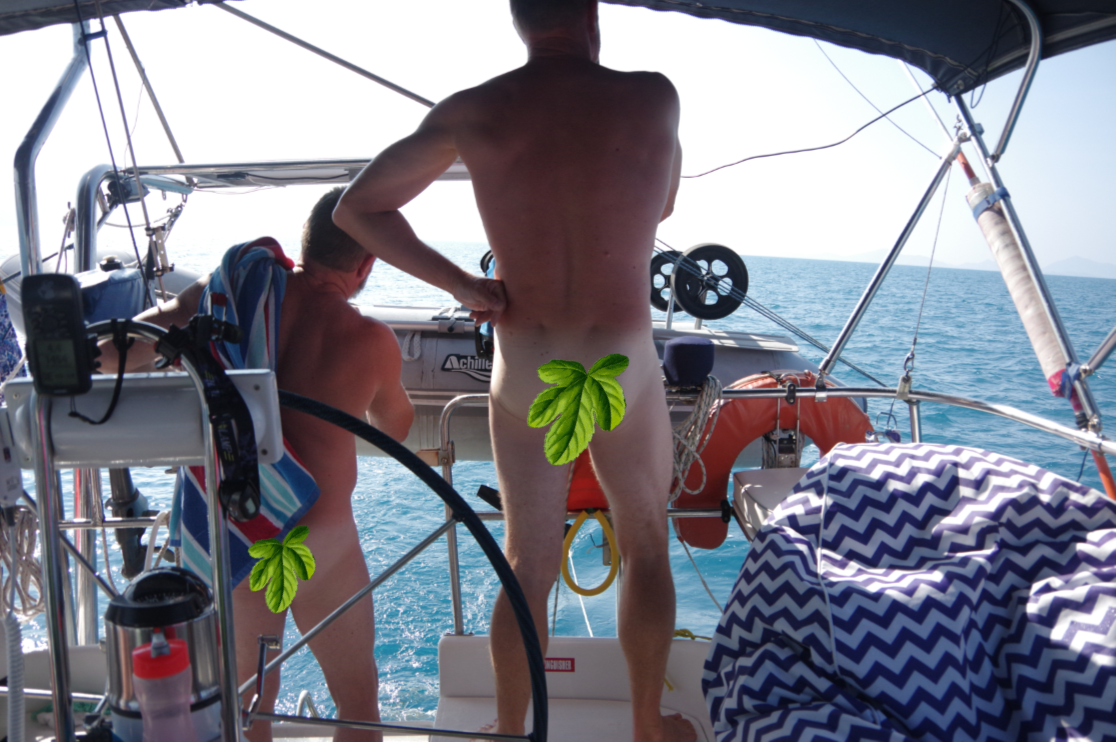
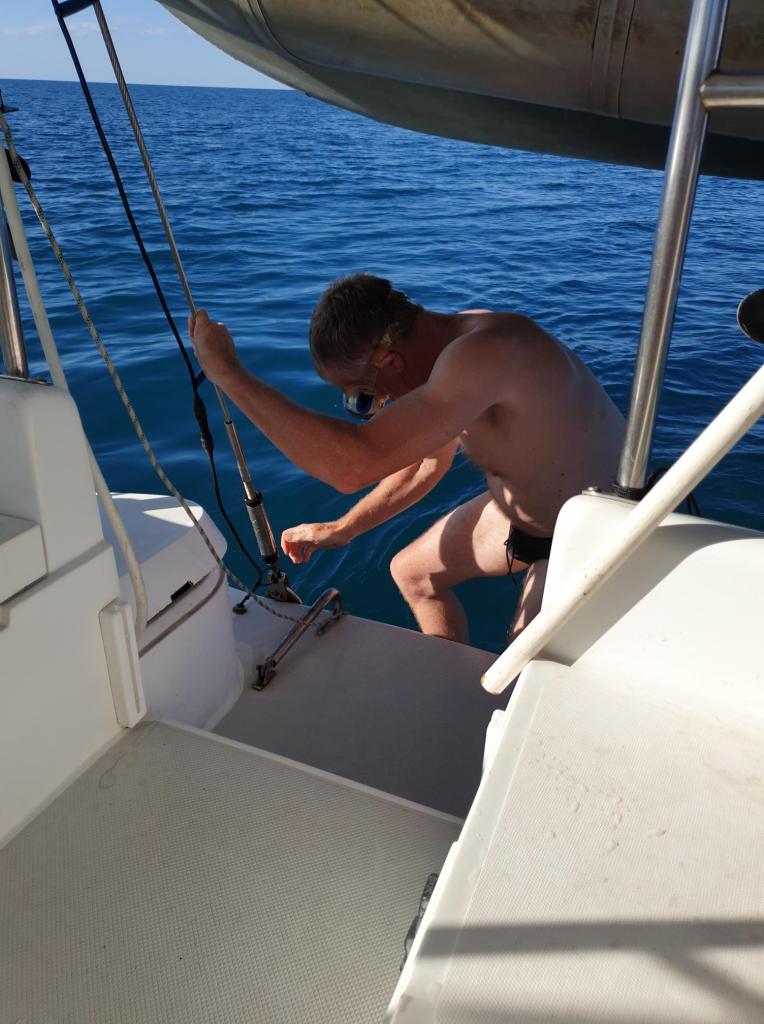
The day was spent crossing Hervey Bay, initially rolly conditions but calming as the day progressed.  Wind was from the wrong direction, so we had problems getting a sail to do anything useful, and something funny was going on, making our speed under motor less than usual for the same RPM.  Graeme put the boat into reverse and late leapt over the back a to make sure there wasn’t something wrapped around the rudder or prop. There wasn’t, but we think putting it into reverse maybe dislodged something, as we went pretty well after that. This little dip in calm conditions led us all to have impromptu showers on the back deck to freshen up after a day and night at sea.
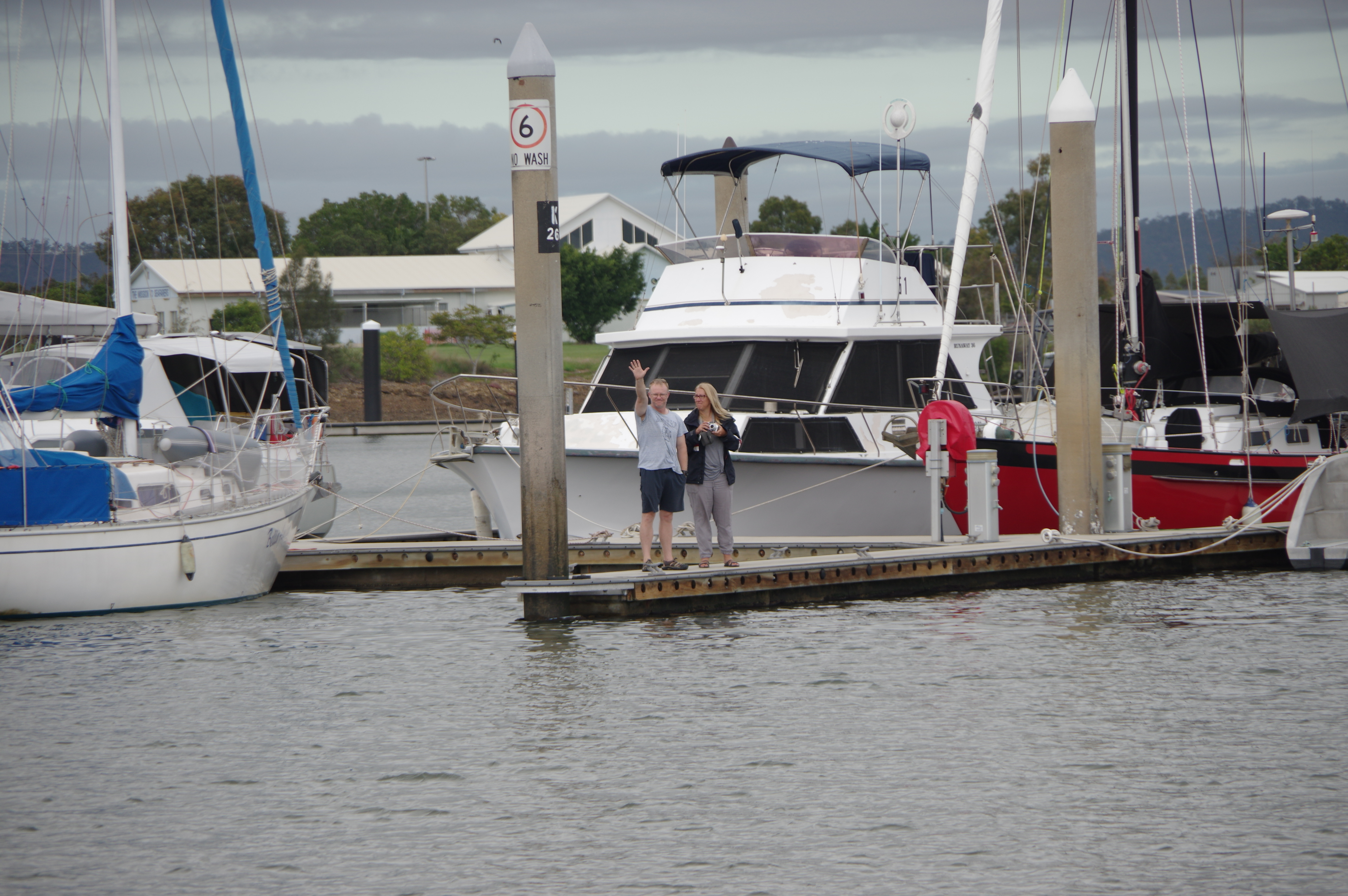
It was wonderful to finally arrive at Bundaberg, our destination on the East Coast, and the starting point for the Beyond the Barrier Rally.  Our friends, Andrew and Lynne, on Mischief,  waved to us from the marina as we anchored in the duck pond for the night.  We went across to their boat in the dinghy – so good to see them!! – and enjoyed a well-deserved Happy Hour, before coming back to the boat for a very early night.
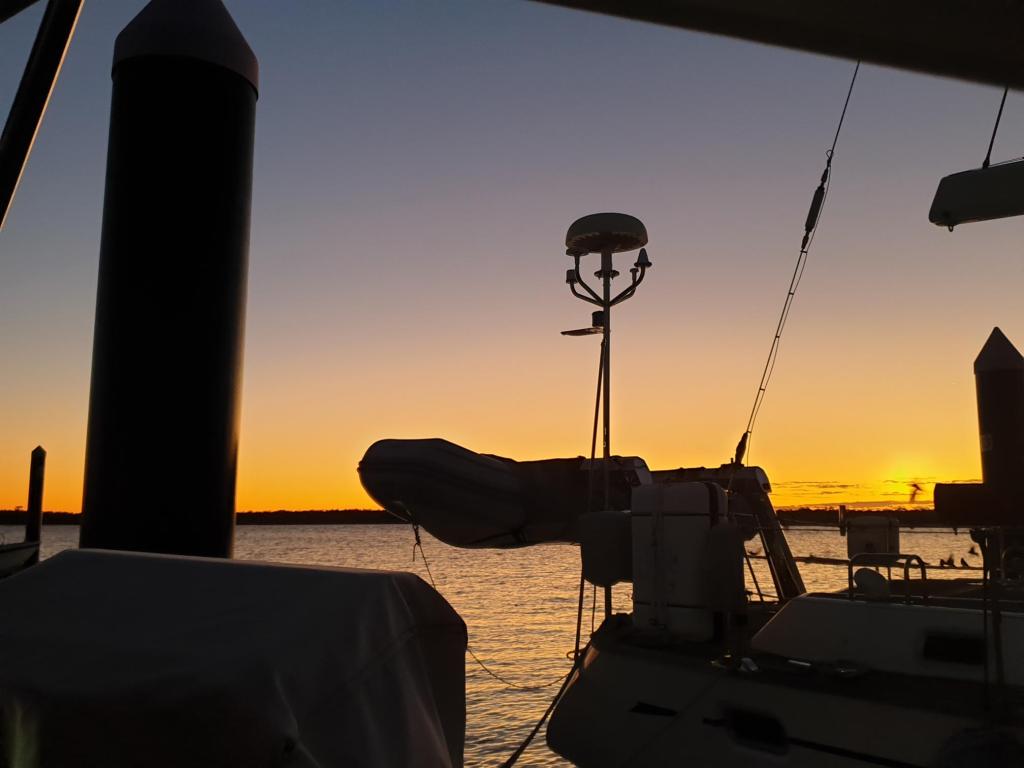
The next day we moved into the marina into a berth next to Mischief (Purple 10). 

We spent almost a week in Bundaberg, meeting the rally organisers, John and Leanne Hembrow, and other participants and doing all the things we needed to do to get ready, as well as a yoga session on the lawn early one morning, and some gatherings for music and company. 
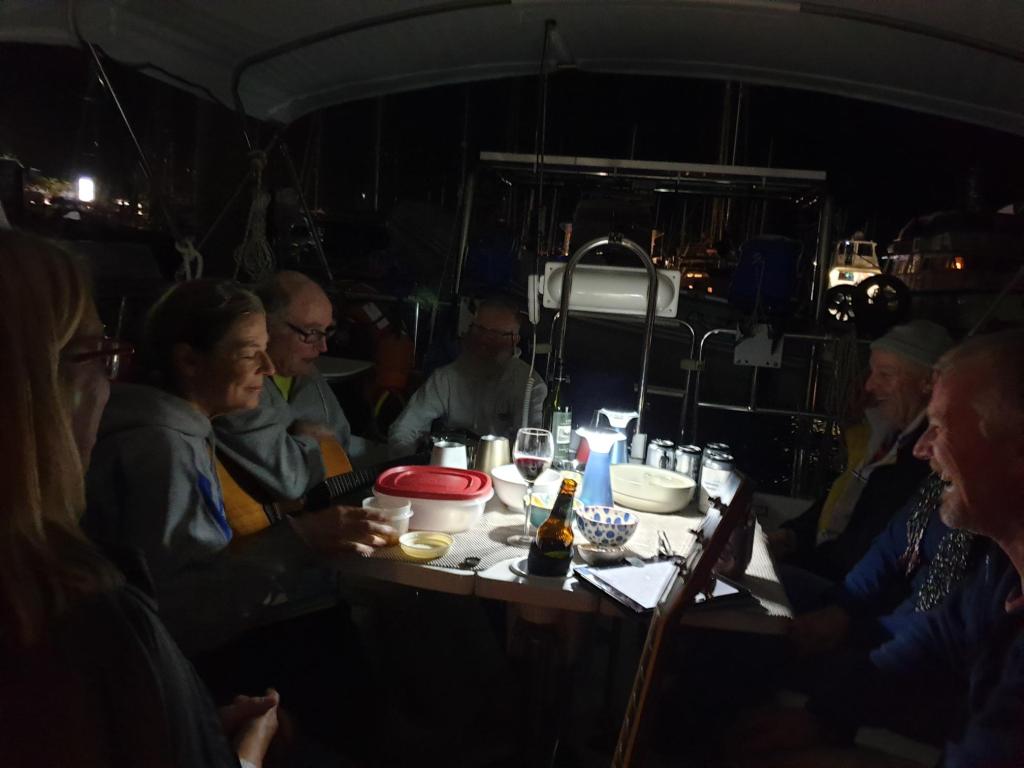
Seems like a great bunch of people, on a vast variety of boats from massive catamarans and power cruisers to quite modest yachts like ours and even smaller.  We’ve studied multiple and regularly updating forecast models (mostly using PredictWind) for the first destination of our adventure, a place called Saumarez Reef, some 200 nautical miles away.

We leave on Thursday morning, 3 June (tomorrow morning as I write this) at approximately 0300 for a short 10-hour leg to Lady Musgrave, departing for Saumarez the following morning. 

Wish us fair winds and calm seas!
Coffs Harbour to Queensland

Firstly, we are thrilled with the response to our first blog.  We’ve had so many visitors and views, and some encouraging comments!  Thank you!  Secondly, I’ve had some complaints that it was too long, so I’m sorry about that…

This one will be much shorter.

We went from Coffs to Mooloolaba.
The End.

Too short?  OK, I’ll provide just a little more detail (and even a short video).  Let’s see…

We left off the last blog waiting for a weather window to depart Coffs Harbour.  Thunderstorms were forecast every day, so much so that we wondered if it was some sort of BOM caveat up in these parts to forecast a thunderstorm ‘just in case’.  Nope, turned out they were real, and the Gold Coast got hammered the night before we left.  There was another storm offshore from Coffs, too, so looks like we made the right decision. 

Thursday morning, we awoke to see that the rain clouds had cleared with a sunny day promised.  We did our last-minute bits and pieces and cast off our lines.  We found a rolly sea outside, which we hoped would dissipate as we headed out to sea a bit.  It didn’t.  And there was no wind.  When we tried to put the jib out, it just flapped uselessly until we furled it again. There was a lot of motoring and a lot of rolling, which took quite a bit of getting used to.  No one was seasick, thank goodness; we’re a pretty tough bunch when it comes to that.     And so, it was a long and mostly boring passage, but we did have a few dramas including some big seas and the engine conking out after fuel had been switched to the secondary tank, which hadn’t been used in a while, causing Graeme to have to change the primary fuel filter in the middle of the night to get us going again.

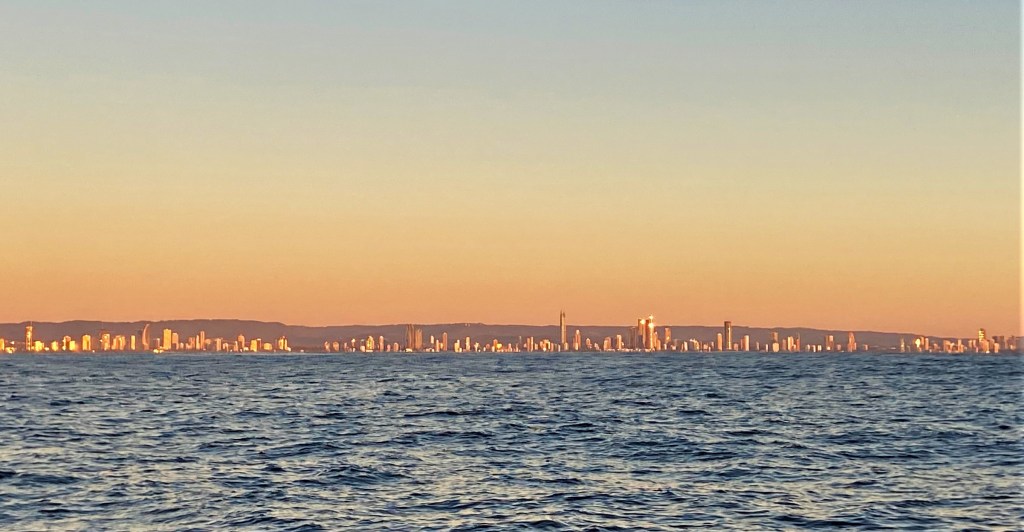
Nothing quite like coming up the coast and seeing the towers of Surfer’s Paradise appear on the north-west horizon.  It was dark but the lights never go out on the Gold Coast, so the towers were lit in all their spangled glory, casting fools-gold glimmers across the sea.  Jamie and I watched the sun come up, a long orange glow along the eastern horizon, which gilded the buildings and flashed off the myriad panes of glass.

 Jamie actually slept pretty well that night, but did get up a few times to check out the starry starry sky and to make sure the sun was going to come up.  He was MUCH more relaxed. 

We crossed the Seaway on Friday morning, so all up about 23 hours at sea.  We anchored in the chaos of good old Bum’s Bay near Sea World, and no sooner had we settled in than good friends Deb and Loz arrived on shore to welcome us to Sunny Queensland, bearing coffee and hot chocolate.

We spent the next couple of days in and around the Gold Coast, finding the most pleasant anchorage around the northern side of Wavebreak Island (out of the powerboat wake).  They have a 6-knot speed limit, and the rule is to stay 60m away from moored/anchored vessels.  Well, we think the “weekend warriors” have interpreted the rules differently, doing 60-knots only 6 metres away!  And the sights!  Parasailing, jet skis by the dozens, jetboats doing doughnuts to make the occupants squeal, powerboats with the obligatory bikini bodies on the foredecks, fishing boats full of eskies, ferries, water taxis, party boats complete with blaring music and scantily-clad serving staff, and of course, yachts like us, just looking for a spot to cool the heels before moving on. 

We went to the Runaway Bay shopping centre by dinghy – it has its own dedicated dinghy wharf, so you can just tie up and walk into a massive shopping centre with all the major retailers.  How novel!

Some of you will recall that in 2013 we joined a rally to the Louisiades (island archipelago in Papua New Guinea).  A few of the old crowd were in the area, so we ended up having an impromptu gathering in a lovely apartment overlooking the Broadwater.  What was supposed to be 6 people swelled to a party of 23.  And what a great night it was, catching up with all the rally folks, and with a mountain of food. 

On the way back to our boat there was a flurry of fish activity beside the dinghy and a garfish launched itself out of the water and landed under our feet.  Who knew catching fish could be so easy?  With Graeme navigating, it was left to me to reach down and grab the slimy flapping thing and throw it back in the water.

From the Gold Coast, we spent a day making our way up the inland waterways (playing the tides) to Moreton Bay, or more specifically, Raby Bay.  Graeme always enjoys the experience of sailing through these quiet areas, with their flat water, laid back atmosphere and pretty surroundings.  We trolled a line for a while and with our awesome LaserPro fishing lure caught 4 lovely clumps of weed before giving up.

In Raby Bay (Cleveland) we caught up with more friends (Colin and Noelene), and Deb and Loz made their way up so that Loz could run a First Aid refresher course for us on the boat (another requirement of the rally).   I love the Cleveland waterfront.  Lots of great restaurants, bars and coffee shops.  A great place to catch up with people.  We spent one night out in the very shallow bay, a long way from the shore, and the second night anchored in the canal much closer to civilisation.

Next day, with Graeme feeling the pinch of not being far enough north yet, and weather windows closing, it was off across Moreton Bay in sloppy seas to Tangalooma, the main resort on the western side of Moreton Island.  Years ago, they scuttled a bunch of old barges to form a harbour north of resort, but it didn’t really work.  The rusting steel hulks, whilst providing great photography, fishing and snorkelling opportunities, were considered dangerous, and the signs on them apparently didn’t deter people from climbing on them, so a few years back they laid charges and blew them to bits. Now the harbour really doesn’t work; the swell comes in and makes you rock and roll all night.   We found a relatively calm spot to anchor south of the resort and spent an uneventful night there, although when the tide came in there was plenty of rocking and rolling to be had.  It wouldn’t be Tangalooma without a bit of that!

Next morning, we tried to get away early, with the seas and winds forecast to increase during the day.  After weighing anchor, Graeme was on the wheel and called out, ‘Can you put the instruments on?’, I replied that they WERE on, but none of the displays were working on the steering hub/pedestal.  The autopilot wasn’t working, and we had no displays for depth or wind.  So I took the helm and navigated out past the shoal towards the shipping channel, whilst Grae tried to work out what was going on.  After a while, with lots of things unscrewed, opened, tested and laying in disarray, he still hadn’t solved the problem of power to the autopilot, so we returned to our spot from the night before and re-anchored.  A short time later, Graeme had pulled apart the panel on the pedestal and discovered a slightly loose plug, which must have jiggled it’s away out of the socket due to some vibration caused by the prop. (We think we might have a barnacle or something causing the prop to be unbalanced at high speeds).  Graeme, Electronics Detective Extraordinaire, solves the mystery!

Anchors aweigh!  A rolly, messy, annoying day across Moreton Bay and up to Mooloolaba, with plenty of squalls and some bucketing rain to keep it interesting.  We set a cracking pace, but unfortunately, we can’t give the sails any credit for that!

PLAYABLE VIDEO It’s not always plain sailing…

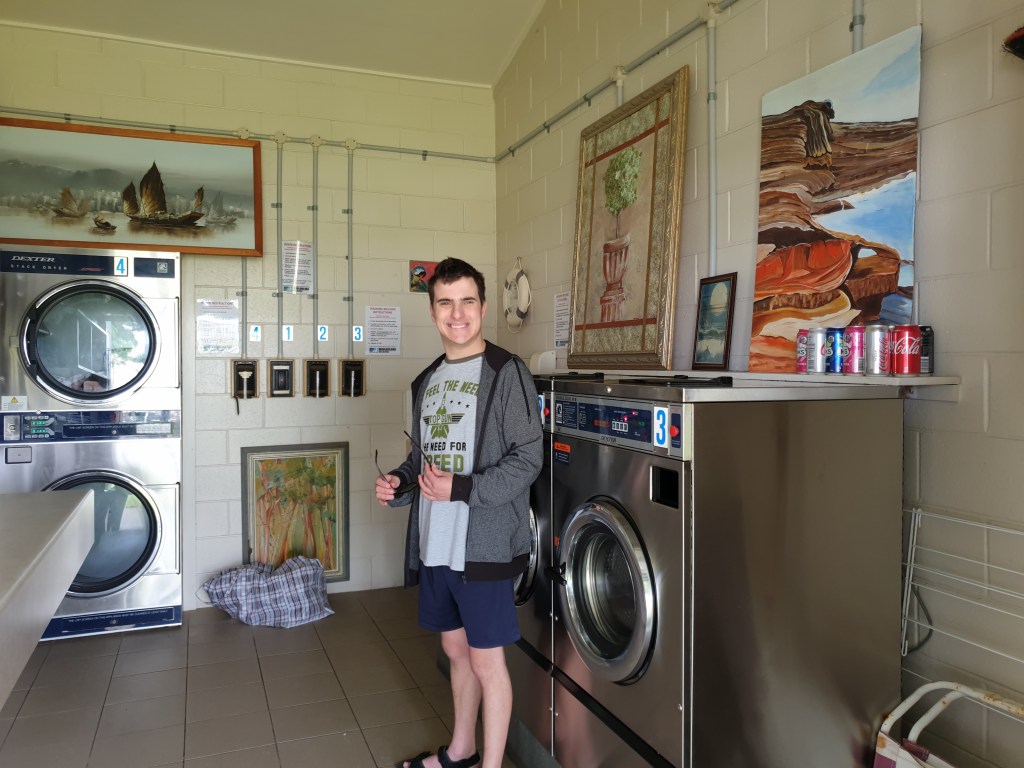
Now we’re tucked up in Mooloolaba Marina.  Jamie was thrilled to be reacquainted with the Dexter washers and dryers (exactly as he remembered) and we spent a bit of time doing washing yesterday.  Also, a walk into town and back along the boardwalk.  Lovely!

Now, we’re just waiting for an opportunity to cross the notorious Wide Bay Bar.  Although the universe is conspiring against us again, and it looks like we may have to go AROUND Fraser Island this time…

The 2021 Adventures of Symphony – It begins!

The Baxter’s are off on another whirlwind adventure!  Yay!  Well… without the whirlwinds, thanks.  And no whirlpools, cyclones, waterspouts, tempests, tsunamis, or other natural phenomena that might turn an otherwise nice day into something a bit crap. So maybe that should read: ‘The Baxter’s are off on another fair-winds adventure!’  Doesn’t have quite the same ring to it though, does it?  It’s missing the drama, the excitement…  Anyway, we’re OFF!

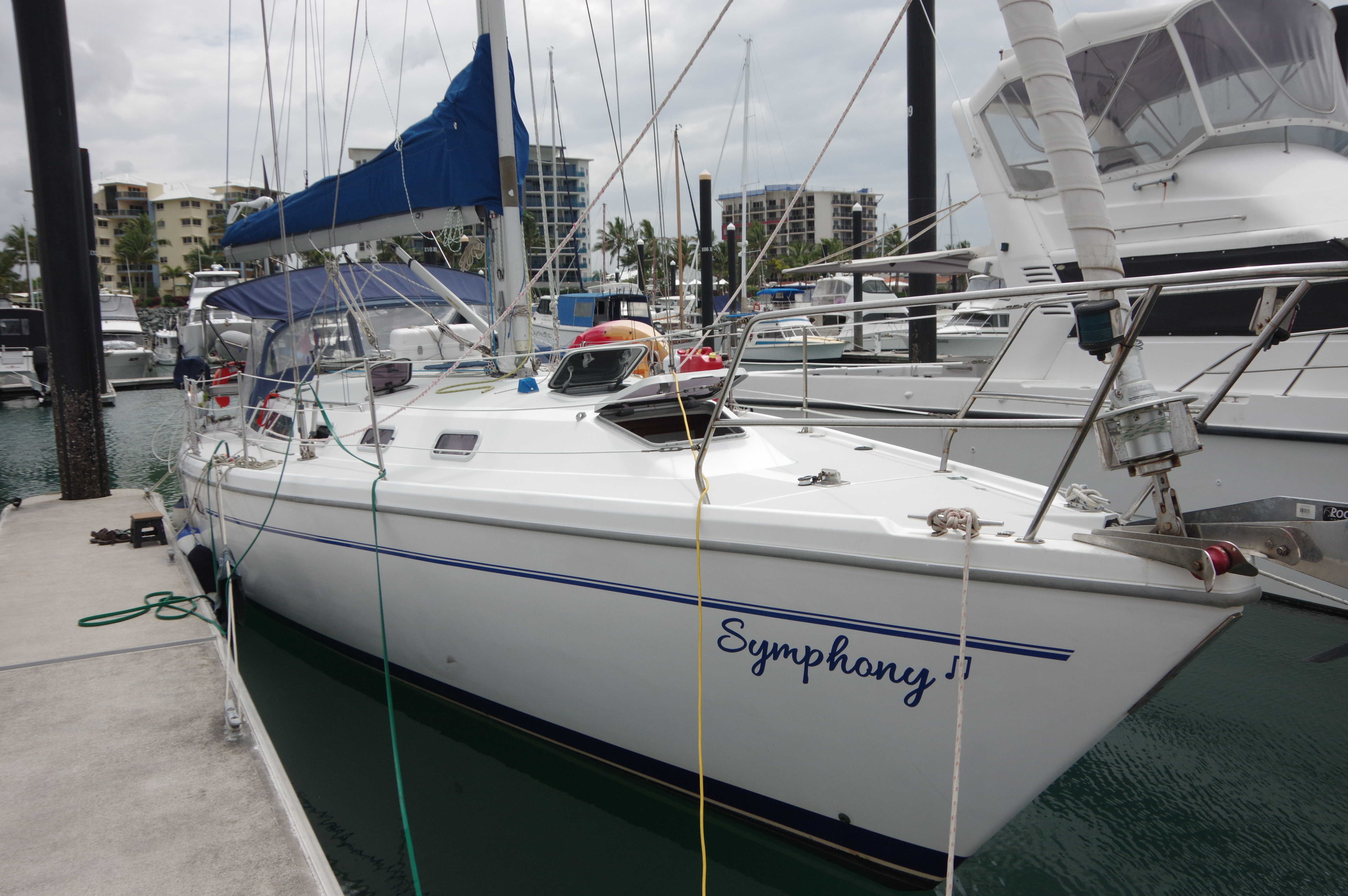
To those of you who’ve never seen this blog before, welcome and thanks for stopping by.  It means a lot to us to know that people are interested.  We hope you’ll stick around.  (For information on our boat, please check the About page.)

To those of you who’ve followed us before, welcome back, and we hope we can continue to entertain you, with our ups and downs and all things in between. Also hoping to include some VIDEO this time!

So, what’s the story?  Well may you ask!

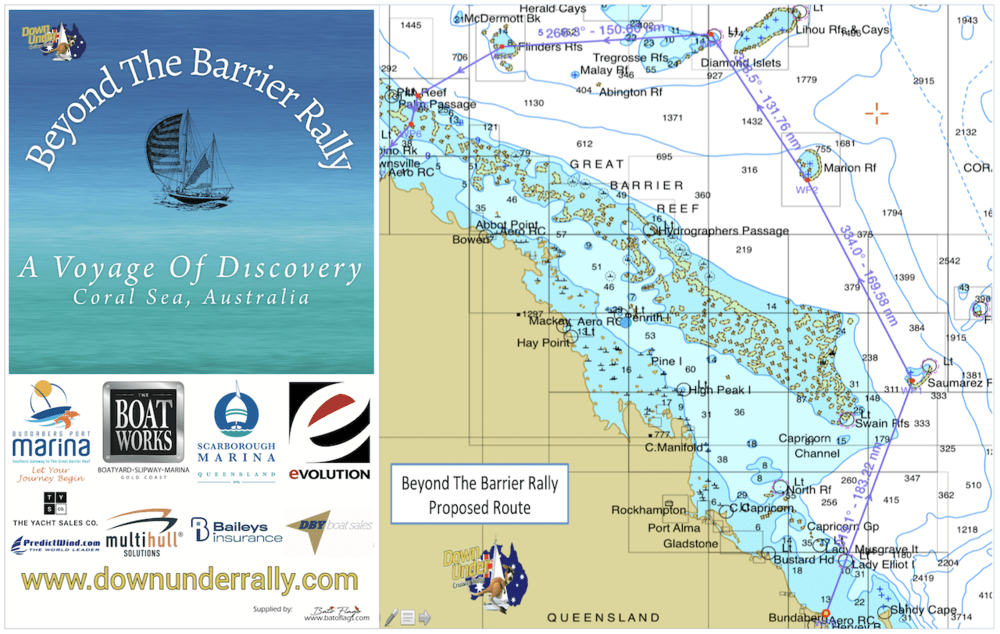
Back in January we heard a rumour that the Down Under Rally guys (who run the Go East/West Rallies) were looking to offer something a little more local, since international boating was not looking like becoming an option anytime soon.  Well, it wasn’t a rumour.  We put our boat name down on an EOI along with more than 100 other boats.  At the end of January, they held a webinar outlining the plan to visit several remote reefs out beyond the Barrier Reef in the Coral Sea, with the rally to commence at the beginning June.  Then, there was the bombshell – out of 140 prospective participants, they would take a maximum of 20.  We were pretty keen, especially knowing that Peter Sayre, a guy with a huge amount of local knowledge and author of Australia’s Coral Sea Islands and Marine Park would be accompanying us, but how could we secure a spot with so many others all champing at the bit to go on this incredible adventure?

Through a stroke of luck, we found out the registration page had gone ‘live’ the afternoon before the appointed opening time.  So, we looked at each other and said, ‘Yeah, what the heck, let’s do it’, and paid our non-refundable deposit.

The panic set in quite quickly. We had 3 months to prepare us and the boat to go cruising.  Sure, that sounds like oodles of time, but the boat hadn’t been maintained in cruising condition since we’d returned from our last adventure in 2017 (although we did manage to install a fabulous heater in the intervening time), AND the list of rally requirements well exceeded the normal preparations we’d make for heading up the coast.  We started to write a list which quickly became about as long as Santa’s NICE list.  The list included some big-ticket items such as:

  • Life raft (and other emergency gear)
  • New canvas work
  • New solar panels
  • Water maker
  • New lifelines
  • Satellite phone
  • Category 1 First Aid Kit
  • AIS Transponder

Fairly early into preparations, things started going wrong.  We were told that 4-person, second-hand life rafts were ‘as scarce as hen’s teeth’.  Too bad if we really wanted one of those.  However, we got lucky for a moment and the wonderful guys at MarineSafe helped us out when someone miraculously traded in their 4-person raft for a larger one.  So, chooks do have teeth, turns out.  We prepared extra items to be packed into the life raft, shipped them to QLD, and then had to pick the raft up from way out at Eastern Creek at a truck depot as they wouldn’t deliver to a home address.

We wanted someone to remake all our canvas work for us: the dodger (the canopy with the windscreen), the bimini (the shade canopy at the stern of the boat), and the link sheet (linking the two for extra shade).  We couldn’t find anyone with less than a six-month waiting list, but we did get on to one guy (highly recommended) who said he could do the hard bit – the dodger.  This meant Graeme would have to take on the job of doing the rest.  No small task (even though he has legendary sewing skills).  After measuring up, the canvas guy messed us around for a few weeks before telling us he was too busy to do the job after all.  We found another guy at the last minute who has done work for us in the past.  At 91 years of age, he’s but a spring chicken and still parachuting and riding his motorbike!  So, he managed to get the job done for us within our timeframe, but we have high standards and we’re not totally happy with it… It isn’t a copy of the old one, so none of the old stuff fits on it. Meanwhile, Graeme got on to the job of making the bimini, which turned out to be a little more challenging and time consuming than he expected, including taking the stainless framework off the boat – a great feat in itself – and setting it up at home on the back deck.  At 4.5x3m, his sewing took over the whole house, pretty much!  And then when he finished doing a BRILLIANT job on that, he knocked up an equally impressive link sheet. 

All this extra work held us up from getting other jobs finished.  We kept missing out on satellite phone auctions.  The you-beaut lifejackets we ordered from Arnold’s never arrived – turns out they’ve gone into receivership! That’s $500 we’ll never see again…

We already had an AIS (Automatic Identification System) receiver unit on the boat.  This device is awesome as it receives information about ships near us, with the rather important purpose of avoiding collision.  Well, the Rally required that we also transmit OUR boat details. So, we needed a transceiver capable of doing both. No longer could we move about in stealth mode!  We ordered a new unit from the US, which took nearly 2 months to arrive in Australia, causing much stress and nail biting as we started wondering if it was going to arrive at all.

There are more stories, but I’ll try not to bore you. Was the universe conspiring against us?  Sure felt like it!  One really positive thing that happened, was that whilst we had planned the trip based on Graeme taking Long Service Leave, the Big Organisation kindly offered him the redundancy package he had pushed for.  So one of us is now a bum.

Time kept on ticking by and the list… well, the list just kept getting longer.  I can see Santa, bag stuffed with presents, sleigh warming up on the runway, suddenly discovering a thousand NAUGHTY kids said ‘Sorry’, and have now magically appeared on the NICE list.  Quick, back to the workshop!  What do you mean the elves have all knocked off and gone to the pub?!

So, D-day came… and went.  It slipped out by 6 days, so we finally managed to drop the mooring on Saturday 8 May, and set sail on Mother’s Day.

Don’t know what you were doing that lazy Sunday morn, but we spent the previous night rolling around in the Basin (Coasters Retreat) acclimatising ourselves to the swell of the ocean.  We got up at 0530 and were on our way by 0600. 

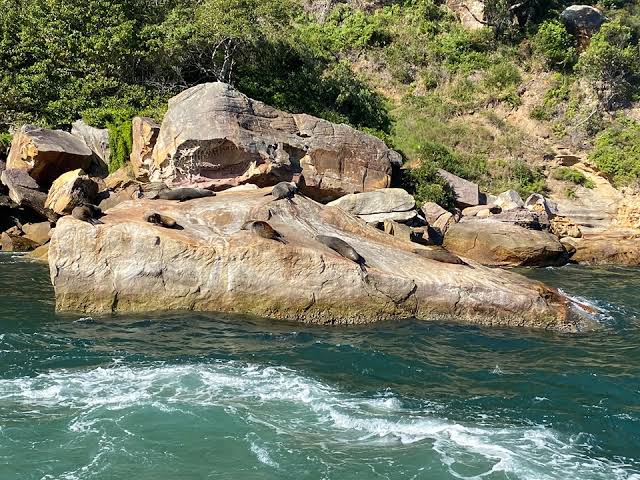
A colony of seals on a rock off Barrenjoey witnessed our departure (not my pic, unfortunately, but same seals, same rock!)

First stop…well, we weren’t really sure.  Port Stephens?  Of course, just to make things interesting, there was a ‘possible thunderstorm’ forecast, and warnings of powerful surf conditions.

Conditions were ‘OK’ outside, although it was an overcast day, and the sun might have tried harder to come out.  It didn’t take long to settle into the motion of the long low swell from the east.  There were large pods of dolphins off to both port and starboard at different times, but they didn’t join us. We’ve heard the whales are on their way north, but none sighted yet. We settled into a speed of 7-8 knots, probably 2nm off shore, with the hope of keeping in close enough to avoid the East Australian Current.

In the evening of that first day, it was very tempting to slip into Port Stephens for a break and a good sleep, but conditions were continuing to be fairly comfortable, so we decided to motor-sail on into the night…

With no moon, and lots of cloud cover, it was a dark night.  There were plenty of ships popping up on the AIS to keep us busy and alert on our watches. I did an early evening shift then another from 3am until dawn, in very calm conditions, taking time to watch the water foam back from the bow, scattered with sparks of bioluminescence, like fallen stars. Around 0400, the moon brightened the horizon like a false dawn, with just the tiniest yellow sliver rising into the night sky; the last crescent of the old moon. 

When the sun did finally start to colour the horizon, Jamie was the first to notice.  He had kept both Graeme and I company on our watches, spending most of the night anxious about sailing in the dark.  He has a long memory, our boy, for traumatic events like storms at sea in the night-time.  We were keen to offer him some new memories of uneventful, even pleasant, nights at sea.  ‘The sun is coming up!’ he announced, with relief in his voice.

Our second day at sea was magnificent.  The sun was out, there were no seas to speak of, just the swell.  We were able to move about the boat freely. We were the only yacht out there on a calm ocean, watching beaches and headlands slip by.  The only downside to Day 2 was that we were unable to avoid the EAC, battling against a 2-knot current around the Trial Bay area.  So, with a speed close to 8-knots through the water, we were only making 6-knots over land. 

We arrived in Coffs Harbour Marina around 1830 and had to navigate our way through the breakwater and into the marina in the dark.  The blue lead-lights are effective, and we soon found our berth, grateful for the lack of wind as we manoeuvred our way into the pen.

Now, we’re just waiting for a good forecast for the run up to Southport. There have been thunderstorms forecast and we don’t want to spoil our good work with Jamie by taking him out into one of those again!

Oh, we’ve done lots of things since we’ve been in Coffs, including having hamburgers on arrival, visiting the laundry, long hot showers, walking up Muttonbird Island, shopping, work, boat jobs…  The best thing about being in a marina is being able to PLUG IN.  You know that saying ‘The best thing since sliced bread’?  Well, we think they got it wrong.  It should be ‘The best thing since TOASTERS’.  Normally, we toast stuff on a camping toaster over the gas element.  But nothing beats a real toaster.

Until next time…

The Final Instalment

OR …
A SERIES OF UNEXPECTED EVENTS, PART 2

The first blog for this adventure was entitled A Series of Unexpected Events, and it strikes me that the last blog should be given the same name.

The previous blog concluded with us departing Gladstone under a weeping sky, as the folk from Mischief cast off our lines.  I write this now from the comfort of my home many weeks later, feeling more than a little reluctant to return to that day and some of those that followed…  But something started should be finished, so I’ve been told.

Gladstone to the Gold Coast

True to Andrew and Lynne’s predictions, we had a fairly dreadful day at sea, with current against us out of Gladstone Harbour, then current with us causing large overfalls and great sheets of bow-spray, which then became overfalls out of Rodd Creek, which then became overfalls out of Pancake Creek.  (We had no choice but to stay close inshore, with an exclusion zone in place. To turn back and go seaward of the exclusion zone would have taken us 20-plus miles out of our way.) With intentions to sail all the way to Rooney Point (top of Fraser Is) we continued past Pancake Creek whilst other boats went in…

A few hours later the forecast thunderstorms loomed on the western horizon, dark and anvil shaped.  Graeme thought we had avoided the storm to our north west and would somehow (hopefully?) miss the one to our south west, as it would cross in front of us.  Wishful thinking!  As the sun set behind storm clouds – copper gleaming through charcoal grey – we ate a simple dinner and prepared the boat for a beating, putting a triple reef in the main.

ms storm behind
Storm building behind us – south of Gladstone.

The wind  quickly rose to over 35 knots (constant 30 knots).  The waves rose to suit.  Perhaps the dark was a blessing: we couldn’t see how big they were!  Graeme had to hand steer, and tried using the motor to slowly jog into the waves, holding position, waiting for the storm to abate. Winds came from the south, south east then east, building three different wave trains.  The storm, though quick to build, was slow to move on, so Graeme remained hand steering and jogging into the waves for a long two and half hours.  (This storm management plan was subsequently reviewed and thrown out the window.) Downstairs, I tried to keep Jamie calm in a boat that leapt and rolled and bucked and skewed.  At one stage, the diesel drums lashed on deck came loose and Graeme had to leave the cockpit, crawl up the deck, and brave the wild weather to secure them!  To heighten the drama, we were traversing the same seaway as the bêche-de-mer trawler that had gone down only days before, with six lives lost.  Recovery operations were underway and there was a large exclusion zone around the area (due to authorities not knowing exactly where she went down), pushing us closer to shore and making it tricky to attempt running with the storm.

Our original expectation was to reach Burnett River (Bundaberg) around midnight.  We arrived in the river a painful four and a half hours over our ETA.  Trying to anchor in the dark is always a little stressful, and the anchorage downstream of the marina at Bundaberg is shallow and dotted with unlit boats.  We spent so long checking depths and boat positions and searching for a spot that the sky began to lighten and we could mostly see what we were doing. With the anchor finally down after a hellish passage (Graeme won’t admit to ‘hellish’, only ‘tough’) we relaxed with a hot chocolate before falling into bed.

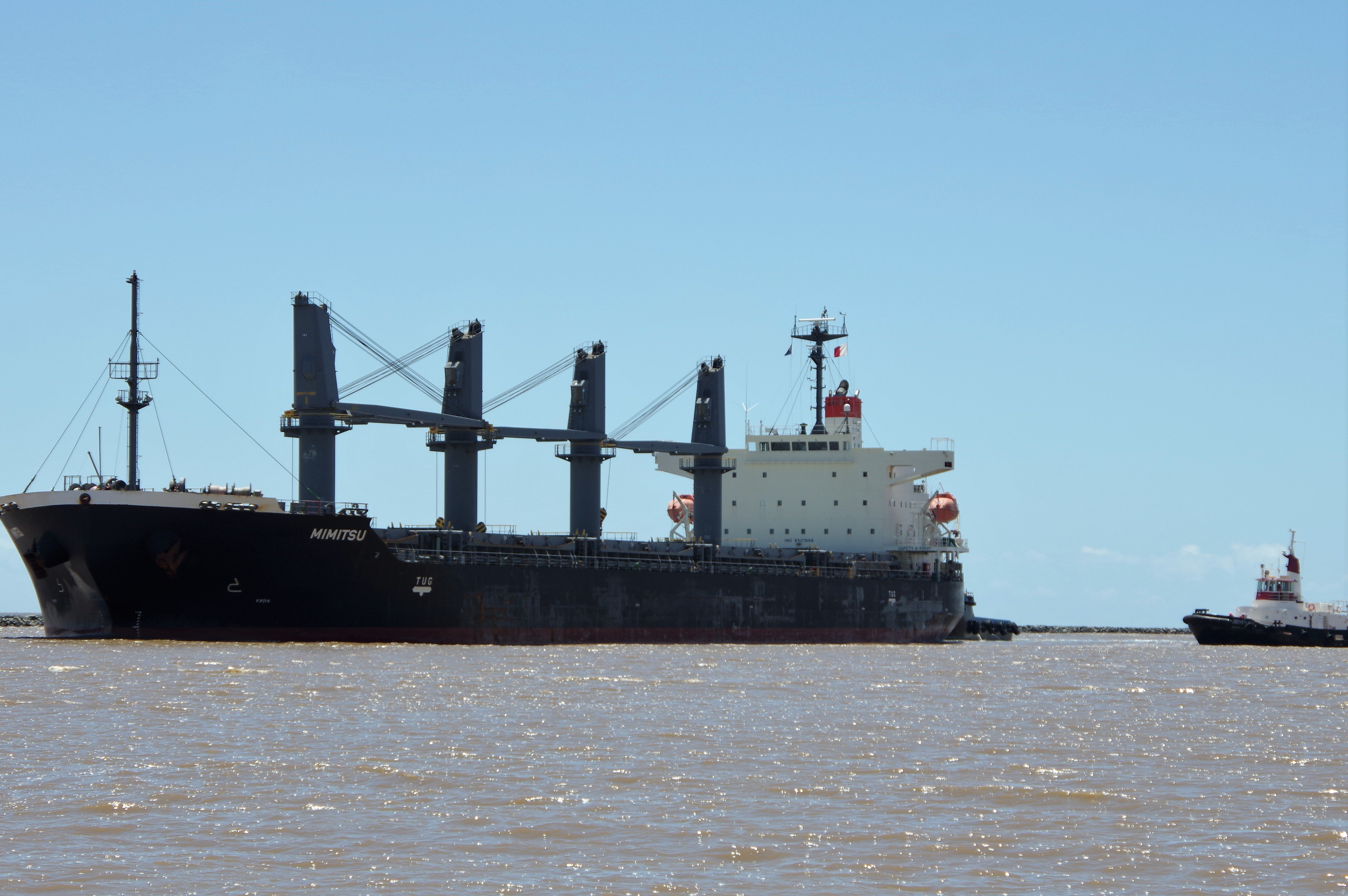
But sleep was hard to get.  With a new day begun, and the sun shining, Jamie wanted everyone to be up and into it! Rest, it seemed, was only for quiet, night time anchorages. It soon became apparent that where we’d anchored wasn’t much good, anyway.  Not only were we were copping overfall waves from the flood waters, but a large bulk carrier was heading in, flanked by tug boats, and we were anchored right on the edge of the channel.

ms ship coming into burnett river
This guy was a little too close for comfort.

We moved further upstream, beyond the marina, and found a delightful anchorage in the river beyond.  We spent an uneventful day and night in that spot, before heading out early the next morning, with hopes of spending some time with the whales.

Most of the whales, by this time (beginning of November) had already started heading south, but there were a few pods still enjoying the cruising grounds of Hervey Bay.  It would have been great to spend some more time in their company, but the wind was clocking around to the west, and forecast to be strong, so we couldn’t anchor on the western side of Fraser Island – we had to get ourselves down into the Sandy Straits, toot sweet.

The wind howled in from the west for the next couple of days, making many of the anchorages in the GSS untenable.  (Have I mentioned Jamie had developed anxieties about anything beyond a light breeze?)  We kept heading south and finally reached Moreton Bay and a sheltered anchorage in Deception Bay.

We had planned to return to the marina at Raby Bay but after booking and paying for a berth over the phone, we were advised that they had a burst water main and thus NO WATER! No long hot showers, no hosing down the boat, no refilling water tanks.  No water?!  And so we had our first experience of the marinas at Manly, and the madness of the surrounding waterways on the weekend, which included a fleet of kids in sailing dinghies tacking through the marina with one capsizing in front of us, and a 70-foot power boat simultaneously bearing down on us from behind.  Nevertheless, we enjoyed spending a couple of flat days in a pen at the Moreton Bay Trailer Boat Club (great access to the shops). We even found our previous boat, Echo II, in a nearby berth. It was interesting to see what the new owners had or hadn’t done to her, and sad to see her looking a little unloved.   We had a quick stop in at Raby Bay after leaving Manly, and anchored in one of the T-intersections of the canal, which worked quite well and allowed us to catch with our friend, Noelene, for coffee in a boardwalk cafe.

From Raby Bay, it was a matter of making our way through the calm inland waterways back to the Gold Coast.  We spent a blessedly still night anchored off the channel below Jacobs Well.

Our friends, Andy and Kelli, were waiting to catch up with us at Paradise Point, where they live on one of the canals.  We have kept in touch with Andy and Kelli after getting to know them on the Louisiades Rally back in 2013, and were looking forward to seeing them.  We anchored in the Coomera River for a couple of days, and it wasn’t far to dinghy around to their pontoon.  We enjoyed our very short time with them, but the clock was ticking.  We were keeping a very close eye on the weather.  We were well within the thunderstorm season (they were forecast almost every day) and it looked like we might have a small window to make it down to Coffs Harbour between southerly blows and storms.  We left very early one morning (4am, from memory) and crossed the Gold Coast Seaway in the dawn light.  Outside, the sea was like a washing machine, all confused and messy.  We kept pushing into it, hoping it was localised . It didn’t abate.  Interestingly, only one other boat (of the many waiting in Bum’s Bay) headed out that morning.  After much discussion, we decided to turn tail and head back in. I think the folks in the Seaway Tower had a chuckle as we came back through.  We re-anchored in the waterway between the Sovereign Islands and Ephraim Island.

Andy had been expressing his concern about Jamie, and we were also worried about Jamie’s increasing anxieties and decreased capacity to cope in stressful or unusual situations. When Andy heard of our aborted attempt to leave, he proposed to help us get the boat home.  Bless his heart!  Light started to shine at the end of a long dark passage full of storms, big seas and meltdowns. Discussions started in earnest. Plans were put into place. In an unexpected turn of events, Jamie and I moved off the boat and in with Kelli, while Andy packed a bag and moved aboard Symphony.

Southport to Coffs Harbour

While Jamie and I swanned around the Gold Coast for a few days with Kelli and Deb, Graeme and Andy were getting down to the serious business of sailing Symphony from Southport to Coffs Harbour.  Here’s how it unfolded…

Graeme and Andy sailed out the Goldcoast Seaway in the mid-morning, into a fairly developed SE swell with SE and E waves.  They had a headwind that was supposed to shift around to the east… but didn’t.  The wind direction remained just shy of being able to maintain a genoa, so they motor-sailed with the mainsail.  Although they had a big southerly swell and twenty knots on the nose, it was a fairly uneventful day…

23376399_1838347499527961_4367221743100790385_n
Graeme off-watch. The sea looks deceptively calm – but wasn’t.

…Until 1830 when they saw a thunderstorm rolling across the horizon towards them.  They made ready, with two reefs in the main, and headed into a storm with building seas, a constant 25-30 knots and lots of rain.  Symphony handled the storm much better with the double reef, which still allowed them to get along at a satisfying 6 knots and thus get through the storm a little faster, albeit with a slightly damp cockpit and crew.  So after the storm coming from Gladstone, where we had a triple reef, it was good to see how much better the boat performed with just a double reef, and it wasn’t overpowered.

23130864_1832648696764508_1000605349304346212_n
Andy’s photo of the approaching storm. Amazing how flat the sea always looks in photos. It wasn’t!

The wind abated to about 20 knots, but still from the south.  And just when the boys were starting to relax, they got hit by a second thunderstorm.  The rain was torrential.  It blew above 25 knots for an hour or so.  Unbeknownst to Graeme, whilst cranking on the jib, a jib sheet came loose and wrapped itself in a big knot around the other jib sheet.  Andy was off watch, so Graeme perched mid-deck untangling the mess with sheets of water flying over him every time the bow hit a wave.  He untangled the knot, but the ropes were still twisted tightly together. (Andy untwisted the ropes on his next watch.)  Graeme ended up saturated and finished his watch sitting on the floor of the cockpit, having a warm shower in his undies.  (He doesn’t remember what colour they were.)  The rest of the night passed uneventfully, although it remained bumpy.

Symphony snuck into Coffs Harbour just ahead of another south-west front.

They found themselves in the company of, and being joined by, boats returning from Noumea at the end of the Sail West Rally.  They were interested to watch boats coming in, licking their wounds.  The fleet had had a tough time of it, copping a fair beating for the last couple of days as they neared Australian shores.  There was a 60-footer with her bow down by about 10-inches.  She slowly came back up to her waterline as the crew bailed bucket after bucket of water out of her forward sail locker.

Whilst waiting for Kelli, Jamie and I to arrive, the boys took their time sampling the local beer and restaurants, – excellent service and great food at the Yacht Club, which is regrettably closing down to make way for a council park!  They also undertook some work on the boat: changed the water pump, fixed some deck leaks that had been annoying us for ages. (Got a good testing in the next passage and didn’t leak at all.)

Meanwhile, Kelli and I packed Jamie and all our stuff into the car and had a nice road trip down to Coffs.  Jamie and I temporarily moved back aboard Symphony with Graeme, while Andy and Kelli stayed in an Airbnb not far away.

Whilst in Coffs, friends of Andy and Kelli’s arrived back in from Noumea in their catamaran.  They had experienced storms with eight metre waves on the third and fourth day of their passage (which made our passage from Gladstone look like a stroll along the promenade).  They were extremely relieved to be in one piece and back in Australia after a wonderful two years’ cruising abroad – and no prior storm conditions. We enjoyed dinner at the Yacht Club and a walk up Muttonbird Island, among other things, whilst the wind spent its days howling around the boats and whistling through the rigging.

IMGP9595.JPG
You can see the work they’re doing reinforcing the breakwater at Coffs Harbour Marina.

IMGP9596
Rough conditions just beyond the harbour.

Finally came a day with a weather window.  So it seemed.  Most people were waiting for a better window, which wasn’t opening for another few days, but the boys were chaffing to get going and Andy was running out of time before things at home needed attention.

And so they set off!

Coffs Harbour to Broken Bay (Pittwater)

The seas were a washing machine, with a big southerly swell and waves, but also an easterly wave train.  Graeme thinks the swell was about 3 metres with a 2-metre sea.  Once again, the wind was just shy of being right on the nose, so they motor-sailed with the mainsail.  The wind was supposed to kick around to the east and the northeast, but never made it beyond southeast for the whole trip – thus the jib never went up.  It was a bouncy trip, with wind speeds up to 25 knots.  It was considerably rougher than Southport to Coffs, with nothing predictable about the motion of the boat.  Fortunately, no storms on this leg.

Andy hooked a big fish (whilst off-watch), so Graeme hauled it in, killed, bled (and there’s always so much fishy blood to deal with!), and bagged it for the fridge whilst already feeling a bit under the weather, only to later discover it was a trash tuna and he should have just thrown it back!

Finally, and with much rejoicing, Symphony sailed under a blue sky into the calm and familiar waters of our beautiful Broken Bay.  They tied her up at the RMYC –arranged, gratefully, by our friends from the stink boat, Papaya.  Jamie, Kelli and I welcomed their arrival as they were tying up.  We then enjoyed another few days relaxing in our own ‘backyard’, Cowan Creek. We’ve covered a few miles and seen a few places, but there’s really nothing that compares with the beauty of these magnificent waterways.

IMGP9604.JPG
A dinghy safari up Smiths Creek.  Jamie’s pretty happy to be back in familiar waters.

Final thoughts:  In retrospect (and with the memory-numbing passage of time since) Graeme enjoyed appreciated the southward passage, as he learned how to better manage the boat in rough conditions.  (We must thank Andy and Kelli for helping to get us all home safely.  Do I regret not joining my husband on the final southward passage?? Do I regret missing not one but two storms?  Hell, no!)

We both learned about the need to be flexible and go with the flow when things don’t go as planned, or when unexpected things happen.  Graeme discovered the excitement of spearfishing and landed some fabulous fish.  We both enjoyed the chance to dive but were saddened by the state of the reef around the Whitsunday’s after Cyclone Debbie.  Perhaps the highlight was interacting with the whales and listening to their song echo through the boat.  It was a joy to meet like-minded people and cruise in company with new friends, and wonderful to meet up with club members in exotic places like Lady Musgrave.

Thank you to everyone who read and supported our sailing blog along the way.  This last instalment (for this trip, at least) probably wouldn’t have been written if one of my avid readers (you know who you are!) hadn’t bailed me up at Christmas time demanding the final chapter.  This one’s for you! X


Heading South…ish

Mackay to Middle Percy

During the first week of October, we finally departed Mackay.  The seas ended up quite messy and the winds were from the north east, making it difficult for us to point to Digby Island, so we headed for Curlew Island instead.

IMGP9237

In the fading light we checked out the small west facing bay and decided it wasn’t much chop, (or maybe too much chop would be more accurate), so we negotiated our way around the south side of the island, avoiding shoals and rocky outcrops, to discover big breaking waves in the alternate anchorage.  We turned around and headed back to the west side, tucked ourselves in between two rock walls as close to the small beach as depth would allow.  Waves were slapping in against the transom and Graeme said something like ‘It’s not hell but I can see it from here’.  We thought it was going to be an awful night, rocking and rolling, but it turned out to be pretty good, and we rested well, safely held by the good ol’ Rocna.

IMGP9255
Curlew Island, west bay in the fading light. 

The following morning saw us head out of the anchorage into flat oily seas towards Middle Percy Island.  A strange mist clung low to the water, blurring the islands and giving everything a dreamlike quality.  Remember that movie, Dead Calm?  It was kind of like that.  Well, except that we were motoring.

IMGP9268
Oily seas and a dream-like mist.

IMGP9281
Middle Percy Island (West Bay) appears through the mist.

We arrived at Middle Percy in the early afternoon, and anchored in the perfect spot just off the entrance to the lagoon.  We swam off the back of the boat and put the shade sail up over the front hatches, bringing some much-needed relief from the heat.  Graeme and Jamie went to the A-frame so Jamie could ring the bells again.

The moon that night was a smudge away from full.

Pine Islet

With the dawn of another hot day, we decided some adventuring might be in store.  We packed a picnic lunch and piled in the dinghy, heading for Pine Islet, where the lighthouse once stood.

IMGP9285 (2)
The two smaller islets of Pine Islet.

We were quite impressed by the geography of the island – the cliffs, dark crevasses, rocky beaches and coconut palms.  The islet is really a tight string of three islets joined by a tumble of boulders in one spot and a long isthmus in the other.

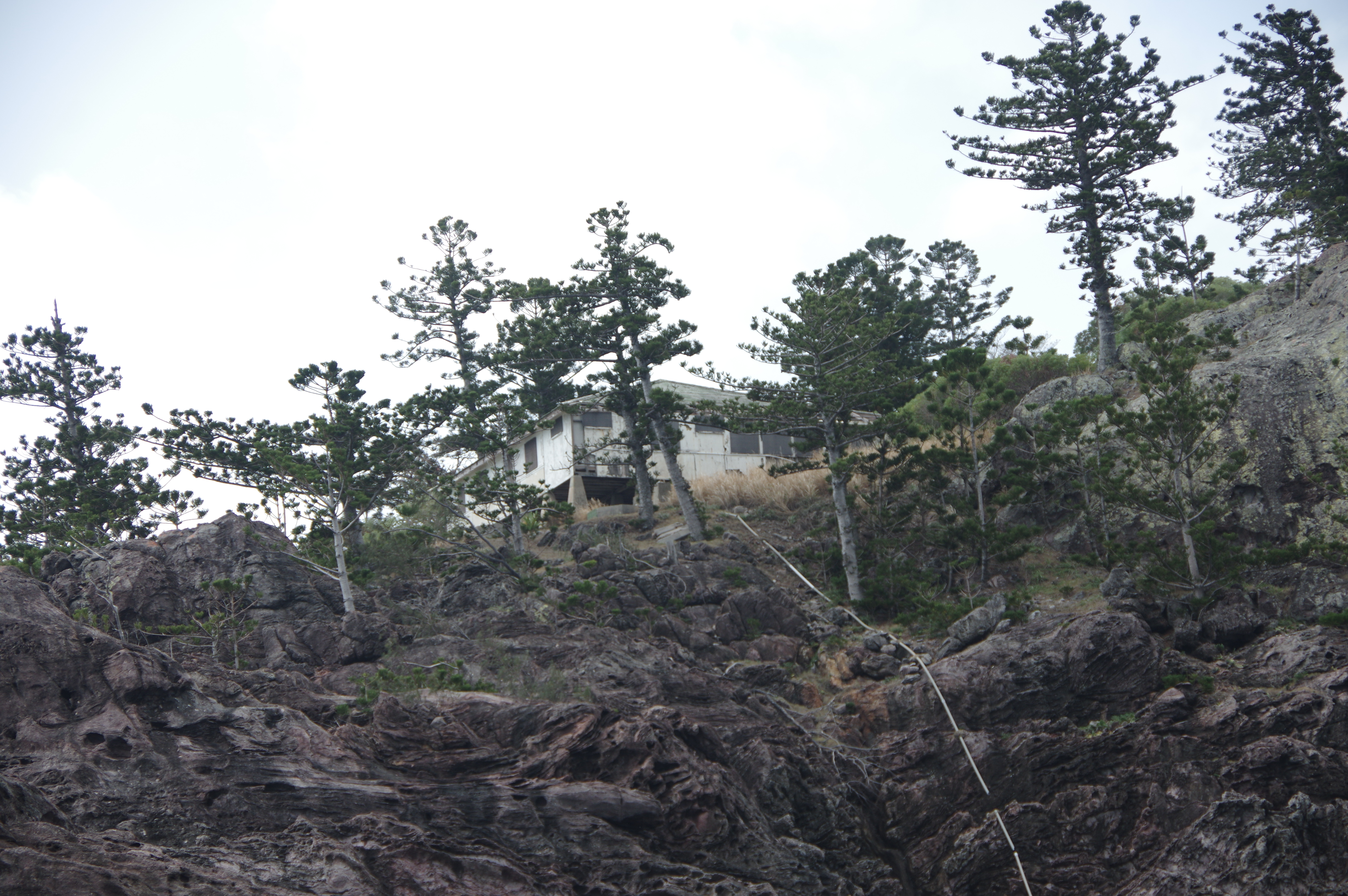
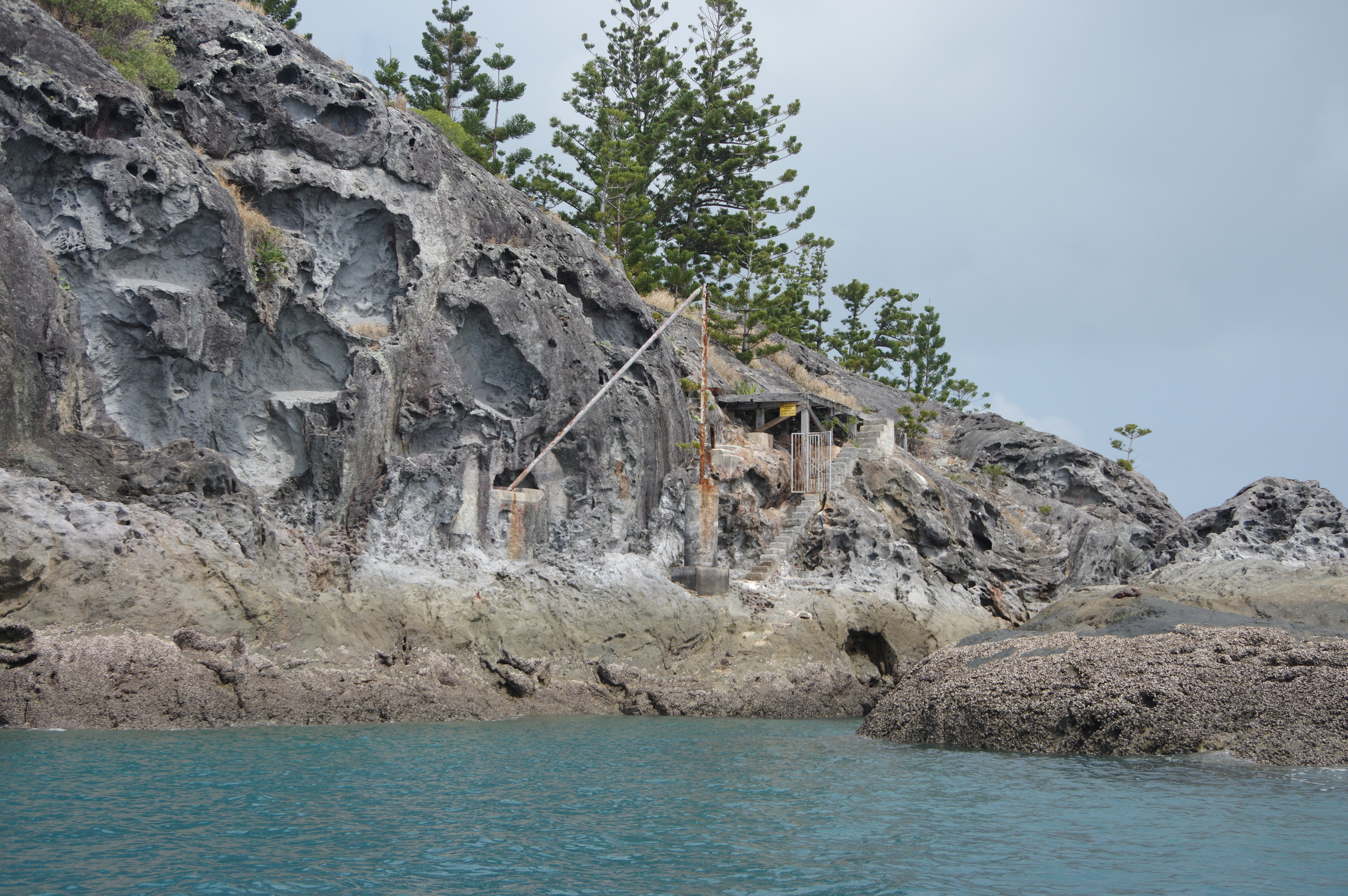
When we rounded the largest of the islets (joined to the others by the boulder fall) we discovered, high on the rocky hill, below the lighthouse foundations, the remains of the houses and service buildings.  A narrow natural harbour provided access to the area, but it has all been closed off with signs prohibiting access.  For Your Own Safety, of course.  With the main entry impossible to access, we completed a circumnavigation only to find there was nowhere else to land where you could access the ruins.  We eventually landed on a rocky beach (isthmus between smaller two islets) and wandered around, looking at the ruins of what might have been a fuel store and the remains of a sailing boat that had wrecked there some time last year.

IMGP9295
Old house from the Lighthouse days.

IMGP9305
Narrow harbour – you can see the stairs leading to a platform and beyond. No access for us!

IMGP9319
The isthmus where we had our picnic lunch.

Story of the Wreck on Pine Islet

So, this guy circumnavigated the world in his 40-foot boat (that’s just a tiny bit smaller than ours).  Incredible achievement.  On return, he tried to clear into Australia through the port of Mackay.  They turned him away as he didn’t have boat insurance.  Welcome home! He made his way to Middle Percy with his Pratique flag still flying.  Allegedly, frustrated with the high winds and bouncy conditions, and drunk (?) on home-made rum, he left the anchorage at West Bay before dawn one morning.  Was he trying to head out and back to the mainland, or was he hoping to anchor at the more sheltered Pine Islet?  We don’t know.  What we do know is that he hit the reef extending from the islet.  He was rescued the next day from the beach.  He returned to the floundering boat to collect his personal effects.  Apparently, all he took was his wallet, his rum-making still, and the sixty litres of rum he’d made!  He then turned his back on the (uninsured!) boat and got a lift to the mainland.  The boat, which had been extremely well fitted out for the circumnavigation, with all the best quality gear, was then picked over by scavengers for the next week or so, before what was left of it slipped into a crevasse between bommies and disappeared under the water.  Graeme found a through-hole valve and a nice length of teak, so the scavengers didn’t find everything, until now!  (He wonders, is it bad luck to use stuff you’ve found from a boat that got wrecked?)

The Famous Middle Percy Yacht Club Goat Stew

We swam, joined the happy hour crowd on shore, and Jamie rang the bell some more.  One of the island dwellers, a colourful character called Ernst, invited us all to come back the following night for (the famous Middle Percy Yacht Club) Goat Stew.  I promised to provide some veggies if we were still here, but we had spoken already about leaving the next morning.

Woke up to a rolly polly morning.  And Graeme woke up with a migraine.  We decided to head around to the southern bays where Graeme could rest his head for a bit in calmer waters and then we could make ready for the next leg.  We ended up anchoring at the eastern end of Rescue Bay in front of a huge sand dune.  After a while, we went to shore to explore.

IMGP9324
Rescue Bay, southern side of Middle Percy.

I am NOT climbing that sand dune,’ said Graeme.  I wandered off to explore the beach and a deep lagoon then turned back to see Graeme and Jamie halfway up the sand dune they weren’t climbing.

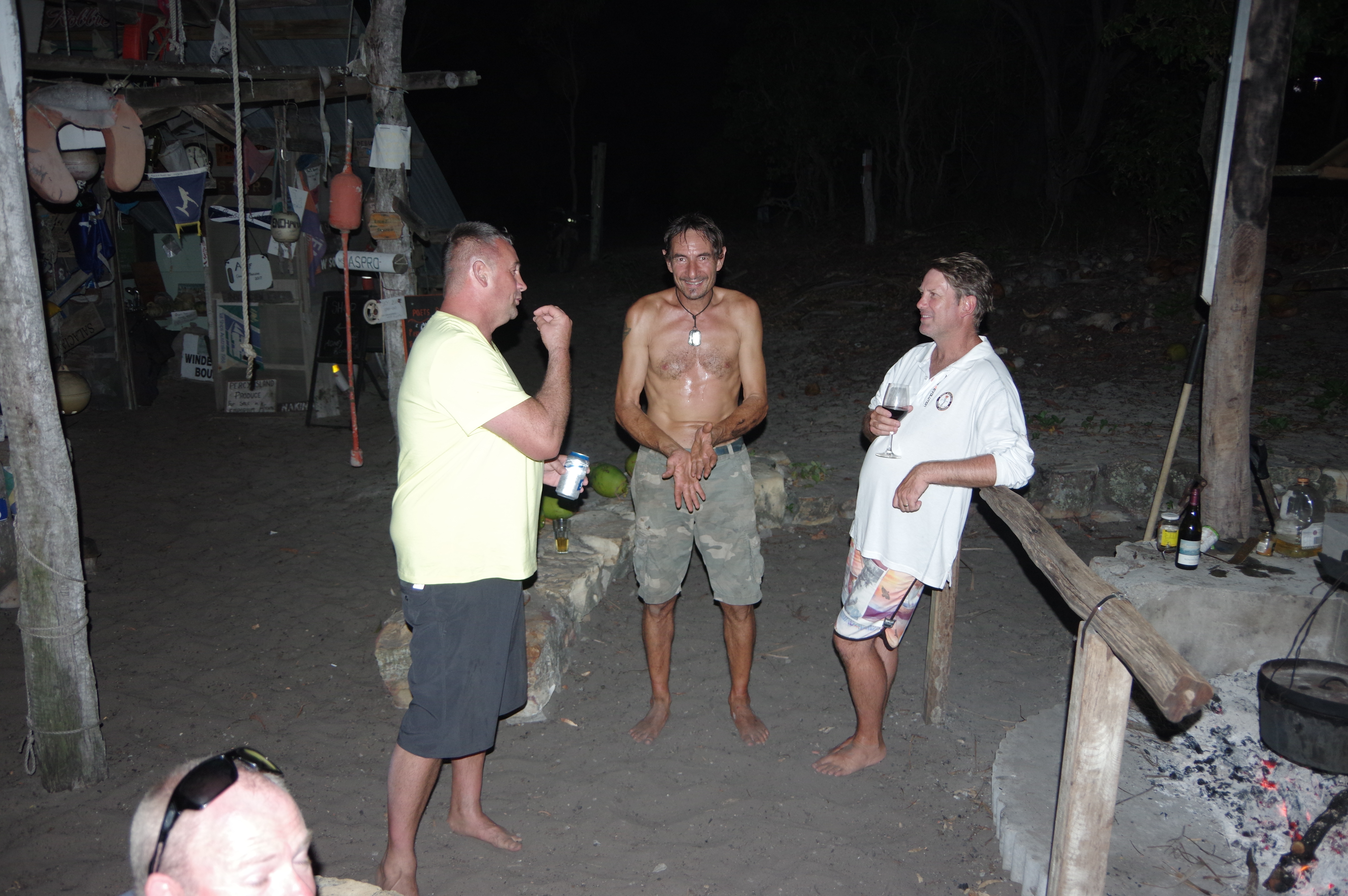
Indecision meant we left it too late to go to Hexham Island and get there before dark, so we motored back to West Bay and enjoyed a fabulous goat stew with Ernst, Kate and Lindsay from the Tree House, a couple with three little girls, a young fellow called Jamie from a little 24-foot sailing boat, and five blokes from a 61-foot power boat that cruises at 25 knots.

IMGP9343
Ernst (middle), island resident and goat curry chef.  Says he saves the testicles for himself – thinly sliced and fried up with onion, they keep him virile!

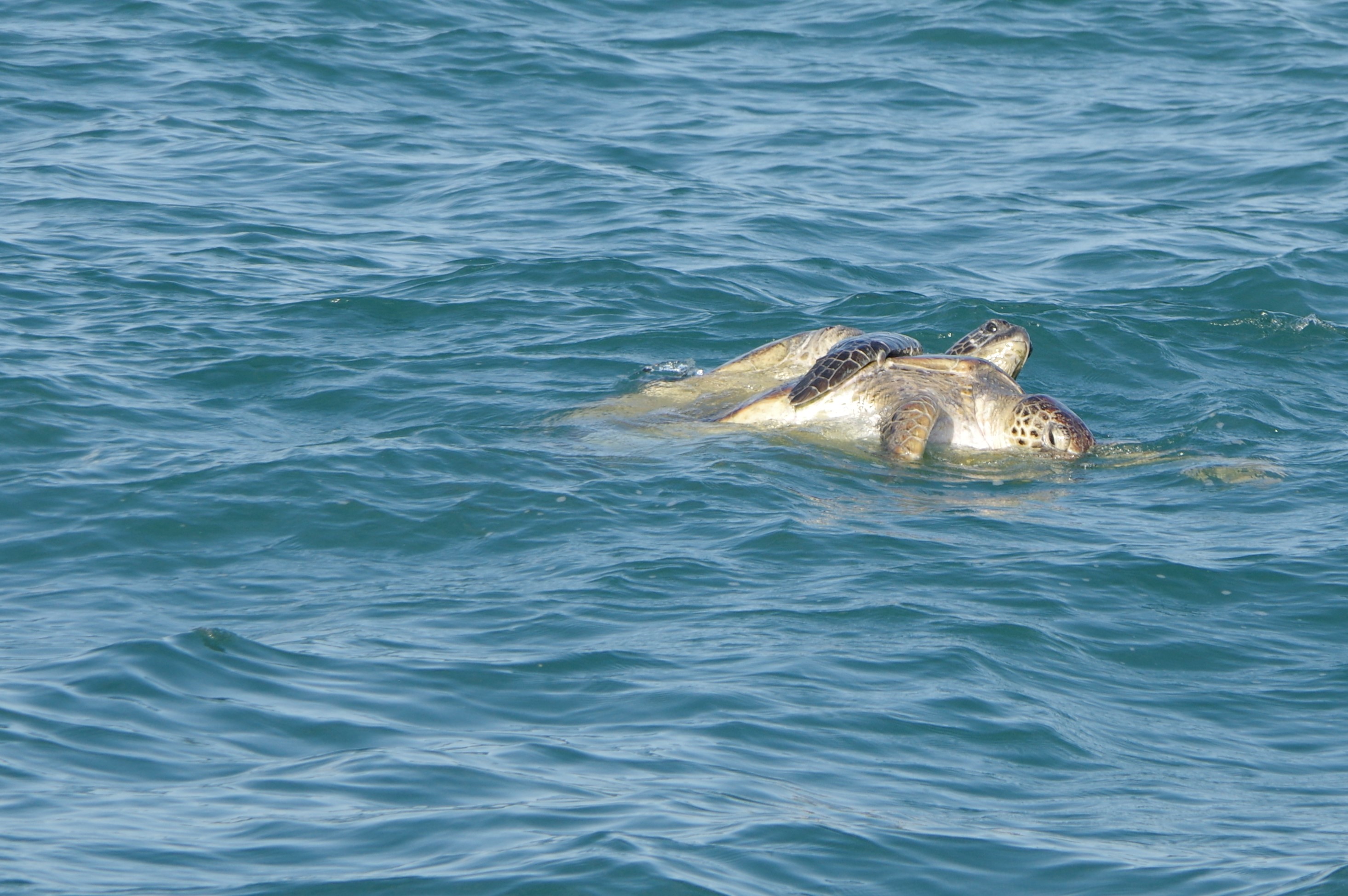
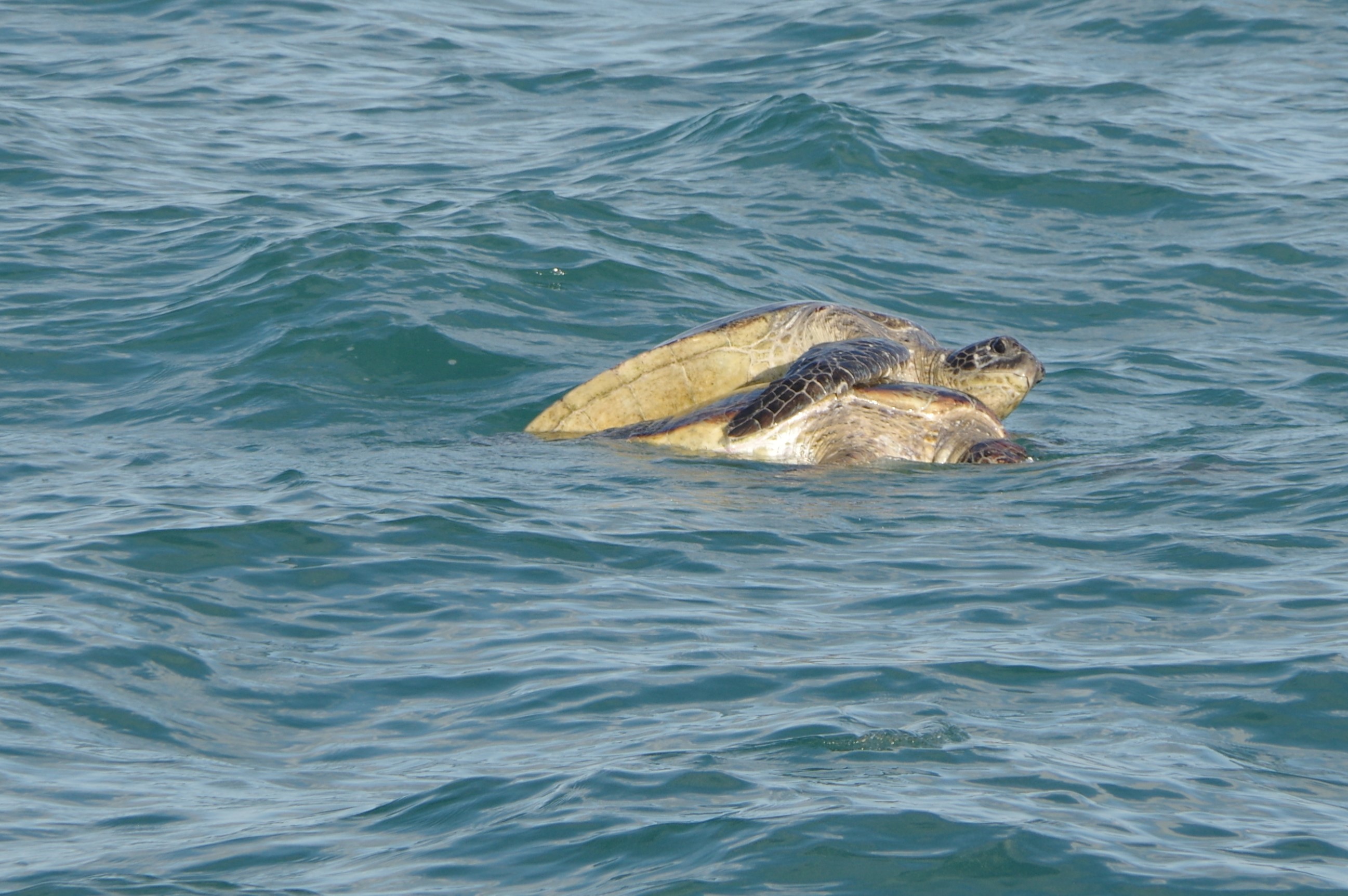
Next morning we were off just after 0630, with not much wind.  Our early start meant we were able to get to Pearl Bay on the mainland –  but entering this gorgeous anchorage from the north on low tide, we ended up with only 30mm under our keel (!!) and quickly kicked the boat into reverse and got out of there.  We were disappointed we couldn’t stay, not just because of the delightful scenery and calm conditions, but because it meant we had to travel further down the coast to the next anchorage, before dark.  We upped the speed to get to Port Clinton.  On the way we saw a strange site: two turtles having a cuddle.  Well, that’s what we’re calling it.  Special cuddles, maybe?  Fellow wouldn’t let his girl up for a breath!

IMGP9389 (2)IMGP9383 (2)

IMGP9381 (2)
Aw, how romantic…

IMGP9375 (2)
“Do you MIND?”

Port Clinton to the Keppels

In retrospect, we anchored too far down the south arm of Port Clinton, too close to the mangroves and beyond the protection we needed.  Graeme said the sand flies descended before the anchor did.  We closed up the boat but it was too late.  Then, during the night, we started to rock and roll.  Oh joy.  Isn’t it supposed to be flat in here??  We got away the next morning into another messy sea with wave trains from two different directions.

IMGP9413
Sun was setting in Port Clinton, before we were near the anchorage.

We made it to North Keppel Island, where we were able to make further repairs to the rod kicker (which hadn’t been working too well since hasty repairs in the Whitsunday’s), and a very pleasant anchorage it proved to be. The next morning we sailed to Rosslyn Bay and filled up with fuel at the wharf near the fish co-op.  Picked up some prawns and mackerel too!

Back out to Great Keppel Island, we anchored off Resort Beach, which really is a magical place.  We went to the bar for lunch then back to the Rainbow Hut for (obligatory) ice creams.  Knowing that Resort Beach isn’t particularly well protected, we upped-anchor and moved around to Long Beach.  Before long, the winds strengthened, rattling in our rigging.  A stream of boats followed us around as conditions at Resort Beach became untenable.

great keppel 3great keppel 2

Mast Head Island to Lady Musgrave

Next morning we were off early, headed for Mast Head Island.  This was somewhere we hadn’t been before.  Mast Head Island is surrounded by coral reef and pretty much inaccessible at low tide, when the reef dries.  The island and colourful reef waters called strongly, promising adventure, but we had to anchor in 23-metres of water (!!) in a fierce current.  We lowered the dinghy and watched as the current tried to tear the dinghy away from the boat, and reluctantly gave up the idea of adventuring.  The Rocna held.  So did the 85-metres of chain – some of which hasn’t seen daylight for years!  (We later discovered there might have been a shallower spot to anchor, but the only other boat there was already in it and we’re not such we would have fit.)

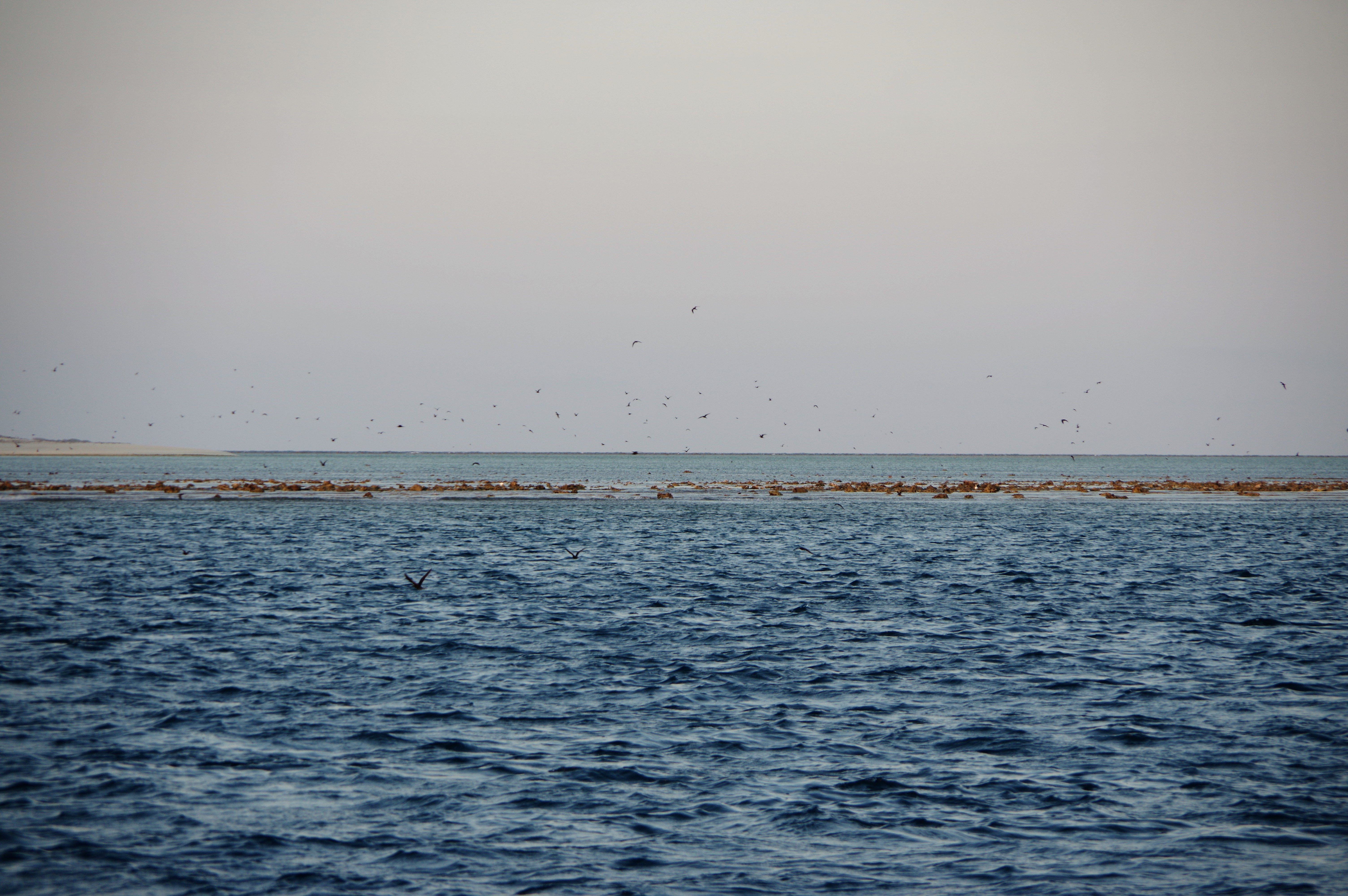
As the light faded, we watched thousands of dark coloured birds, (probably sooty terns) silhouetted against the sky, returning to roost.  We can’t say it was the calmest spot we’ve ever anchored, nor one that filled us with reassurance, but the Rocna held and we passed another night.  The alarm was set for 0500.

IMGP9445 (2)
Sooty terns heading back after a day of fishing.

We set off in excellent conditions, although the day was quite overcast and some anvil-shaped clouds threatened on the horizon.  We made it to Lady Musgrave and entered the lagoon with no difficulty.  A welcome party stood on the bow of one of the anchored boats.  It was Andrew and Lynne, on Mischief.  We were reunited, at long last, with the friends we were supposed to have been cruising with.

IMGP9473

We swam in the crystal waters, had a leisurely lunch, then Andrew and Lynne joined us.  It was so good to see them and be able to share such a divine location.

IMGP9459
Bubbly all ’round to celebrate!  Well, maybe not for Jamie!

Later that afternoon, Tom and Patricia from Mary Claire joined us all for sundowners, along with another club member, Peter, who had joined Mary Claire.  So we had an impromptu CCCA Happy Hour which finished close to midnight after a BBQ dinner.

IMGP9462

The next day it was all about snorkelling with Andrew and Lynne, and using the Power Dive at the bommie with the white stick.  I had a great dive, with everything working just right.  Later, we dinghied out to the entrance and discovered remarkably clear water.  Graeme and I went for another snorkel, marvelling at the visibility (it was about 40-feet deep, and we could see the bottom) and the array of sea life.  There was a bommie with a whole village of sea anemones with their resident clown fish.  I’ve never seen so many clown fish in one place.  Graeme saw several reef sharks, to his delight. The area is a ‘green zone’ (no fishing), and we think the fish have worked that out, as they were there in abundance.

We had a curry night and played a funny card game called Exploding Kittens.

Lady Musgrave to Graham Creek

We left Lady Musgrave the next morning around 0900.  Visibility was not ideal with the sun silvering the water, so we took it pretty slow. A short time after exiting the lagoon we looked back at an ominous sky.  We watched water spouts developing in green-hued clouds, a phenomenon we haven’t seen before.

IMGP9476

IMGP9479The water spouts would develop, grow alarmingly long, then retract back into the cloud.  Fortunately, the water spouts couldn’t seem to maintain themselves, and dissolved back into the clouds without causing any havoc.
Wanting to spend some time in Mischief’s company, we made plans to head to Pancake Creek, then north again (shhhh, don’t tell Jamie we’re headed north again!  He thinks we’re going home!)  The plan was to eventually restock in Gladstone then head back out to Lady Musgrave, then down to Platypus Bay.  Ah… the best laid plans.

IMGP9486
Mischief en route to Pancake Creek.


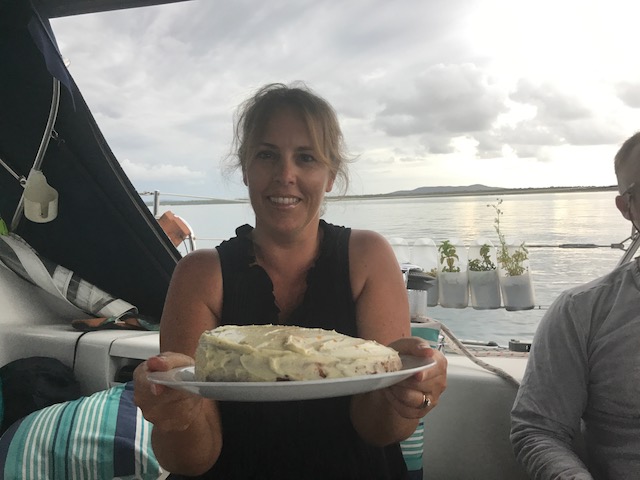
wonky cak
What happens when you bake a cake while the boat is leaning and you forget to gimble the oven…

We had an uneventful time in Pancake Creek, although there’s nothing uneventful about socialising with Andrew and Lynne!  We departed the Creek at 0500 the next morning to catch the depth before the tide dropped any further.  And it rained.  And rained.  We had limited visibility up through Gladstone Harbour through the steadiest and heaviest rain we’ve had this trip.  We found all the leaks in the cockpit canvas and elsewhere.  Fortunately, there were no shipping movements to speak of, in this usually incredibly busy industrial port.  Gladstone Harbour is miles and miles of shipping lanes.  Its banks are lined with steal processing plants, ship loading facilities, massive black piles of coal, red piles of iron ore and white piles of gypsum. We passed almost-kilometre-long ships being loaded and watched tug boats jostling ships into place. We passed the entrance to the marina and, still with constant rain, entered Graham Creek, where industry stops and mangroves reign.  We spotted John Barleycorn and a catamaran, Cool Change.  We eventually rafted up a little further up the creek.  This is the first rafting up we’ve done this trip, and it was nice.  (Rafting up, for the landlubbers amongst you, is when you tie boats together – alongside- instead of being separately anchored.  It allows easy access between boats.)

A Quick Mention:  Women Who Sail (Australia)

I’d like to take this opportunity to mention Women Who Sail, Australia, a wonderful Facebook-based association of women who are (generally) into sailing.  It’s a great group appealing to any woman who wants to be or is on the water in any capacity, whether she be a die-hard racer or a cruiser, someone with loads of experience and know-how, through to women just starting out with a dream (or helping follow someone else’s dream!).  As a member, you feel like you’ve got ‘sisters’ out there with words of support or advice from everything to keeping the heads smelling nice through to major engine replacements, boat deliveries, provisioning, techniques and strategies, recommendations (or otherwise) for brands and service providers, everything!  Members look out for each other – we’ve got a blue and white burgee.  Gatherings and get-togethers occur spontaneously.

women who sail aus

Back to the trip…

The sand flies and mozzies were FIERCE in Graham Creek.  We had all our screens on and mozzie coils burning.  No doubt Graham Creek is a great place for fishing and crabbing.  We chose to socialist instead. In our second day there we had a couple turn up (braving the rain).  Jo (with husband Jeff) was from Cool Change, and we’d ‘spoken’ on the Women Who Sail facebook page.  It was great to have them join us for a chat about their travels.  They keep Cool Change in Pittwater but live in Melbourne. I expect we’ll see them again down south.

Fed up with the rain and the biting insects, and with strong winds forecast, we made our way to Gladstone Marina the next morning.  We headed off first, attempting to get into a pen before the wind came up and then be ready to assist Mischief into the pen alongside us.  We were pleased to see three fellows ready to take our lines in our ‘blow off’ berth.  Mischief arrived somewhat late, announcing they’d had some trouble with their engine.  It has a new ‘note’ to its sound, was running hotter than usual, and there was black stuff coming out of the exhaust.  There new mission was to have the engine diagnosed and repaired as soon as possible.

We spent a week in Gladstone Marina, enjoying dinners, socialising with Mischief, their friends  from Scintilla, the guys from John Barleycorn (who ended up on the same marina arm as us) and walks around the parks and township (when the rain allowed).  Jamie enjoyed acquainting himself with a new laundromat and helping as many people with their washing as was possible.  Gladstone is a funny place.  The marina and park surrounds are well kept.  The parks a verdant green.  The town is obviously built on the mining dollar but for a ‘backwater’ town (sorry, Gladstonians!) the prices for coffee, restaurant meals and real estate more closely align those of a big city.

Tragedy

During our time in Gladstone, a bêche-de-mer fishing trawler went down in rough conditions off Round Hill (1770), not far south of us, with six men lost of the seven men on board.  I’m sure you’ve heard about it, no matter where you are.  Whilst discussing the tragedy and the miracle of the fellow being found after spending all night in the water, on Women Who Sail Facebook page, a woman from the boat who rescued the lone survivor joined the discussion, and we suddenly realised she was on the boat in the pen right next to us.  On my way to the showers we struck up a conversation about events surrounding her part in the rescue.  She was quite traumatised by the whole thing, as you can imagine.  They saved a life that day.  It was only because they were there that we all have some idea of the fate of the trawler.

Mischief’s engine needed some serious work.  I won’t go into too many details here, as I expect they will write another article for our club magazine regaling readers of their engine woes.  Suffice to say, the decision was made to replace Mischief’s ailing engine with a brand new one.  This would take no little time.  Graeme joined Andrew in the engine room and helped dismantle as much of the engine as possible, in readiness for the new one.

mischief engine

They expect to be in the marina a few more weeks, and while we love their company and were supposed to be cruising with them, we were feeling the pinch – the need to get further south to stay on schedule for a mid-November return to Sydney.  We still had Wide Bay Bar to cross, and now it was thunderstorm season, which meant getting out of Southport for the final push was also going to be getting trickier.

It was a dreary grey morning, and I think we were all feeling a bit sad as we said our farewells and Mischief’s crew cast off our lines.

IMGP9512
Andrew and Lynne wave their goodbyes as we leave the marina.

The Whitsunday’s – Take 2

I promised another blog hot on the tail of the other, so here it is.  From Mackay to the Newry’s, through the Whitsunday’s to Hook Reef and back again. There’s even some gratuitous nudity.

The Newry Islands

This time heading into the Whitsunday’s, instead of going over the same ground, we sailed to the Newry Islands, which are north of Mackay but very close to the mainland.  The seas were a bit confused, but it wasn’t far.  We were soon anchored in a very calm spot close to Outer Newry, with the old resort on Newry Island behind us, with a CCCA boat we knew from back home: Amici.  This anchorage offers protection in almost all weather.  We spent that night and the next at the Newry’s, enjoying sun-downers with John and Jane and their very cute toy poodle, Josie.

IMGP9100 (2)
Looking from our boat across to the old resort on Newry Island.

The Newry’s are an interesting spot, with the charm of bygone years.  The resort dates back to the 1930s, and was in operation until 2001, when it reverted to National Park.  Queensland National Parks has made a good attempt to fence off and preserve what remains, with good signage to explain the original purpose of the buildings.

IMGP9106 (2)
The old Beachcomber Bay is now a picnic shelter. The boys might be waiting a while to get served…

IMGP9105

IMGP9112 (2)

Jill Knight wrote about her experiences of the Newry’s some years back, and it seems a lot has changed over the years.  At one time, the resort buildings were quite intact and you could wander through them, unimpeded.  There were vegetable gardens and dams, all now gone. However, we enjoyed our visit and recognised that you could spend quite a bit of time here, exploring the island group, discovering more of the area’s history, attempting the walks (although the tracks seemed overgrown) through dry rainforest and eucalypt looking for koalas and echidnas and checking out the unusual rock formations.  I’m sure they have names, but we named a couple of them ourselves.  Perhaps we were hungry at the time?  One is Birthday Cake Rock and the other is the Pancake Stack.  If you can come up with anything better, let us know!

We left the Newry Islands with Amici not far behind, heading back into the Whitsunday’s to Thomas Island.  Thomas is a very pretty spot and we have fond memories of good snorkelling ten years ago, but the anchorage proved to be really rolly and uncomfortable.   With an hour or so of daylight left, we weighed anchor, said farewell to Amici, (who had been great company), and shifted over to our familiar flat anchorage at Burning Point.

Hook Reef

Christian, who had left Blackwattle at Hamilton Island for a few days and flown back to Sydney for business, was back on board and keen to go out to the Reef in company, so the next morning we were away early and heading out to Bait Reef and beyond.  (We had 40-odd miles to travel, Christian only 20-odd as he had overnighted in Butterfly Bay.) We eventually found ourselves in Hook Reef, about 22 miles out to sea from the top of Hook Island.  From the reef, you can just make out the peaks of Hook Island in the distance.  They are a grey, cloud-like smudge on the horizon.

If you haven’t been out to a reef before, you’re basically anchoring in a shallow spot in the middle of the ocean.  If you’ve picked the right weather conditions, then the ocean is calm and clear.

IMGP9142
Anchored in the reef.  Our closest neighbour is the far right of the pic.
If you’re close, you can see rolling, breaking waves at low tide, but they expend their energy on the reef and come no further.  Between the hours of about 0930 and 1600 you can see into the depths, so you can navigate around the coral bommies that rise from the sea bed.  Shallow areas appear green or yellow amongst the aqua and ultramarine, and those are ‘no go’ areas, especially for a fibreglass boat.  We hit one of those, we’re probably sunk.   There’s nothing much to see above the water, unless it’s a really low tide, then you might see some rocks.  We go there mainly for what’s under the water.
Christian, who had anchored ahead of us on a higher tide, discovered he was anchored way too close to a shallow bommie.  After we successfully anchored, Graeme went and helped him re-anchor.  Not an easy thing to do in a bommie field!  (Christian later discovered he had hit the bommie – it took some of the antifoul and paint off his keel, but no lasting damage, thank goodness!)  We enjoyed a swim in the deliciously clear water.  It was wonderful to be away from the charter and backpacker boats and be out there on our own.

IMGP9135
Christian joins us for sun-downers.

The next day we enjoyed snorkelling over various bommies.

The visibility was quite good and we saw a lot of hard coral, some soft corals and plenty of fish life, including butterfly fish, rainbow-coloured parrot fish, anemone fish, humbugs (black and white striped – Christian calls them zebra fish), patterned sea cucumbers, honeycomb cod and many more.  The photos don’t really do it justice – we must update our underwater camera.

P1070264 (2)

P1070258 (2)

Graeme went for a spearfish with us following along behind him in the dinghy.  The current was quite strong so he let it take him from bommie to bommie.  While he saw quite a few reasonable sized fish, he also saw a few too many reef sharks.  At one point, he got a shot off but the fish – now wounded – got away.  There were FIVE SHARKS near him within moments, all keen for a free dinner.  After that, he displayed a little reluctance to go in again. Can’t understand why!  However, with some encouragement, he went out for a short swim the next morning with his spear gun and came back with a stripey, which was an absolutely delicious sweet white-fleshed fish.

IMGP9141

Bait Reef

We watched Christian winch his anchor up mid-morning and start to head back.  We weighed anchor a short time later and started to make our own way back, ahead of increasing wind.  Coming back near popular Bait Reef, we found someone dropping a mooring, and decided it was a fortuitous sign, so we picked it up.  (There is no anchoring at Bait Reef, so if you can’t get a mooring, you can’t stay.)  We went for a snorkel in very strong currents, and then a dive at the highly recommended Stepping Stones; a long row of bommies apparently unique to Bait Reef.  We were a little disappointed by the lack of coral along the top of the bommies, or rather the apparent destruction of the coral.  Every bommie we looked at was topped with coral rubble.  Diving further down proved a little better, with quite a lot of fish including some big ones.  Graeme took the Go Pro and shot some footage through the canyon between two bommies, and the fish lurking at the other end.  We saw both some soft and hard coral, but nothing like what we had expected to see – nothing like we saw in the same place ten years ago.  Has the cyclone caused all this damage or is there something else at play here?  Something else happening that is destroying the coral?  I’ve only seen one crown-of-thorns starfish – nothing like the numbers you would think would be required to wreak such destruction.

Stonehaven Anchorage

Back at the boat, we had a late lunch in the gorgeous reef surrounds, and let go of the mooring.  We still had a few hours of sailing to get back to the Whitsunday’s.  We may have slightly misjudged how long it would take us to get back, or lost time by heading around the western end of Hayman Island.  As the day was fading, we motored through Blue Pearl Bay.  No moorings, and we couldn’t find a suitable spot to anchor.  (The ‘free’ area was around 18 metres deep!)  So, with the sun setting, we kept on, heading for Stonehaven – an anchorage on the west side of Hook Island.  Along the way, we managed to spot moorings in the near-dark along Langford Island.  After several attempts to pick one up (due to poor visibility) before we were successful, we ended up working out that the area offered no protection from the predicted northerly winds, so we dropped the darned thing and resumed our route to Stonehaven, now in full dark and with a reef to negotiate.  Fortunately, the end of the reef is lit, so we kept the light to starboard and soon found ourselves motoring towards what looked like the twinkling lights of a small town.  These lights, of course, were all the anchor lights of the myriad boats sheltering in Stonehaven.  We were feeling a little anxious about anchoring in the dark, as Christian had relayed to us over comms that anchoring had been difficult in deep water, and he’d done it in daylight.  Our charts showed a circular shoal area of about 10 metres depth a fair distance off the main anchoring area, so with no one in the immediate vicinity, we dropped our anchor there.  It proved a perfect spot, although the doof-doof music and raucous laughter from the party boats carried a little too well across the calm water.

Airlie Beach and Stonehaven – and guests!

A mecca of backpackers the world over, Airlie Beach is a bustling township that has spread up the surrounding hills in recent years.  The constant ebb and flow of backpackers ensures the pubs and souvenir shops are busy, hostels are always full and the party boats are overflowing.  From Stonehaven, with its dramatic backdrop of steep hills and cliffs, we motor-sailed down to Airlie Beach and anchored amongst the moorings in the area known as Muddy Bay.  (It’s notorious for being a spot where boats drag their anchors, the bottom being apparently a light layer of mud over very hard clay.) It was Saturday, and we were keen to check out the beach-side markets and try and do some shopping before our visitors joined us.  The markets were expansive, with fresh produce, handicrafts, live music and an impressive sand sculpture of a dragon, with smoke wafting from his nostrils. There was even a couple of real beardless dragons you could pet.

We discovered that since our last visit they’ve built a big Woolies, so we did a bit of shopping (only as much as we could carry back to the dinghy at the Sailing Club wharf).

That evening, Graeme’s brother David, and his wife Alison, arrived in Airlie Beach from where they had been camping near Bowen.  They had already travelled from Canberra to Townsville and we all were excited about them joining us for the next week.  We met up with them at the Sailing Club for a couple of drinks, finalising plans for collecting them from shore the next day.

Next morning, we didn’t get away before 1200, with some complicated moves to get both David and Al to the boat while leaving their car and caravan some 20 kms away.  Once we had everything stowed and everyone aboard, we set sail for Stonehaven again, and this time managed to anchor in daylight!

IMGP9143
One of the anchorages at Stonehaven. We love the backdrop of steep, rugged hills.

The next morning, we set off for Hook Reef again, excited to show David and Al somewhere special; somewhere they hadn’t been before.  We had two more wonderful days and nights out at Hook Reef, with perfect conditions, anchored in almost the exact spot we had anchored before.  We enjoyed some excellent snorkelling and diving around nearby bommies, swimming in the clear water, and just spending time together.


Graeme tried out his home-made high-pressure dive setup (Hookah style – whereas we’ve been using a low-pressure Power Dive setup) off the back of the boat, and whilst down the bottom in 10m he noticed some big fish.  He came back up, got the homemade Hookah off, donned his snorkelling gear and took down his spear gun.  It took three goes free-diving down before he saw the fish again, but on his third attempt, he came up with a fish on the end of the spear!  And what a beauty!  We identified the 64cm fish as a slate bream.  Al and I made a lip-smacking coconut fish curry for dinner, which fed five and had enough left over to feed the guys again the next night.

IMGP9153
64cm slate bream. Not too shabby.

Luncheon Bay, Saba Bay, Hill Inlet and Whitehaven

With lots more places to visit, we finally tore ourselves away from the Reef and headed back to Hook Island.  On the way, there was this section of ridiculously clear cellophane-blue water, so we dropped the anchor and tried swimming.  The current was so strong you had to hang onto the ladder, and your legs popped out behind you.  Later, David was keen to be shark bait, so we let a line drag off the back of the boat with some knots in it, and he hung onto it, as we sailed along doing about 4 knots.  Not to be outdone by his big brother, Graeme had a go too.  Apparently, it was extremely hard to pull yourself forward on the rope back to the boat.


studs afloaf
Bums at the back of the boat.  A blatant attempt to attract more readers.  Studs afloat??

With hopes of good snorkelling on the northern side of Hook, we picked up a mooring at Luncheon Bay (to the east of Maureen’s Cove, which we’d already identified as a good spot).  100 Magic Miles, the definitive guide to the area, suggested Luncheon was also a good spot.  How disappointed we were to discover that not only was the water visibility terrible, the whole place was a coral graveyard!  The only thing worth seeing was a crayfish tucked under an overhang, his long white antennae giving him away.  We have to assume that Luncheon Bay was hit hard by the cyclone, and we just hope that in time the reef there will recover.

We ended up anchoring in Saba Bay for the night – a lovely spot on the eastern side of Hook Island, where we had a calm night.  (There are many great anchorages all the way around Hook Island.)

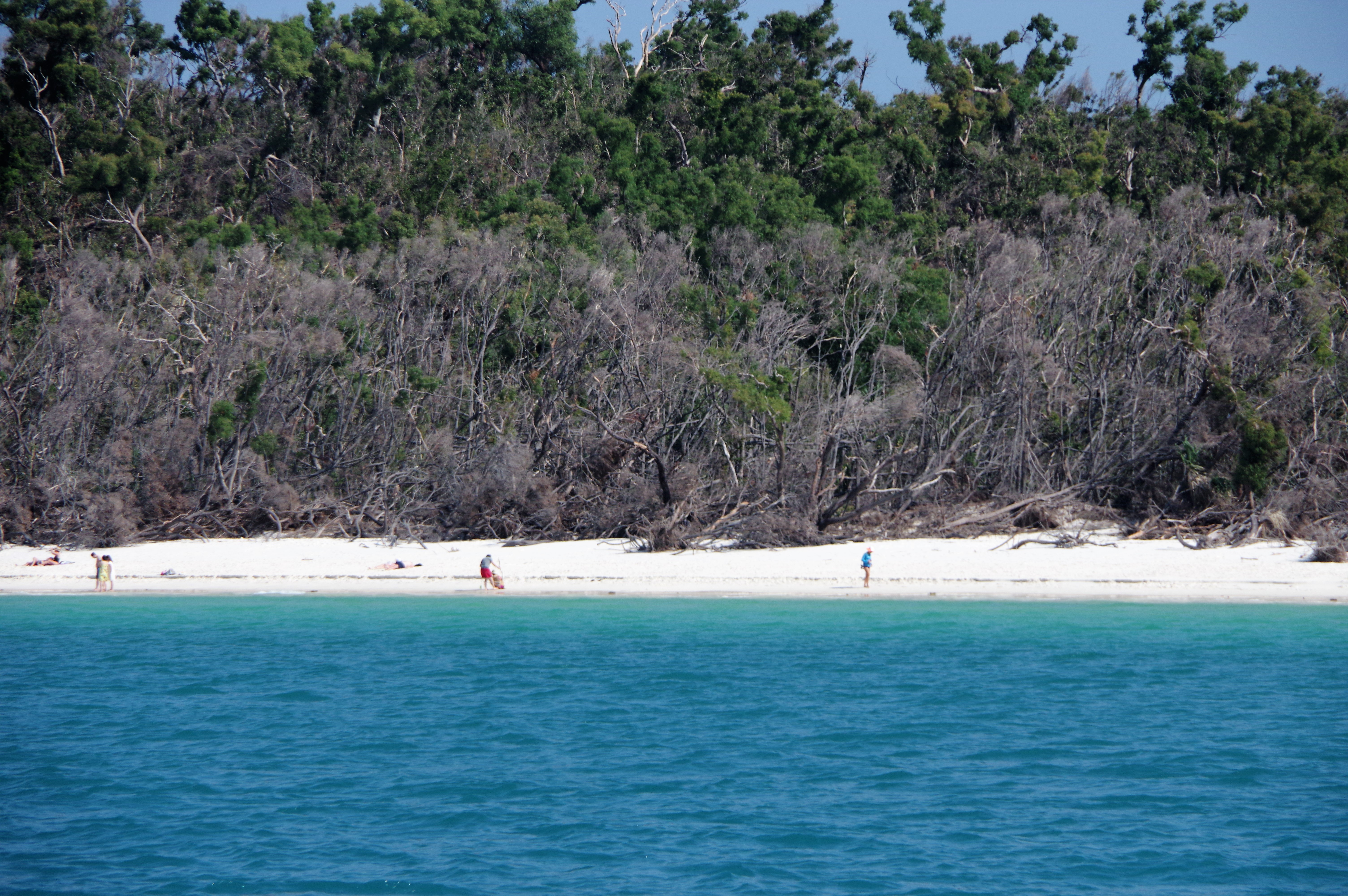
Next morning, we were off early.  We anchored off Hill Inlet and went in for a delightful swim in the crystal-clear shallows of the Inlet.  Our swimming requirements satisfied, Graeme, David and Jamie went back to the boat and proceeded to move it to the southern end of Whitehaven, while Al and I walked the length of the beach.  The sand is still that squeaking white silica, and the water the graduating shades of pale aqua through to cerulean, but the grey shambles of torn and twisted trees on the shoreline is a constant reminder of the cyclone’s fury just months ago.

IMGP9162 (2)
Whitehaven – a lasting reminder of the cyclone’s fury.

Turtle Bay, Goldsmith Island and Mackay

We moved to Turtle Bay for the night, watching the charter boats flock in behind us, many of them coming in at dusk and some anchoring uncomfortably close.  A snorkel the next morning showed that Turtle Bay had a similarly decimated coral reef to what we had seen previously in Luncheon and Butterfly.

We were enjoying mild winds from the northeast, but with strong southerly winds forecast for a couple of days’ time, Graeme came up with a cunning plan.  With David and Al on board, we would make use of the nor’easters and make our way to Mackay.  From there, we would grab a hire car from the marina and drive them back to Airlie.

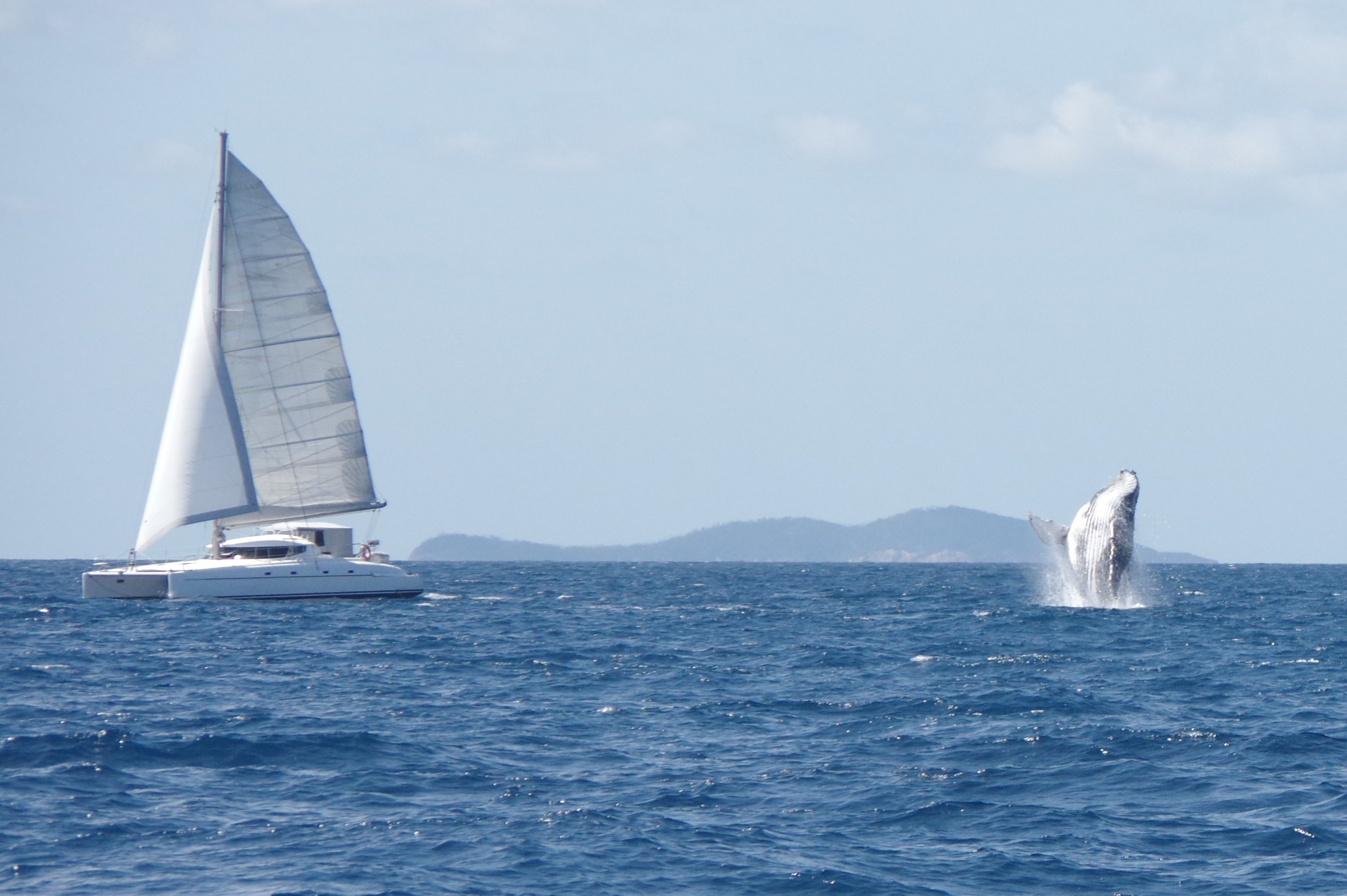
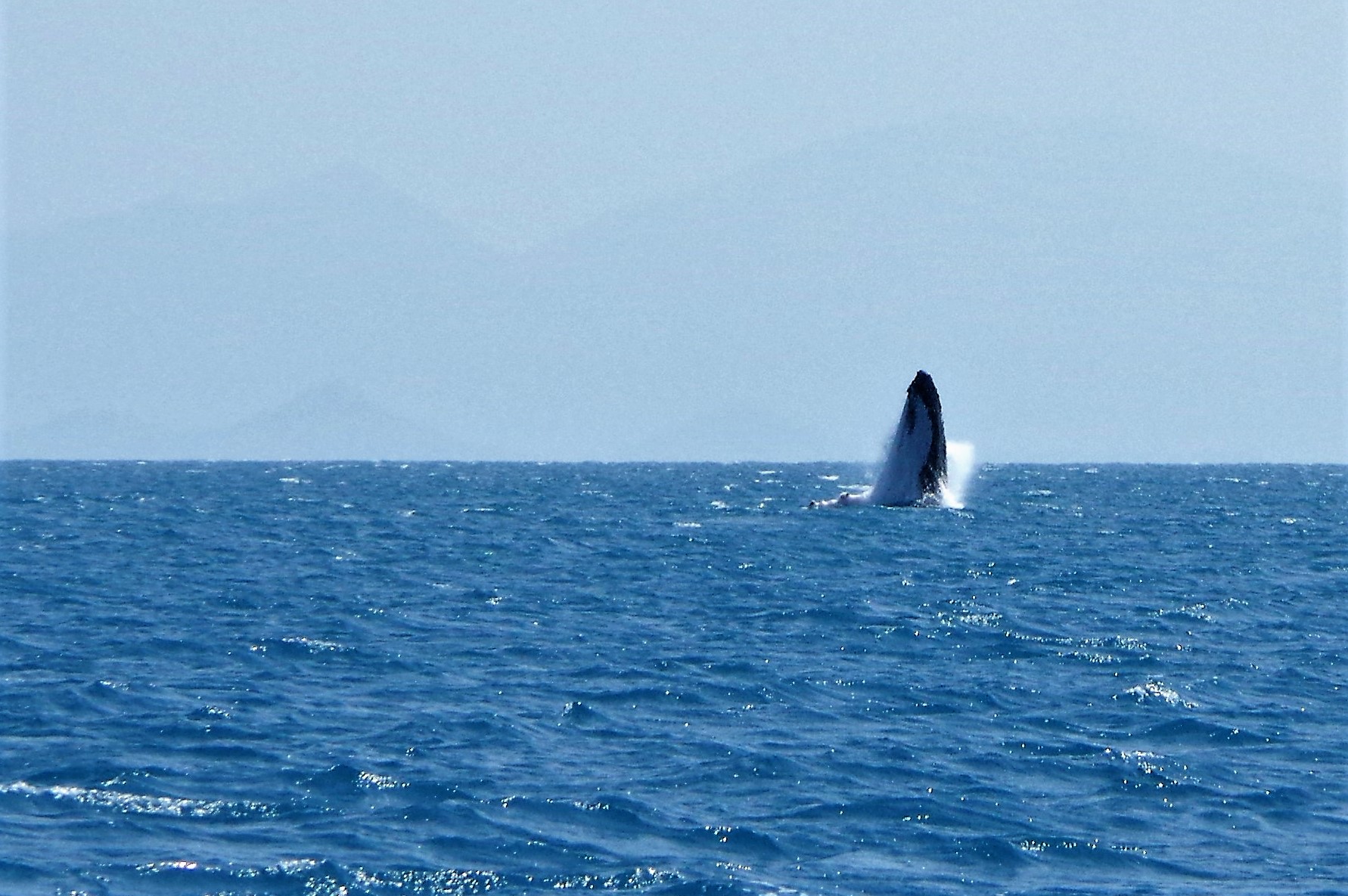
From Turtle Bay, we had a pleasant sail to Stingray Bay on the southern side of Goldsmith Island.  It was great to be out of the charter boat grounds and into an area less frequented.  We enjoyed swimming off the beach the next morning and then a hooting sail down to Mackay.  We were even able to provide an experience we didn’t think we’d get to share with David and Al – a whale and her calf practising their breaching skills!

IMGP9224 (3)
Is this the last whale heading south?

Must have been the last whale to head south.  We reached Mackay in the mid-afternoon and had twenty knot winds against us getting into the marina pen.  Nothing like a challenge!

The last time we were headed back to Mackay, it was with the knowledge that we intended to return to the Whitsunday’s.  Now we were turning our backs on the Whitsunday’s and beyond for the last time.  Any place, any anchorage, cove, bay or reef would now have to wait until another journey north.  We were at that turning point: officially on our way home.  I don’t think it was much in our minds at the time; the idea that we were now heading south.

Whilst showing Al around the marina we discovered, much to Jamie’s horror, that someone had tried to burn down the laundromat (gas dryers).  Suffering considerable damage, it was ‘closed until further notice’.  Returning to the boat, we ran into Helen from John Barleycorn.  Their boat was on the hardstand nearby, awaiting a part to be shipped up to make some repairs.  Their rudder, prop and cutlass bearing was out, and as to what was wrong, let me just summarise by saying ‘there was a dry joint in the propeller line time base’, or something to that effect.  They’ll be back in the water soon, and heading south. We were thrilled they joined us all for a delicious dinner at George’s Thai.  (Have to recommend the Penang Duck!)  It was David and Al’s last night on board, after a great week.  We were sad to say goodbye the next day.

Seemed like everyone was heading south.  David and Al would be heading south, the whales were heading south, John Barleycorn would soon be heading south.

And as soon as we got suitable weather, we’d be heading south too.

The Whitsunday Islands – Take 1

I apologise for taking so long to provide another instalment of Symphony’s travels.  We’ve been busy having too much fun and not enough time to just sit and write.  Or maybe I’ve just been slack.  You decide.
So, to reward your patience, I’m going to publish not one but TWO blogs.  

Keswick and St Bees

From Mackay, it’s just a hop and a skip, and you’re in the Whitsunday Islands wonderland.  We left Mackay on 6 September and headed to an island pair which seem to be called collectively ‘Keswick and St Bees’.  It was a lovely sail with less than twenty miles to cover, so we took our time, enjoying the scenery and the whale encounters.

IMGP8867
Graeme working hard, as usual.  (Beanbag is great – can be used anywhere!)

With gentle southerly winds, we anchored in north facing Connie Bay on Keswick, pleased to find we had the place to ourselves.  That’s a rare thing up here.  Once anchored at a safe distance from the coral reef, we dinghied over to the beach and went for a wander.

IMGP8888
Symphony from Connie Bay

IMGP8884

We thought we could climb quite easily to the lookout on the western side of the bay; surely there was a track from the beach straight up to the lookout?   We discovered after some searching that we had to walk to the eastern end of the beach, through bush land, up a steep hill and along a ridge to the west to reach the lookout.  What might have been a fifteen-minute direct walk turned into a meandering 7 km round trip.  And we didn’t take much water with us.  And it was hot.  But the view was worth it.

IMGP8903
Along the track from Connie Bay to the lookout.

IMGP8905
You can kind of make out how far the reef comes out – restricting anchoring in the bay.

IMGP8908

When we arrived back at the beach, there was good news and bad: Blackwattle had joined us, which was the good news.  Bad news was, the tide had gone out, leaving the dinghy high and dry with many rocks between us and open water.  We hadn’t expected to be away so long.  You get some pretty impressive tides up in these parts!  It took quite some effort to get the dinghy back to deep water, which included taking the outboard off and lugging it to the water’s edge first. There might have been some cursing and slightly heated exchanges while this all took place.

It was nice to be reunited with Christian.  Graeme helped Christian feed a cable through his mast – for better radio comms.

IMGP8920
Blackwattle with Christian at the top of the mast.

We enjoyed a lovely sunset and caught up with news.  Later that evening the whale song started up, filling our boat with the otherworldly moans, whistles, clicks and hoots for the best part of an hour, and it was the loudest we’ve heard it.  Jamie was a little freaked out by the whole thing, and thought the whales were crying.

Brampton,  Lindeman and Shaw Islands

From Keswick we travelled in company with Blackwattle to Brampton Island.  It was once quite the destination (who hasn’t heard of Brampton?), but the resort has been closed for years.  It seems that everything was just left behind – the furniture, artworks, a cluster of jet skis, vehicles… Sand has claimed some of the beach-front cottages, sifting in under the doors and spreading.

From Brampton, we hot-tailed it Lindeman Island (another – extensive – closed resort).  Our friends from Bush Spirit had lost an anchor a couple of days earlier at (Pain-in-the) Neck Bay, Shaw Island.  Fortunately, they had another one as a spare. But they’d lost a Rocna, and were very keen to retrieve it.  They did some soundings and spent a lot of time with the Go-Pro, scanning the sea bed where they thought the anchor was.  They managed to pinpoint the anchor to within a few metres.  They’d already had a diver attempt to find the anchor, an unsuccessful and costly exercise, so were almost ready to give up and relieved we had turned up to help them with our dive set-up.  Graeme went over with them at low tide, and within sixty-seconds of him descending, he had located the anchor and was ready to begin the retrieval process.  We had a long celebratory happy hour that evening, with Hilary and Allan chuffed at the day’s results.  We passed them the next day as they were switching their spare anchor from one bow roller to the other, and reattaching their newly retrieved anchor (not as easy or simple as it sounds).

IMGP8967

Cid Harbour, Butterfly Bay, Maureen’s Cove, Whitehaven

From Lindeman Island, we started doing some pottering around different anchorages.  First it was off to Burning Point – a lovely north-facing anchorage at the southern end of Shaw Island.  Then Cid Harbour with a million other boats and some rain.  The weather quickly fined up and we were off to Butterfly Bay at the northern end of Hook Island for some (average) snorkelling, followed by Maureen’s Cove where we used the Power Dive from the dinghy for some excellent diving.

We moved from Maureen’s Cove eastward past the Pinnacles and an unusual rock formation known as the Woodpile, and down towards White Haven.  White Haven, that long stretch of pure white sand, is ‘Tourist Central’ and always packed with big tourist boats and charter boats, so we gave it a drive-by, shocked at the carnage wrought by Cyclone Debbie earlier in the year.  The once-lush coastline is a tangle of sticks, and the hill, in places, looks stripped back to its bones.  After the cyclone, a lot of people got together and tried to ‘fix up’ the beach.  They’ve managed to make the southern end (where the tourists go) look half decent, but it’s a long beach and there’s an awful lot of destruction.

IMGP9162 (2)
Whitehaven. Still white, but not so much a haven…

Pretty sad to see this once pristine beach has taken such a beating.  We picked up a mooring at Chalkie’s Beach (roughly opposite White Haven), where we spent a rather sleepless night listening to the mooring buoy clanging against our hull with a contrary tide/current thing going on.

The weather forecast for the following night had us scratching our heads a bit.  There was meant to be four days straight of 25-30 knot winds.  With northerly winds forecast, ahead of the southerly change due about midnight, we thought we’d spend the day in Turtle Bay on the southern side of Whitsunday Island before heading to the protected anchorages of Cid Harbour or perhaps Airlie Beach (Muddy Bay) to sit out the nasty stuff.  But then we thought of being stuck in either place with not much to do, and all the charter boats potentially dragging their anchors…  Mackay suddenly started to look very appealing.  With the boat safely in a marina berth, we could hire a car and go exploring, go out for dinner, go shopping, potentially fix the water pump (which was supposed to be getting delivered to Mackay), Jamie could get his laundry fix… So, the decision was made – not until after 10am, mind you!  We had an easy, quite fast sail on calm waters all the way back to Mackay, with whales keeping us company for some of the way, and we were safely back in the same marina berth by 1700 with plenty of daylight left.  Lizzie, one of the office ladies, sent her hubby along to help with our mooring lines, which made docking all that much more relaxed.

Mackay

If you haven’t brought a yacht into a marina berth before, it’s like trying to drive your stretch limo into a really tight car space, expensive cars on either side. Now, imagine the road is ice and you’re sliding all over it, and the wind keeps blowing you towards the other cars, so you’ve got to keep your speed up to counter-act the drift, and did I mention the owners of the nearby luxury cars are standing there watching you? And you’re steering the limo from a position pretty much in the boot.  And you don’t have any brakes.  Your passenger has one shot at lassoing a cleat or a post to control your forward progress so you don’t collide with the end of the parking space.  And the limo weighs 15 tonnes so you can’t just push it away from other cars with brute strength. That’s what it’s like getting a boat into a marina berth.  Pretty much all there is to it.  

As Graeme says, ‘What could possible go wrong?’

Ah, Mackay Marina.  How we love thee.   Once safely tucked into our berth, we enjoyed long showers and delicious Thai takeaway from George’s Thai on the marina.

IMGP9233.JPG

The wind came in that night not long after midnight, as predicted.  It blew around 25 knots all night, making Symphony shudder and vibrate against her mooring lines.  This vibration caused Jamie excessive anxiety and he stayed awake all night, stressing.  This meant we stayed awake all night too…  It was a long night.  It was pretty tough to get into motion the next morning, but we got the washing done and took Jamie to see the Emoji Movie.  Maybe we were tired, or maybe it was just meh. (You’ll appreciate that reference if you’ve seen the movie. If you haven’t seen it, don’t bother!)

Cane fields and Finch Hatton Gorge

The following day, we had a hire car and spent the day enjoying Mackay’s surrounds.  We took a big drive out through the cane fields, watching the cane trains in action.

Our destination was Finch Hatton Gorge in the mountains, a semi-rainforest area with pretty walks.  We walked to the Ring of Fire waterfall and Araluen Falls, about a 7km round trip and well worth it.  There was plenty of bird life and critters in the undergrowth.  Even way out here there were signs of the recent cyclone, with huge fallen trees in places.

All but one of the four forecast models turned out to be wrong about the wind strength.  We only had that one day of strong wind then it all settled down again.  So, the next day, once more stocked up and with clean washing, we headed north again.

Coming soon: Whitsunday’s – Take 2.

Sticky Places

When you’re cruising, some places can be ‘sticky’. You get attached to them for a whole bunch of different reasons. They might be marinas with all of life’s little luxuries just steps away, or they might be places that delight your soul or leave you awestruck with their beauty.
And you just don’t want to leave.

Middle Percy Island

Middle Percy, of the Percy Island group, has long been one of our favourite stopping over points.  We went there for the first time ten years ago and we were happy to see that on the surface nothing had changed much.  West Beach is a stunning white-sand beach fringed with coconut palms, backed with gently rising hills, thick with bush. In the early 1960s, one of the leaseholders (Andy Martin) built a basic two-storey A-frame hut on the palm-lined West Beach.

IMGP8757
Symphony with the A-frame in the distance.

IMGP8818
The famous A-frame hut.

IMGP8761
View from the beach. Such clear water.

IMGP8762
Looking south, towards Pine Islet where the lighthouse used to be.

It is a meeting place for cruisers, home of the Percy Island Yacht Club, and a sort of shrine of remembrance to past visitors.  Many cruisers leave behind a plaque, memento, message-in-a-bottle or some sort of calling card with their boat details and the year they visited.  There are items that date back sixty years.  There’s a prosthetic leg, shell mobiles, carvings, mooring buoys, fenders, flags, posters, clothing, bark paintings, professional laser-cut plaques and hand-drawn scraps, but nearly everyone leaves something.

IMGP8812.JPG
Looking down one half of the A-frame. Jamie’s found something of interest.

Ten years ago, we left behind a small painting we did of our boat, Echo II.  We tacked it to an upright at the top of the ladder. We knew exactly where we had put it, but it wasn’t there.  Cyclones have done their damage over the years.  One even took the roof off some years back and a lot of stuff disappeared, or was recovered and placed somewhere else.

We were anchored in amongst twelve other boats by 1530, and were soon visited by our new friends from Bush Spirit.  They invited us to Happy Hour at the A-frame at sundown.  Half a beer later we had an unexpected boarder – a slightly familiar-looking character called Don with long white hair, a long yellowing beard, battered straw hat shading clear blue eyes, and calloused bare feet.  A self-proclaimed hippy from way back.  He is a current semi-permanent resident of the island, and wanted to welcome us.

Over on the shore, we met a bunch of people, including Cate (one of the leaseholders), and a lovely couple from cruising yacht, Ruff n Tumble.  They also are cruising north so we hope to see more of them along the way.  We soon made the discovery that our new hippy mate was none other than Don from the trimaran Silvergull – one of the boats who had joined us on the rally to the Louisiades four years ago. I thought he’d looked familiar…

Middle Percy is another ‘sticky’ place, and, with a burning sunset, a beautiful fire sending orange sparks into the starry sky, and lots of friendly banter, it was hard to tear ourselves away.

IMG_1528

Early the next morning, Graeme enjoyed watching a pod of whales cruise amongst the anchored boats.  One young fellow was fortunate enough to have time to throw on his snorkelling gear and jump in the water with his Go-Pro.  A whale swam right under him. I slept through the whole thing 😦

Bush Spirit and Ruff n Tumble departed.  We returned to shore and climbed the (roughly) 4km sandy track up to the Homestead.  It’s a bit of a slog through soft sand much of the way, (and it was hot) but it has its rewards.

IMGP8770

Not far up the track you can take a detour to reach a rock platform with spectacular views and phone reception.

IMG_1525
Panorama taken on Graeme’s iPhone.

Graeme managed to get a call through to his big brother.  Further on, there’s Andy’s Lookout, named for the longest serving leaseholder, Andy Martin.  The track is interspersed with bric-a-brac hanging from branches, and poems, urging you to slow down and enjoy the journey.

IMGP8788.JPG

The walk was made prettier with the presence of hundreds of butterflies, some that even posed for photos.

IMGP8784
Blue Tiger Butterfly, Middle Percy

IMGP8787
A bit tattered, but still beautiful.

We eventually reached the Homestead.  John, the leaseholder, welcomed us with the offer of tea and a pot already set to boil on the stove.  The Homestead (1887) has a deep covered veranda shaded by ancient mango trees, with soothing views across the trees to the distant sea and the islet where the lighthouse once stood.

John gave us a little of the history of the place over a cup of tea sweetened with Percy Island honey, and talked about the battle with sections of the government, who would like to see the island come fully under National Parks and be returned to nature, including razing the A-frame hut.  The leaseholders and other residents won a legal battle about seven years ago to remain occupiers of the land, but John thinks the war isn’t over. After our cup of tea, we took the short track back to the beach, which turned out to be not that much shorter owing to its rocky steepness, which meant Jamie needed assistance at times and we all had to be careful of our footing.

Back aboard the dinghy, we discovered John Barleycorn had anchored in the bay.  It was great to see them again, and we were thrilled when they gave us a couple of litres of UHT milk to see us through the next few days.  It was the only essential thing we were getting really low on, and they had spare.  This meant we didn’t have to rush to Mackay to restock.

We enjoyed a swim on our return to the boat.  Discovered the loaf of bread we’d left to rise had fortunately not consumed the whole boat (I had imagined it oozing out the hatches) even though it had been left to rise for way too long.  Lots of boats had left that morning, and there didn’t seem to be many new ones replacing them.  We met up with the guys from John Barleycorn on the beach for sundowners, and installed a new Symphony plaque with sturdy cable ties.  For the second night in a row, Jamie loved (endlessly) ringing the various ships’ bells.

IMGP8763
Quasimodo!

We were awoken gently in the early hours of 1 September by whale song coming through the hull of the boat.  We lay awake for about an hour, and listened to the eerie, beautiful sounds of whales singing.  How do I describe something so otherworldly, so moving and awe-inspiring?  It was a most unusual and magical start to my birthday. Unforgettable.

Another perfect day dawned.  We left Middle Percy after a leisurely breakfast, heading for a little-known island called Digby, in the Northumberland Group, only 22 nautical miles away.  We’d been to Digby before, and recorded an extremely detailed entry in our Curtis Coast book:

Good.

With such a great recommendation from ourselves, how could we resist?  (We couldn’t really recall the spot but it is a good mid-way point between the Percy’s and Mackay.)

Along the way, we saw a whale teaching its calf how to fin-slap, and watched a family of five turtles (some tiny) paddle by.

Digby Island

Digby had a surprise in store for us – a newly wrecked boat on the low tide point of the rocky beach.

IMGP8834.JPGWe went for a walk to wonder over the wreck and look over the remnants of someone’s life aboard.  We assumed it had washed up there after the recent cyclone.  The wreckage was strewn from one end of the beach to the other.
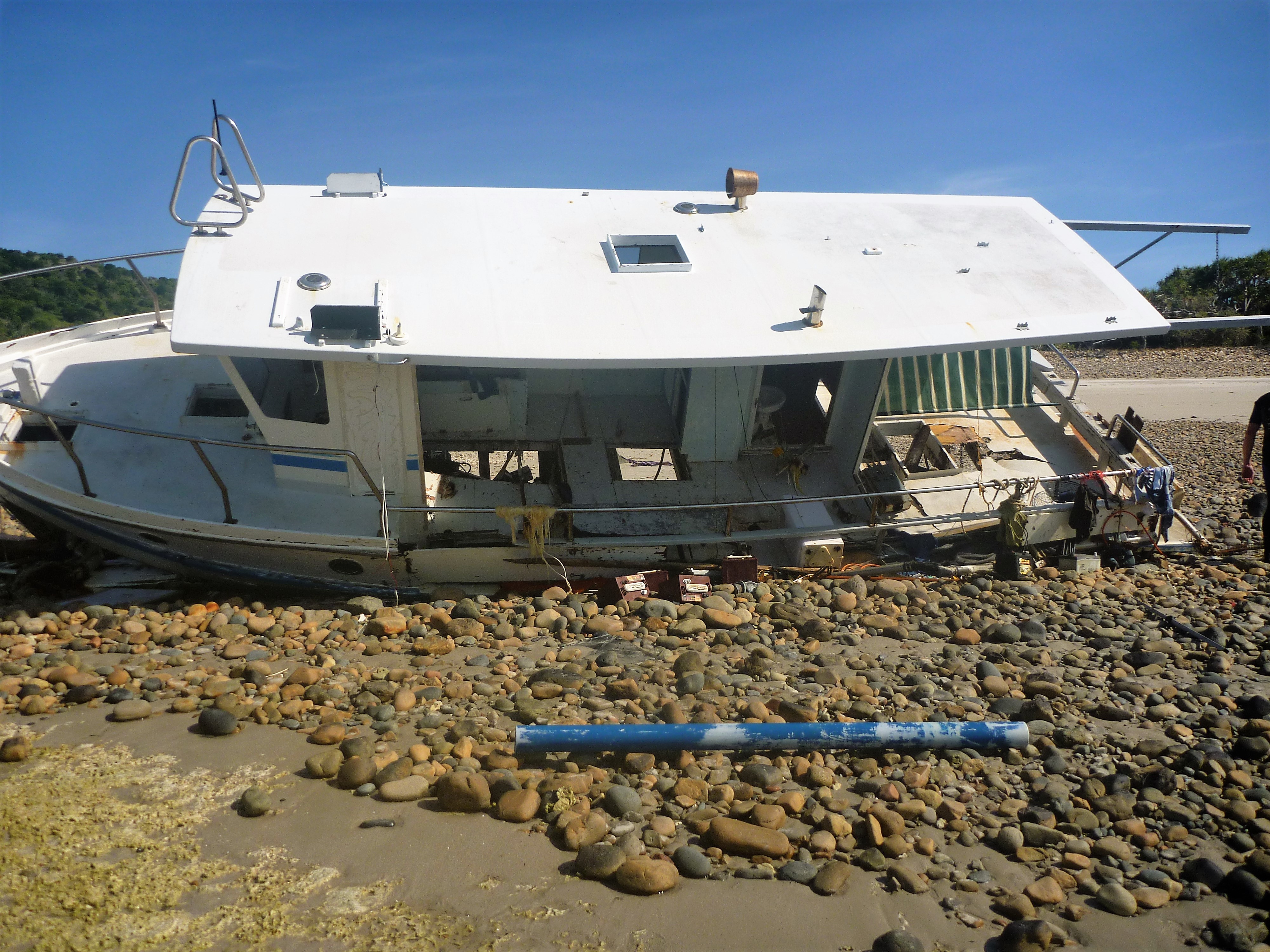
P1070167 (2).JPGMany items from the boat had been dumped by someone in piles beyond the high tide line, but much remained around the boat and amongst the rocks, or just buried in the sand; a laptop with its keyboard caked in wet sand, CDs stripped clear, a rusting potato peeler caught between two rocks, broken crockery, dentures still in their plastic box, spectacle frames half buried in the sand, books – flayed open and yellow, all manner of tools and parts succumbing to the twice daily immersion, clothing being slowly swallowed by the sand…  There was something terribly sad about seeing someone’s life scattered so arbitrarily, and we couldn’t help but wonder what had become of the owner.

Graeme went spearfishing and caught a beautiful coral trout for dinner – our first ever coral trout.

We made birthday cake and I managed to scrounge enough ingredients to make Jamie a pizza.  Whales visited the anchorage.  We baked the fish in foil.  We ate yummy cake.  We watched the sun set and turn the water gold.  We settled back and watched the movie, La La Land.  I could not be more grateful to my boys for such an interesting and unforgettable day.

2nd September – Happy 50th Wedding Anniversary to Mum and Dad.  By the time they read this, they will probably be back from their cruise to PNG.

Unable to unstick ourselves from Digby, we enjoyed a great day whale watching and snorkelling.  There are good patches of coral to the east (towards Keelan Island) and west (at the rocky outcrops) of the anchorage.  We saw hard and soft corals, a huge stingray hiding in the sand with just his eyes and the tip of his tail showing, three different kinds of anemone fish, including the tiniest cutest little clown fish.  There were colourful Christmas tree worms too.  Graeme speared another two coral trout (he’s getting good at this!), so we made a big korma curry with coconut rice.  So, so good.

IMGP8851

IMGP8854

Mackay

After a couple of days at the wonderful (very sticky!) Mackay Marina, doing all the things you do, as well as celebrating recent birthdays and Fathers’ Day, we were ready to head further north.

IMG_1540
Dinner cooked by someone else – priceless.

The Whitsunday’s were so close now, and they were calling…

Back to Paradise

Well, you’ve probably guessed by now we survived our Lady Musgrave to Bundaberg ordeal. If someone had said to me, ‘You’re going to have weeks and weeks in paradise and just one crappy day,’ I’d take it.  If doing this wasn’t a challenge at times, would it be worth doing? Would it be worth reading about? 

Bundaberg

The morning after we anchored in the Burnett River, we tootled into Bundaberg Port Marina.  There were strong winds forecast (the main reason we’d come back from Musgrave) so we were most pleased to be somewhere tied up and secure, with access to most of life’s little luxuries.

We spent three nights in Bundaberg, doing the washing, reprovisioning, and recharging.  In the early hours of Sunday, a cool change came through and, to our disgust, the temperature plummeted to about 12 degrees.  We caught the marina’s courtesy bus into town to the markets to kill a bit of time, waiting for a suitable weather window, and wishing we’d worn warmer clothes!  On the way, we met a couple who’d spent seven years building their beautiful catamaran, Bush Spirit.  They invited us to come and see their labour of love and we had an enjoyable time looking over their boat and getting to know them.

The Curse of Pancake Creek

We departed Port Bundy Marina at dawn on Monday morning headed for Pancake Creek.  This is one place you only ever enter in the daytime.  They don’t even bother lighting the channel markers.  Some people we know think the place is cursed, and for good reason.  Some friends in our club came in at night a number of years back (storm conditions, from memory).  They hit a reef and sunk their boat.

Last year, our friends on Mischief were in the process of re-anchoring.  Andrew put the boat into forward gear and … nothing happened.  They’d lost all propulsion.  They had somehow sheared the splines off the input drive on their V-drive.  They requested a tow out to the heads of the creek (Marine Rescue Gladstone) but ended up having to be towed all the way to Gladstone as there was not enough wind to sail.  They were then stuck in Gladstone for weeks and weeks, awaiting repairs.  On their return trip south, they ventured in once again.  Their plotter system mysteriously reset to factory settings, and they lost all way-points and routes.

Blackwattle, in Pancake Creek before us, had a bump in the night (0330) as another boat dragged onto them during strong winds.  During re-anchoring procedures, the other boat pulled up Blackwattle’s anchor as well as their own and they were both drifting towards disaster.  Christian managed to get things under control and it all ended well, although he didn’t get a scrap of sleep the rest of the night.

So, there we were, heading for the dreaded Pancake Creek.  However, the Creek has always been good to us, so we don’t put much chop in the Curse of Pancake Creek.  After a pleasant day of sailing, we had no problem getting into the creek – which involves playing the tide and doing a little crab-walking through the current to stay in the channel.  It was busy in the main anchorage, with not much space for anchoring.  Our old chart plotter showed we were anchored on a sandbank that dries at low water.  We didn’t have much depth and would have been in trouble if the wind had been stronger than the current and caused us to blow onto the sandbank.  Mysteriously, the water pump on our engine started leaking…  Nothing a few hundred dollars can’t fix.

IMGP8623.JPG
Looking back through the anchorage at Pancake Creek.

IMGP8622.JPG
Sunset in Pancake Creek.

After reuniting with Christian, we decided the following day was optimal for getting up to Great Keppel Island.  If we were travelling on our own we might have stayed a couple of days in Pancake Creek.  It is a lovely unspoilt sheltered creek with pretty beaches and wooded hills on either side, and a reportedly beautiful walk up to the lighthouse on Bustard Head.  But conditions were closing in, meaning we could get stuck for a few days.  And no one wants to tempt fate!  Oh. We had pancakes for dinner. Of course.


Great Keppel Island

Another very early morning, with enough of Dawn’s rosy glow to light the way for Blackwattle and Symphony to head out of Pancake Creek.  We had 66 nautical miles to cover, and figured we were going to arrive way after dark, so we travelled for the first half of the day at a leisurely pace.  With a good wind of 20 knots throughout the afternoon, we started hooting along.

20170822_164035
Sitting around 8 knots was pretty sweet.

We were hard on the wind and leaning at 30 degrees for quite a bit of that, but we now realised if we could keep this up, we’d arrive at Great Keppel before dark, and anchoring is always an order of magnitude easier with daylight.  It was a pretty wet ride, with spray shooting over the boat and water sluicing down the side decks, but we were averaging over 8 knots!  With the wind strengthening, (and some of the crew getting a bit over leaning at 30 degrees) we decided to put a reef in the main, then later, a second reef.  Even with two reefs in the main we continued cracking along, reaching the anchorage off Long Beach with the last of the daylight bleeding from the sky.

We spent four wonderful days at Great Keppel Island.

20170823_133637
Stunning Main Beach (also called Resort Beach) south end.

20170823_133648
Great Keppel, Main Beach, looking north.

20170823_133742
Jamie having fun on the beach.

It is a beautiful tropical paradise with a contentious history, both distant and recent.  The main resort has languished, fenced off, stripped out and empty, since 2008.  Remember the old ads? – ‘Get Wrecked at Great Keppel’? It’s pretty sad.  Fifty million dollars spent on proposals later (allegedly), and the developer has not yet been able to get approval for his grandiose plans, which include a casino, golf course, marina, shopping precinct, hotel, villas and hundreds of residential dwellings. The place could well do with some kind of resort, but the general consensus is that the developer is simply reaching too high, and his plans don’t take into account the traditional caretakers of the land or the current residences’ wishes.  Anyway, the Rainbow Hut and the pizza restaurant are still open for business, as well as a few delightful back-packer-style accommodation possibilities.  The big shark is still there, although it could do with a coat of paint.  As could the Rainbow Hut.


20170823_134731
Main Beach at Great Keppel. The Rainbow Hut is behind. 

Up the northern end of Main Beach is a slightly more up-market resort with a bar area that extends right out to the edge of the sand dunes.  The cyclone last year caused significant damage and erosion to the foundations of several buildings including the bar.  They’ve shored up the beach with a whole pod of whale-sized sand bags in the hope the whole thing doesn’t fall down the hill.


The whole place has a very laid-back feel.  You can walk into the bar with bare feet and sand between your toes.  There is quite a lot to do around Great Keppel.  It’s a ‘sticky’ sort of place; so lovely you get stuck there longer than you had planned.  We snorkelled, swam, paddled, walked, went on dinghy safaris to nearby islands and up into the lagoon at Leekes Beach, all the way up through mangroves in clear water to the old cattleyards.

IMGP8648

IMGP8652


20170826_114913
Dinghy safari up the lagoon at Leekes Beach.

20170826_115002
Any crocs?

20170826_120321
The cattle yards from bygone days.

We enjoyed coffee and sundowners with old and new friends, watched whales, and Graeme finally had a chance to try out the spear gun I got him for his birthday.  I wasn’t expecting him to have any success first time around, but he came back with a nice brown-spotted reef fish (yet to be identified but oh so yummy!) and a parrotfish (which was released).


IMGP8654.JPG
Graeme (with Christian looking on) with the parrotfish he released. 

We attempted to leave on 27 August at first light, after a rainy night.  We rocked and roll our way to North Keppel, but the rain, fog, unpleasant seas and lack of wind sent us back to our anchorage.  The sun soon came out and we had another gorgeous day at GKI.  Told you it was sticky!

Great Keppel to Island Head Creek

We tried again the next day, and found the conditions much more to our liking.  We spent the day having a lovely sail in calm seas, although we left Christian in Blackwattle behind, awaiting the arrival of some people he befriended in Bundaberg.  I’m sure we’ll meet up with him again soon.

IMGP8661.JPG
Light winds meant it was time to try our motley spinnaker.

We arrived at our planned destination, Island Head Creek, as the afternoon sun painted the surrounding cliffs a warm golden colour.  And once anchored, we had plenty of time to watch the sunset.

IMGP8712.JPG
Watching the sun….

IMGP8725.JPG
…sink slowly…

We spent the following day at Island Head Creek, known for its impressive backdrop of rugged mountains.  This is another unspoilt place, part of the Shoal Bay Armed Forces training grounds.  It is often closed to the public and was recently used for the Talisman Sabre exercises. Looking up at those sparsely wooded, boulder tumbled hills and windswept peaks, I can understand the appeal of the place for training soldiers.

IMGP8733.JPG
Rugged hills overlook Island Head Creek

IMGP8734.JPG

We went on a dinghy safari, trolling fish and looking for crocs.  We caught not a single fish, sighted not a single croc, but the turtles were out in force.  I don’t think we’ve ever seen so many turtles, and the water was so clear you could see them scooting away with their powerful flippers.  (Took the wrong camera so the pics aren’t good enough to show, I’m afraid.)  We also saw a large dugong.  Jamie identified it as a ‘white whale’, so that might provide some clue of how big it was.

By 0620 the next morning, we had weighed anchor and were underway again, with our destination this time Middle Percy Island.  The seas were a little messy just outside the creek, but improved as the day went on.  We witnessed an impressive whale display on the way.  A mother was teaching her dolphin-sized newborn calf how to breach (well, we assume).  The little one would do a bit of a dolphin flip, then the mother would launch her bulk from the water and land with a ka-boom of white foam.  That’s how it’s done, sweetie.

I’ll leave you with the pics and a promise to do another instalment very soon.

IMGP8743
That’s mumma.  Compare her size to the passing catamaran.

IMGP8744
That’s a zoom in on the little one having a go too.


Find me a Neuralyser!

(or Musgrave to Bundaberg)

Thursday 17 August is a day we’d like to wipe from memory.  The Men in Black had it right with their little memory wiper doo-dad, the ‘Neuralyser’.  Get me one of those and instead implant a memory about how lovely it was. 

Remember my dramatised version of our Wide Bay Bar crossing?

Getting out of Lady Musgrave was worse than that.

Let’s just rewind for a moment and set the scene.  By 0930 we were underway, carefully picking our way through the bommies in the lagoon.  We had listened to another boat about an hour earlier report that the conditions outside were acceptable, with a bit of ‘overfall’ at the exit of the lagoon.  In our opinion, they’d left too early.  Even for us, the sun could have been higher.  The water still had a silvery sheen, making it virtually impossible to see the bommies until you were almost upon them.  We entered the pass and were navigating our way through, committed to leave.  There is considerable outwards current and NO ROOM to do a U-turn in the passage.  If you attempted to turn around and go back in, you would more than likely end up getting swept onto the reef.  Not only that, we had Blackwattle following pretty close behind.  So, changing our minds was not an option.  As we reached the final approach, Graeme called out that I might want to return to the cockpit.  I was looking to port and starboard, making sure we were staying in the middle of the channel, so he’d seen it before me.

Huge overfalls (waves) breaking just outside the exit.  I feel ill just writing about it, all these days later.  I returned to the cockpit, and sheltered behind the dodger, my attention pulled to the roar of the curling breakers ahead of us.  I didn’t want to look at Graeme.  The blood had most likely drained from his face, but I didn’t want to see fear.  If he was afraid, I would be too.  Symphony and the first wave came together like two heavyweight fighters in a ring.

Top-10-Rocky-Movie-Fight-Scenes-Kung-Fu-Kingdom-770x472
I did not take this photo.

There was an almighty slap as our bow hit the wave, then she rose up, and up, reached the peak and fell back down with a ka-boom.  Now our stern was in the air. Water that was scooped in onto our transom on our upward rise now rushed in through the cockpit almost to the companionway.

And then we did that a few more times. And a few more.

17222
The waves were THIS BIG.  I think…

We still love Lady Musgrave, but we we’ve learnt that conditions inside the lagoon can vary wildly with those outside, changing dramatically even in the space of an hour (with the falling tide, in our case).  She’s beautiful but she’s deceptive.  We’ve gained a whole new level of respect.

IMGP8596
The Lady on a good day. Photo taken the day before.

At some point, Jamie appeared in the companionway to enquire why the boat was crashing.  Poor kid.  We’d been so caught up in the unexpected turn of events that we’d had no time to warn him about the conditions we were about to encounter.  We directed him to stay below and hang on.

Yep, it was hideous.  Even when we were out of the overfalls things didn’t improve much.  We had hoped to be able to head high enough to set course for Pancake Creek, but the ride was terribly uncomfortable.  We were hard on the wind sailing, and there were swell trains of about two metres high (which then add and subtract from each other, creating bigger peaks and troughs) coming from two different directions.

Unfortunately, the waves at the lagoon exit had dislodged quite a few things downstairs.  Cupboards that stay closed in most conditions slid open and spilled their contents.  Things that never move launched themselves off shelves and flew through the air. Five Corelle bread and butter plates kamikaze’d out of a cupboard and only two survived.  So now we had shards of glass everywhere.  A hard knot in my belly had turned to nausea; I was sick – only my fourth time seasick in almost 10,000 offshore miles, and I think it was mostly anxiety, but I became useless for quite a while, I admit.  Jamie was confined to his cabin, much to his disgust, to avoid walking on broken glass, and it was up to Graeme to sail the boat AND clean up the glass.  It was decided to change course to get into a more comfortable motion which meant we were heading for Bundaberg.

Christian, his much heavier cruising boat coping with conditions better than us, had everything under control and was determined to maintain course for Pancake Creek.  He’d already spent more than enough time in Bundaberg.  (We later found out he a very uncomfortable day, culminating in had a hair-raising ride into Pancake Creek, and entering through the leads with breaking water all around had been terrifying.  He was extremely relieved to get his anchor down.)  Cruising is fun!

So, we maintained course to Bundaberg.  The conditions, which had improved slightly with the course adjustment, gradually deteriorated, with swells increasing until the horizon disappeared.  For those unfamiliar with boating, losing sight of the horizon means you’re in some pretty big seas.

And it continued like that, with the boat rolling wildly from gunwale to gunwale, through the afternoon and into dusk.  Things didn’t improve until we got behind the low breakwater at the entrance to the Burnett River, although we did average 8 knots (and more than 10 surfing down waves).

It wasn’t over.  Burnett River has limited anchorage areas, in shallow water.  We arrived after dark to discover numerous boats already anchored, some of them without any lights at all!  We had to try to find a suitable spot to anchor, in the dark, amongst lit and unlit boats, outside the shipping channel, with a current, and shallow spots everywhere.  We finally dropped the anchor, decided low tide would almost put us on the mud, so re-anchored to discover we’d only gained about 200mm of water.  I think we said something like, ‘Stuff it.  This’ll do!’

Exhausted and greatly relieved to be in flat water, we spent the next hour cleaning up the remaining glass, washing the cockpit down with fresh water, and putting everything to rights.  We had a light dinner of pancakes then fell into bed.

pancakes

So, sometimes being at work or doing a really unpleasant chore like changing the kitty litter is better than cruising.

Who’d of thunk?